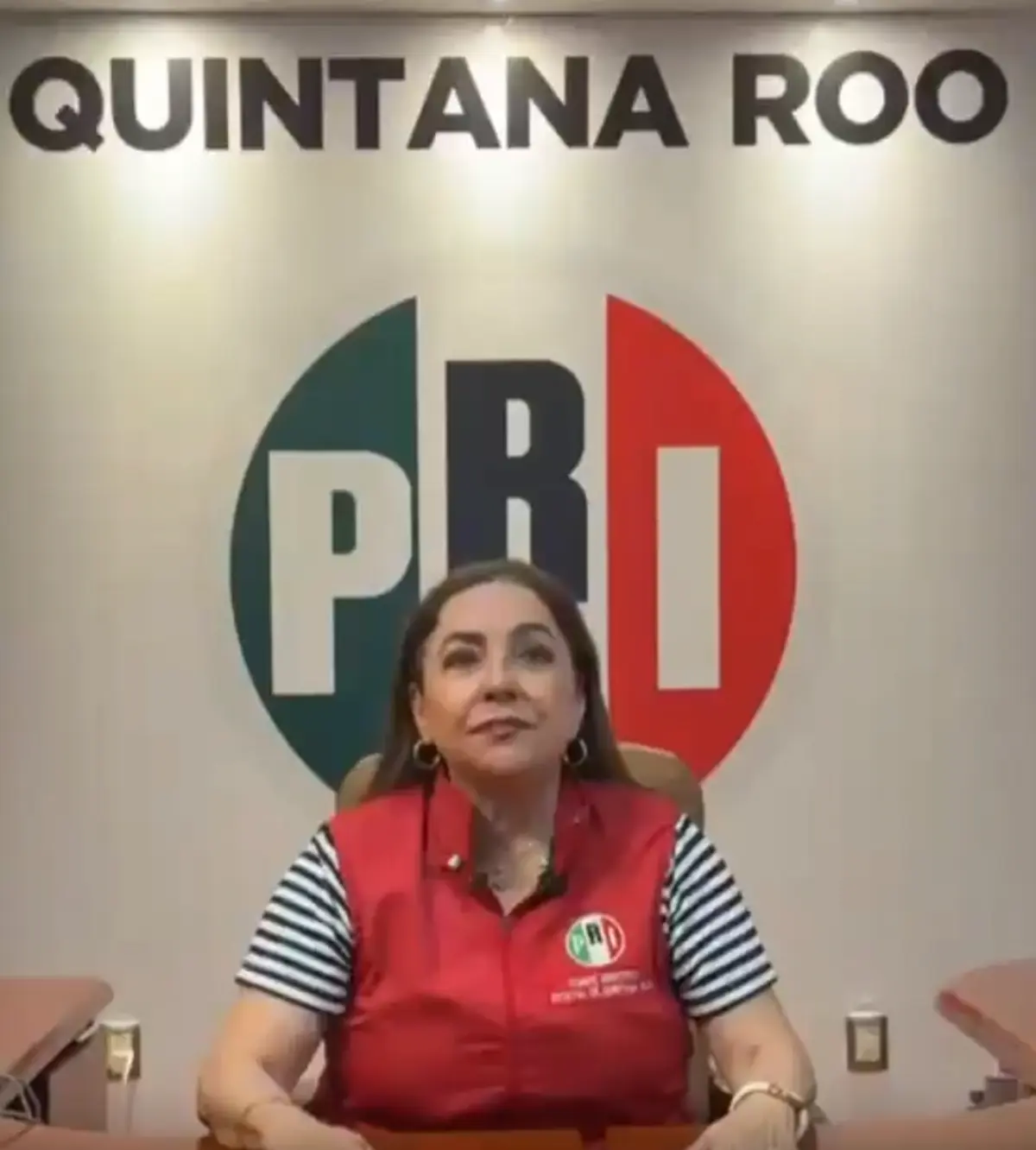
Chetumal, Quintana Roo — The leader of the Institutional Revolutionary Party (PRI) in Quintana Roo accused defenders of National Electoral Institute (INE) chair Guadalupe Taddei of building a “smoke screen” to deflect attention from press reports about Taddei’s political ties to Morena and her alleged networks of influence inside electoral institutions.
Cora Amalia Castilla Madrid, who heads the PRI’s state steering committee, questioned why, instead of offering clear explanations about the facts reported in the media, the discussion has been shifted toward former INE presidents — accusations that, she said, must also be backed by evidence.
“It is unacceptable that, when the media have carefully documented situations that deserve to be investigated, the response is to try to change the center of the discussion,” she said. “Now it seems that what matters is not clarifying the questions about Guadalupe Taddei, but building a smoke screen to involve former INE presidencies and prevent current responsibilities from being exposed.”
Castilla Madrid said the PRI believes Taddei’s political closeness to Morena cannot be downplayed, and that the circumstances of her appointment and the decisions taken during her tenure must face rigorous public scrutiny.
“We have said it clearly: Guadalupe Taddei arrived at the presidency of the INE in a political context favorable to Morena,” she said. “What we demand is that it be clarified how far those relationships went and whether there was any partisan influence over the decisions of an institution that must be absolutely independent.”
The PRI leader praised the work of news outlets, whose investigations have placed issues on the public agenda that the competent authorities are obliged to examine.
“The media did the investigative work that the authorities should have deepened. Instead of forceful answers from the Federal Prosecutor’s Office, we see a discussion that seeks to divert attention from the facts originally reported,” she said. “A distraction strategy cannot be allowed to replace the clarification of possible irregularities.”
She warned that the questions should not be limited to the national level, arguing that investigators should also determine whether the alleged influence networks linked to Taddei extended to state electoral bodies, known as OPLEs, particularly in the processes for appointing their members.
“We want to know whether those networks reached the state electoral bodies, who took part in the appointments and whether there were political agreements or interventions,” she said. “It must also be clarified whether Morena knew about, facilitated or tolerated any of these possible practices. Electoral autonomy cannot become a simulation.”
Castilla Madrid made clear that no previous INE administration should be exempt from investigation when there are elements to justify one, but she rejected the use of accusations against former officials as a way to dodge questions about the present.
“Let whoever must be investigated be investigated, but with evidence and without selectivity,” she said. “What we do not accept is the use of the past as an alibi to hide what is being pointed out today. If there are responsibilities, they must be determined regardless of names, positions or political affiliations.”
Looking ahead to the 2027 electoral process, the PRI leader warned that any well-founded suspicion that electoral authorities are subordinate to a party represents a risk to the credibility of elections and to public trust.
“Morena must understand that the INE does not belong to the government or to any political party. Smoke screens, distractions and attempts to discredit those who came before are not enough,” she concluded. “What Mexico demands are answers about the facts the press has uncovered. Electoral independence is defended with transparency and accountability, not by covering up possible irregularities or diverting attention to the past.”
More Politics
- Sheinbaum Rules Out Militarizing Southern Border Despite Trump’s Tariff Threat
- Tulum Council Approves 2026 Budget Adjustment, Sends 2027 Revenue Bills to State Congress
- PRI Quintana Roo Leader Seeks Permit to Legalize Unauthorized Bacalar Home
- Playa del Carmen Installs 2026 Youth Council With 18 Adolescent Members
- Mayors of Tulum and Felipe Carrillo Puerto Seek Multimillion-Peso Loans Amid Bids for Federal Seats
More Quintana Roo
- Quintana Roo Records 570 Dengue Cases in 2026 as Fogging Brigades Fan Out
- Quintana Roo Taxis to Require Digital Taximeters Starting in 2027
- Quintana Roo Joins Noche de las Estrellas 2026 With Free Astronomy Events in Five Cities
- Fewer Than 20% of Young People in Quintana Roo Use Condoms, Advocacy Group Warns
- Quintana Roo Real Estate Slows but Is Not in Crisis, Says AMPI Cancún Chief