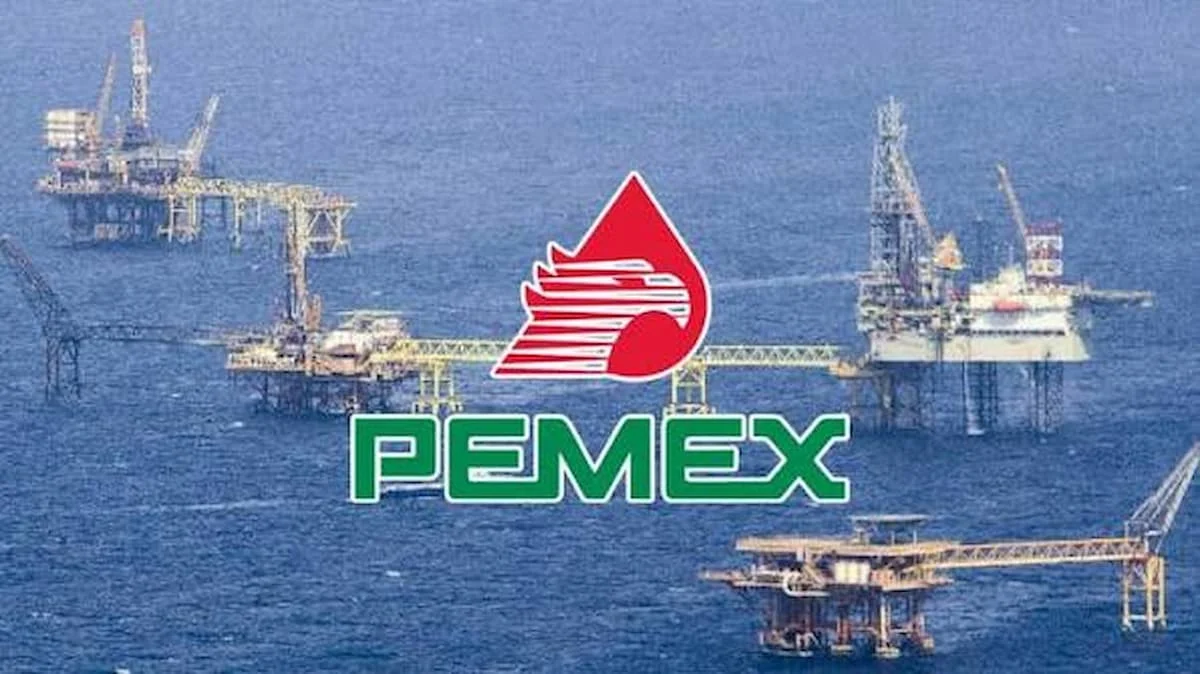
Ciudad del Carmen, Campeche — A new oil spill has been detected at a Pemex facility in the Gulf of Mexico, 46 nautical miles north of Ciudad del Carmen, triggering a large-scale containment operation led by the Mexican Navy.
The Permanent Observatory of the Gulf of Mexico announced the incident on the morning of Sept. 10 and immediately activated its continuous observation and spill-forecasting protocol, which draws on scientific and operational teams.
At 6:45 that morning, the Mexican Navy activated its Local Contingency Plan through the Regional Emergency Response and Management Group based in Ciudad del Carmen. The operation deployed the ocean patrol vessel ARM Guanajuato, four additional vessels, two aircraft and 255 naval personnel to support Pemex’s containment work.
A Pemex team identified the leak in a pipeline and is working to contain it. The Agency for Safety, Energy and Environment (ASEA) will carry out an aerial overflight to document the containment, cleanup and repair work.
Satellite tracking maps the slick
Four satellite observation reports have been issued so far, using Synthetic Aperture Radar and multispectral imagery that show how the oil slick is evolving. The data allows observatory scientists to gauge the spill’s reach in near real time.
Three drift forecast models agree on a net westward movement over the next five days. The simulations indicate the slick is unlikely to reach the coast or any sensitive area during that period, though a cold front could alter its course within the next ten days.
Technical teams are continuing to:
- Monitor the slick by satellite every day.
- Update drift models in case the cold front moves in.
- Coordinate offshore containment among the Navy, Pemex and ASEA.
Pemex activates protocols
Hours later, Pemex issued a brief statement saying it had “activated the corresponding response protocols” after the observatory’s report.
The state oil company said it identified the leaking pipeline and depressurized it in an effort to stop the flow of hydrocarbons. It added that recovery work, along with pipeline inspection and repairs, remains active in the affected area. No harm to personnel or beaches has been reported so far.
Observatory born from earlier spills
The Permanent Observatory of the Gulf of Mexico was not created in response to this incident. President Claudia Sheinbaum ordered its establishment after a spill reported last February as part of a strategy for scientific monitoring and environmental risk response in the region.
The Ministry of Science, Humanities, Technology and Innovation (Secihti) coordinates the effort, which brings together the Navy, Semarnat, Sener, ASEA, Pemex, Profepa, Conapesca and state and municipal authorities. The system combines oceanographic buoys, weather stations, tide gauges and satellite technology to generate real-time information.
During an April operation, 32 of 48 monitored beaches were already free of arriving oil, with the greatest progress in Tabasco and Veracruz. Universities including UNAM, the Autonomous University of Baja California and CICESE also take part, aiming to turn scientific knowledge into public policy for contingency response.
Earlier spill led to three dismissals
The observatory’s direct predecessor was a spill from a 36-inch pipeline at the Abkatún-Pol-Chuc complex, detected on Feb. 6. Pemex’s then-director general, Víctor Rodríguez Padilla, acknowledged that operational areas systematically denied the leak, even as oil began washing up on Gulf coasts.
An internal investigation, which cross-referenced the logs of eight vessels with satellite data, documented that it took eight days to fully close the main valve after the fault was detected, and that at least 350 cubic meters of oily water recovered by containment booms were concealed. Investigators also found a contradiction between reports describing the event as a mere “drip” and the actual deployment of 11 vessels to contain and disperse the oil.
On Sheinbaum’s direct instructions, Pemex dismissed its deputy director of Safety, Occupational Health and Environmental Protection, its marine control coordinator and its spills and waste chief, without disclosing their identities. The company filed complaints with the Federal Prosecutor’s Office (FGR) and the Anti-Corruption and Good Government Ministry to establish responsibility.
That spill affected roughly 630 kilometers of coastline in Tamaulipas, Veracruz and Tabasco and required the collection of more than 915 tons of contaminated waste, according to Navy Secretary Raymundo Pedro Morales.
More Environment
- Cancún’s Benito Juárez Recycling Drive Recovers 6.8 Tons of Waste
- US Releases 1 Billion Sterile Flies to Stop Screwworm’s Return
- Delphinus Blue Planet Pulls Out of Deal to Buy The Dolphin Company, Leaving 101 Marine Animals in Limbo
- Cozumel Beach Club Kuzá Targets 4,000 Daily Visitors in Protected Area With CONANP Backing
- Sargassum and Low Season Drive Tulum Beach Weddings to Decade Low