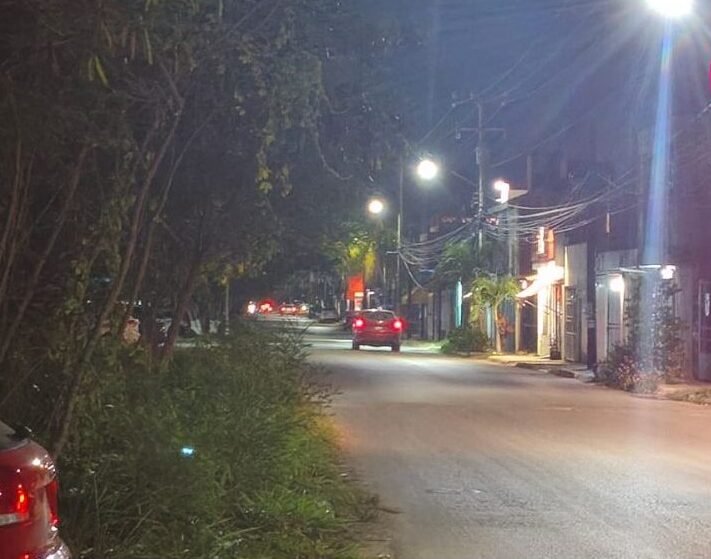
Cancun, Quintana Roo — For thousands of residents in Cancun, walking often means stepping onto the road. In several neighborhoods and housing developments, pedestrians must navigate along the edge of the street or cross avenues without a safe space, a situation that increases the risk of accidents.
One example is in Supermanzana 518 on Instituto Politecnico Nacional Street, where a stretch completely lacks a sidewalk. Those passing through must walk on the pavement or cross the road to reach the opposite sidewalk, exposing themselves to constant vehicle traffic, especially at night.
The problem is not limited to that area. Neighborhoods such as Villas Otoch Paraiso, Cielo Nuevo, Tres Reyes, Avante, and El Milagro also have streets where pedestrian infrastructure is nonexistent or incomplete, forcing children, elderly people, and workers to share space with cars.
The lack of sidewalks not only complicates daily commutes but also poses an obstacle for people with disabilities, stroller users, and cyclists seeking safe passage.
Mobility Is Not Just for Vehicles
Urban mobility experts agree that a city should be built not only for vehicles but also for those who travel on foot. Continuous sidewalks, safe crossings, adequate lighting, and access ramps are basic elements to reduce accidents and improve quality of life.
In Cancun, many roads have been widened to ease car traffic, but in some sectors, pedestrian infrastructure has been neglected or never built.
Meanwhile, walking a few blocks can become a risky maneuver, where the greatest challenge is not the distance but finding a safe place to walk.
In a city designed to receive millions of tourists each year, walking through some of its neighborhoods remains a daily challenge for those who live there. The problem is not just the lack of sidewalks — often, crossing to the only one that exists also puts them at risk.
More Development
- Cozumel Boardwalk Renovation to Keep Historic Features and Traffic Flowing
- Quintana Roo Hoteliers Push Regenerative Tourism Amid Beach Access Disputes
- Cancún’s Route 17 Leona Vicario Draws More Than 16,000 Riders on First Free Day
- Quintana Roo Beaches Lose Up to 14 Meters of Sand a Year as Restoration Plan Advances
- Meliá Invests €50 Million in Paradisus Cancún Renovation
More Cancun
- Hells Angels Leader Arrested in Cancun Over Cartel Drug Trade
- Tourist Boat Traffic Slumps Across Quintana Roo Ports in September
- Cancún Waives 100% of Fines and Surcharges to Help Businesses Get Licensed
- Puerto Morelos Mayor Says Cancún Mansion Raided by Federal Agents Was ‘Lent’ to Her
- Mothers Keep Up Protest at Cancún Middle School Over Alleged Attack on Student