
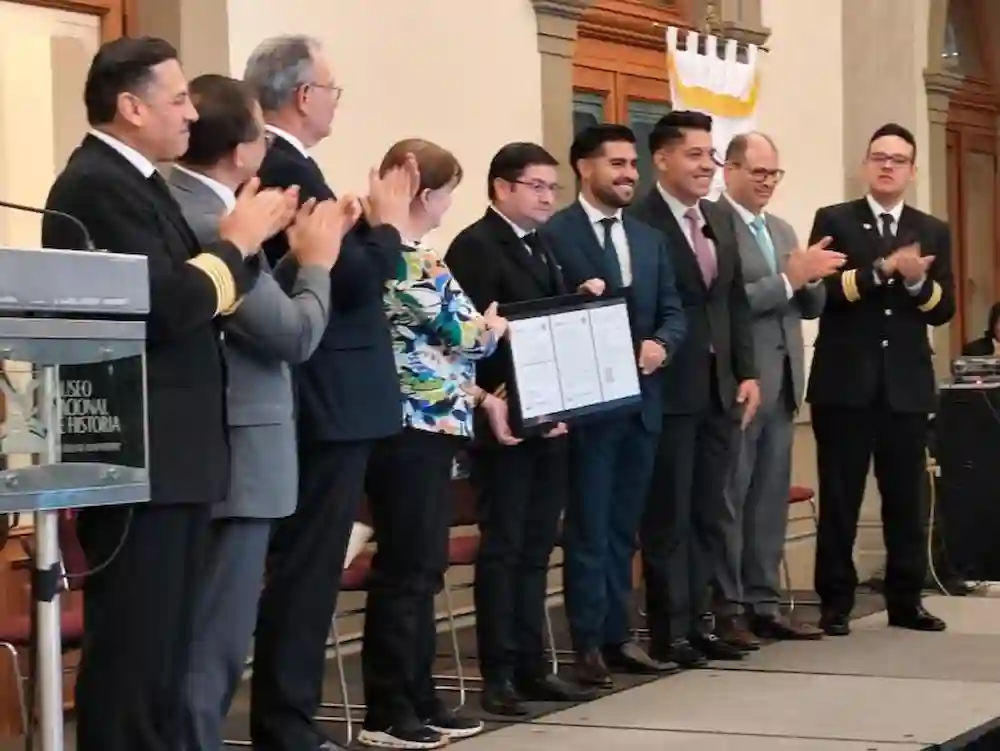
Mexico City — Mexico has launched its first university degree program for airline pilots, a move officials say will improve aviation safety and address a shortage of qualified crews. The program received approval from the Ministry of Public Education and the Federal Civil Aviation Agency.
The announcement came during an official presentation at Castillo de Chapultepec, led by the College of Airline Pilots of Mexico, which has advocated for the initiative for over 40 years.
“By validating this degree, the Ministry of Public Education is not just endorsing an academic program, but recognizing a profession fundamental to the country’s development,” said Ángel Domínguez Catzín, president of the College of Airline Pilots of Mexico.
He emphasized that aviation “demands comprehensive training that meets 21st-century standards.”
Safety and Training
Emilio Avendaño García, director general of the Federal Civil Aviation Agency, said raising pilots’ educational level is key to strengthening operational safety and the competitiveness of Mexico’s aviation sector.
Regarding labor implications, Jesús Ortiz Álvarez, general secretary of the Mexican Airline Pilots’ Union Association, argued that professionalization will have direct effects on safety.
“A better-prepared pilot contributes to a safer, more competitive, and more dignified Mexico,” he said.
Academic Content and Specialization
The initiative aims to align training with international standards as the International Civil Aviation Organization has warned about the need to reinforce technical training amid growing air traffic.
In that context, Julio César Siu, the organization’s deputy regional director, highlighted the importance of harmonizing aeronautical education with global criteria.
The degree will have a minimum duration of three years in a mixed format, combining in-person and online classes, with an initial cohort of 50 applicants starting June 8, 2026.
Industry and Future Challenges
The curriculum includes 20 additional subjects compared to the university technical level, including Advanced Aerodynamics, Aeronautical Law, Airline Administration, and Incident and Accident Investigation.
The program also features a gender perspective aviation course developed with support from the Mexican Airline Pilots’ Union Association.
Thalía Lagunas, head of Accreditation, Incorporation and Revalidation at the Ministry of Public Education, said such content responds to the need to increase female participation in a sector where women currently represent about 7% of crew members.
Implementation and Expansion
On the legal front, Eurípides Flores, director of Legal Affairs at the Ministry of Public Education, indicated that official recognition of the degree provides academic and employment certainty for graduates by fully integrating them into the national education system.
From the industry perspective, Gabriel Sánchez, vice president of Flight Operations for Aeroméxico Group, said a larger base of pilots trained in Mexico could help reduce the need to hire foreign crews.
Senator Emmanuel Reyes of the Morena party argued that strengthening aeronautical training will be strategic to support the sector’s growth in coming years.
Paul Castelazo, president-elect of the College of Airline Pilots of Mexico, said the next step will be to consolidate the program’s implementation and expand its reach to meet growing pilot demand.
More Lifestyle
- Cancún to Hand Out 117,000 Pairs of School Sneakers Starting Monday
- Chetumal Chef Kevin Chávez to Represent Mexico at S.Pellegrino Young Chef Regional Final
- Hepatitis A Outbreak Prompts Class Suspension in Tizimín Village
- Diocese of Cancún-Chetumal Warns of Man Posing as a Priest in Chetumal
- Cancún Cyclists Plan 8.2-Kilometer Ride for World Car-Free Day
