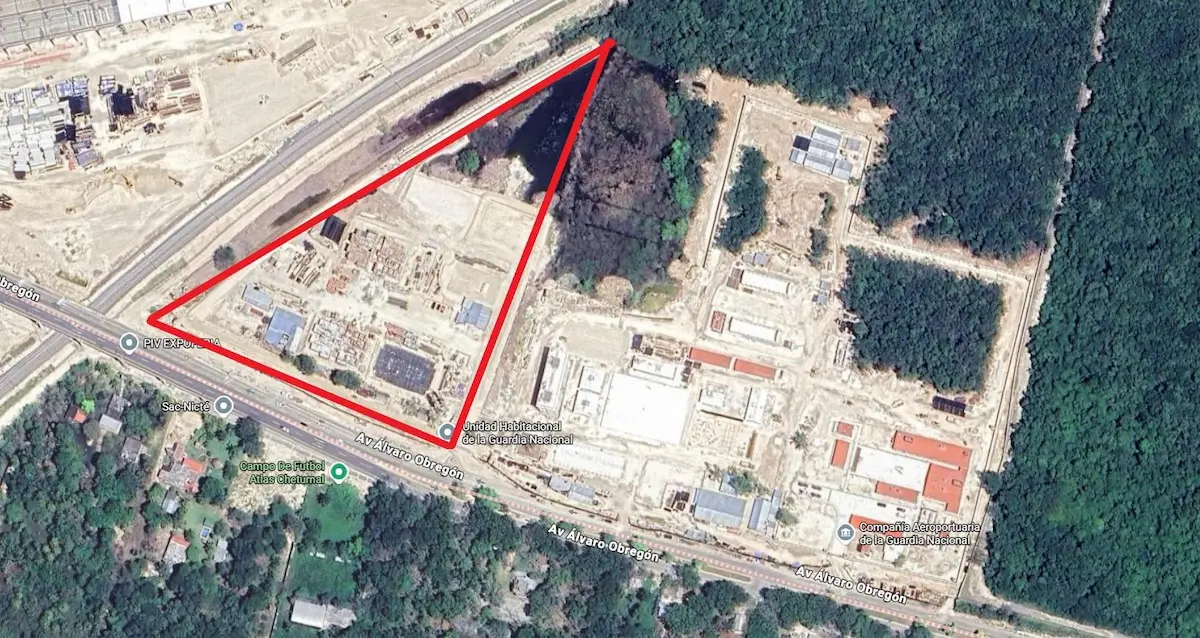
Chetumal, Quintana Roo — The Mexican Army is building a military housing complex in Chetumal without waiting for the environmental authorization required to change the land use on forested terrain, according to officials.
The Environment Ministry, known as Semarnat, announced last Thursday that it received an application on June 11, 2025 for a unified land-use change permit for the project, which is intended to house National Guard members and their families. The permit has not been approved, but the army has already cleared the site and advanced construction on three apartment buildings and other facilities.
Work on the housing unit is far enough along that it is visible in aerial and satellite images, and Google Maps already identifies the site as a National Guard housing unit.
The project covers a 2.99-hectare plot, of which 2.54 hectares are to be built on. That area has been cleared of medium jungle, according to the application. Plans call for three buildings with 20 apartments each, a house, three guard houses, a multi-use court, administrative areas, a swimming pool, a palapa, a cistern and elevated water tank, common areas, parking, internal roads and a wastewater treatment plant. The complex is expected to house about 180 military families.
The property is located on the extension of Alvaro Obregon Avenue, near the intersection with Insurgentes Avenue, next to the Tren Maya workshops and the barracks of the National Guard’s Fourth Company of the Second Southeastern Railway Security Battalion.
The Defense Department, known as Sedena, has budgeted about 391 million pesos for the project, of which roughly 10 percent, or about 39 million pesos, is earmarked for prevention and mitigation measures. Semarnat’s records show the evaluation is in its final stage and a response is pending.
This is not the first time the army has carried out construction in the area without the necessary permits. The adjacent National Guard barracks, built under the same circumstances, began construction on Aug. 23, 2024, before an environmental permit was issued. The army submitted an environmental impact statement on July 14, 2025, seeking authorization for the work and the clearing of more than 45,000 square meters of jungle.
Semarnat rejected that application on Aug. 13, 2025, after finding that construction was already well advanced and 45,531.11 square meters of vegetation had been cleared. The ministry said the army had violated the preventive purpose of environmental impact evaluation by carrying out the land-use change and construction without prior authorization. Semarnat said the army could submit a new impact statement for the remaining work, but the military branch instead completed the barracks and brought it into operation on Jan. 28, 2026.
More Development
- Profepa Shuts Down Work Damaging Coastal Dune in Yucatán
- Cancún Urban Development Plan Reaches 50% as Officials Weigh Where City Can Grow
- Isla Mujeres Residents Demand Land for Cemetery, Market and Slaughterhouse
- Cozumel Residents March Against Malecón Rehabilitation Project
- Playa del Carmen Draws Over $1.6 Billion in New Tourism and Real Estate Projects
More Chetumal
- Coparmex Backs Bid to Add Bacalar to Chetumal Airport Name
- Activist Demands Universal Accessibility at Quintana Roo Prosecutor’s Office in Chetumal
- Quintana Roo Electoral Body Orders Councilwoman To Pull Videos Criticizing Mayor
- Chetumal’s Barrio Mágico Project to Temporarily Relocate 50 Street Vendors
- Tren Maya Archaeological Finds Won’t Be Displayed in Chetumal, INAH Says