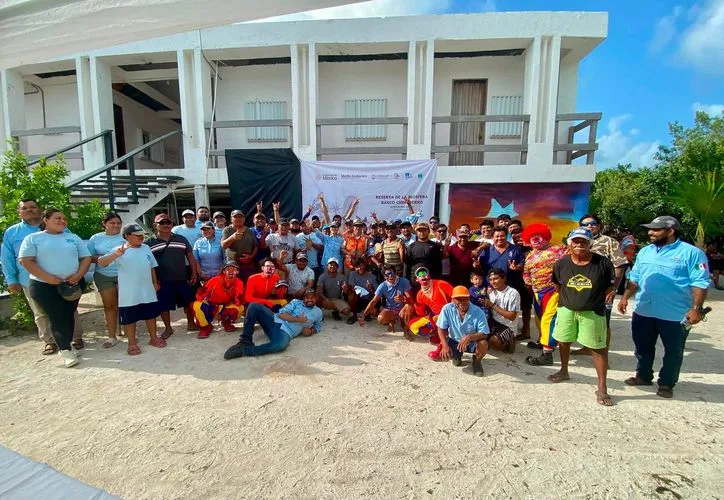
Chetumal, Quintana Roo — Mexico’s largest platform reef complex is beginning a three-year restoration and monitoring program as the Banco Chinchorro Biosphere Reserve marks 30 years as a federally protected area.
The National Commission of Natural Protected Areas, known as Conanp, said the program will continue through June 2028. It combines coral and mangrove restoration, water-quality testing, community surveillance and training for residents who depend on the reef for fishing and tourism.
Fifty-five members of the Andrés Quintana Roo, Langosteros del Caribe and Pescadores del Banco Chinchorro fishing cooperatives will participate. Their work will include surveillance patrols, biological monitoring and recovery projects in damaged areas.
The initiative is financed by the German government through the KfW development bank and coordinated with the MAR Fund and the Mexican conservation organization Espacios Naturales y Desarrollo Sustentable, or ENDESU.
It covers four federal protected areas in southern Quintana Roo: the Banco Chinchorro Biosphere Reserve, Xcalak Reefs National Park, Sian Ka’an Reefs Biosphere Reserve and Mexican Caribbean Biosphere Reserve. Together, these areas protect connected coral reefs, mangroves and seagrass beds along Mexico’s Caribbean coast.
Mexico’s Largest Reef Complex
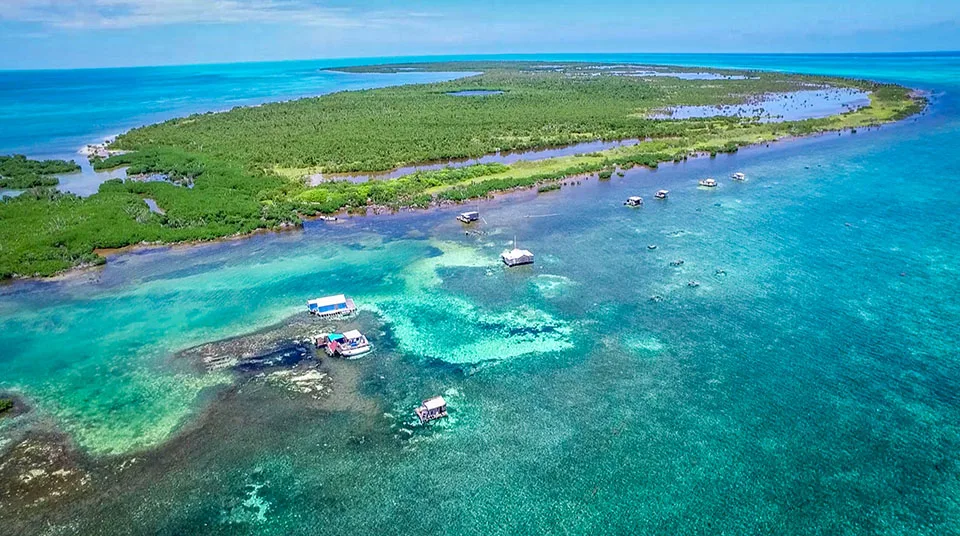
Banco Chinchorro lies about 31 kilometers, or 19 miles, east of Mahahual. Its offshore location separates it from the mainland by a deep channel and has helped protect it from some of the coastal development pressures affecting reefs closer to shore.
The reserve covers 144,360 hectares, of which less than 1% is dry land. It contains an extensive reef lagoon and three main island groups: Cayo Norte, Cayo Centro and Cayo Lobos.
UNESCO describes Banco Chinchorro as Mexico’s largest platform-type reef complex. Its mix of coral formations, open water, seagrass, beaches and mangrove islands creates habitat for a wide range of marine and coastal wildlife.
Banco Chinchorro is part of the Mesoamerican Reef System, which extends for more than 1,000 kilometers through the waters of Mexico, Belize, Guatemala and Honduras. According to Mexico’s biodiversity commission, the regional reef system supports more than 500 fish species, 65 species of stony coral and hundreds of mollusks and crustaceans.
The reserve was declared a federally protected biosphere reserve on July 19, 1996. Its official management area includes coral formations, a reef lagoon, ocean waters and the small cayes. It was recognized under UNESCO’s Man and the Biosphere Program in 2003 and designated a Ramsar Wetland of International Importance in 2004.
Banco Chinchorro has also been on Mexico’s tentative list for possible UNESCO World Heritage status since 2004.
Why The Reef Matters
Healthy coral reefs reduce wave energy before it reaches the coastline, helping limit erosion and storm damage. They also provide feeding, breeding and nursery grounds for fish and other marine life.
At Banco Chinchorro, reef conservation is directly connected to the local economy. The reserve supports regulated fishing for Caribbean spiny lobster and other species, as well as diving and nature tourism based primarily in Mahahual.
The three cooperatives participating in the new program have been involved in fisheries management for years. They helped establish a network of fishing-refuge zones where harvesting is prohibited or restricted so populations can recover.
Federal fisheries authorities have said such refuges can increase the size and density of marine species inside the protected zones, with benefits eventually extending into adjacent fishing areas. The system also gives fishermen a direct role in monitoring the resources on which their livelihoods depend.
This is particularly important for spiny lobster, one of Banco Chinchorro’s most valuable commercial species. During the anniversary ceremony, Conanp recognized El Colegio de la Frontera Sur, or Ecosur, for a decade of continuous lobster monitoring carried out with fishing communities.
The reef is also home to sea turtles, sharks, rays, groupers and protected corals. Mangroves on the cayes shelter juvenile fish and provide nesting and resting areas for birds. Cayo Centro supports a notable population of American crocodiles adapted to the island’s saline coastal environment.
Banco Chinchorro has another layer of value beneath the water. Centuries of navigation through the western Caribbean left numerous shipwrecks scattered around the reef. Federal environmental officials say the National Institute of Anthropology and History has documented 69 maritime archaeological sites dating from the 16th through the 20th centuries.
Preparing For Storms and Warmer Seas
Despite its remote location, Banco Chinchorro faces growing pressure from warming ocean temperatures, coral disease, hurricanes, illegal fishing, pollution and vessel groundings.
Coral bleaching occurs when heat or other stress causes corals to expel the microscopic algae that provide much of their energy and color. Mexico’s biodiversity commission says water temperatures only 1 to 2 degrees Celsius above the normal seasonal maximum for several weeks can trigger bleaching. Prolonged events can reduce reproduction, weaken corals and increase their susceptibility to disease.
Hurricanes can break large coral colonies and scatter living fragments across the seabed. In 2025, Conanp trained 15 brigadiers from Banco Chinchorro and Xcalak to assess storm damage, remove debris, stabilize broken corals and reattach living fragments.
Those brigades are supported by a parametric reef-insurance program managed through the MAR Fund. When a qualifying hurricane reaches an insured reef area, money can be released quickly for damage assessments and emergency restoration rather than waiting months for conventional funding.
The new program will expand that work by training additional participants in diving, reef assessment and early-response procedures. It will also establish standardized monitoring so scientists and communities can compare reef conditions over time.
Water-quality testing will help identify changes that may be connected to pollution, runoff, sewage or other stresses. A broader reef-health assessment will measure coral condition and other biological indicators, providing a baseline for future restoration decisions.
Community cleanups are another part of the project. During one recent operation, 92 participants removed 321 kilograms of waste from 1.5 hectares of beach and coastal habitat.
At the anniversary ceremony, Conanp presented recognition to the participating cooperatives and unveiled a commemorative plaque and a mural by artist Imer Hu. Reserve Director Denisse Ángeles Solís said the program brings together scientific research, government management and the experience of people who work on the reef.
The monitoring carried out through June 2028 will help determine where restoration is working, which areas are declining and how Banco Chinchorro responds to increasingly warm seas and stronger coastal threats.
More Environment
- Mexican Army Nears Completion of 16-Kilometer Jungle Road Over Tulum’s Sac Actún Cave System
- Akumal Halts Turtle Swim Tours Through September
- Mexico Assigns $110 Million Navy Budget to Fight Sargassum in Quintana Roo
- Mérida Opens First Green Corridor to Fight Climate Change
- El Niño Keeps Atlantic Hurricane-Free, Setting Record for Latest First Storm in Decades