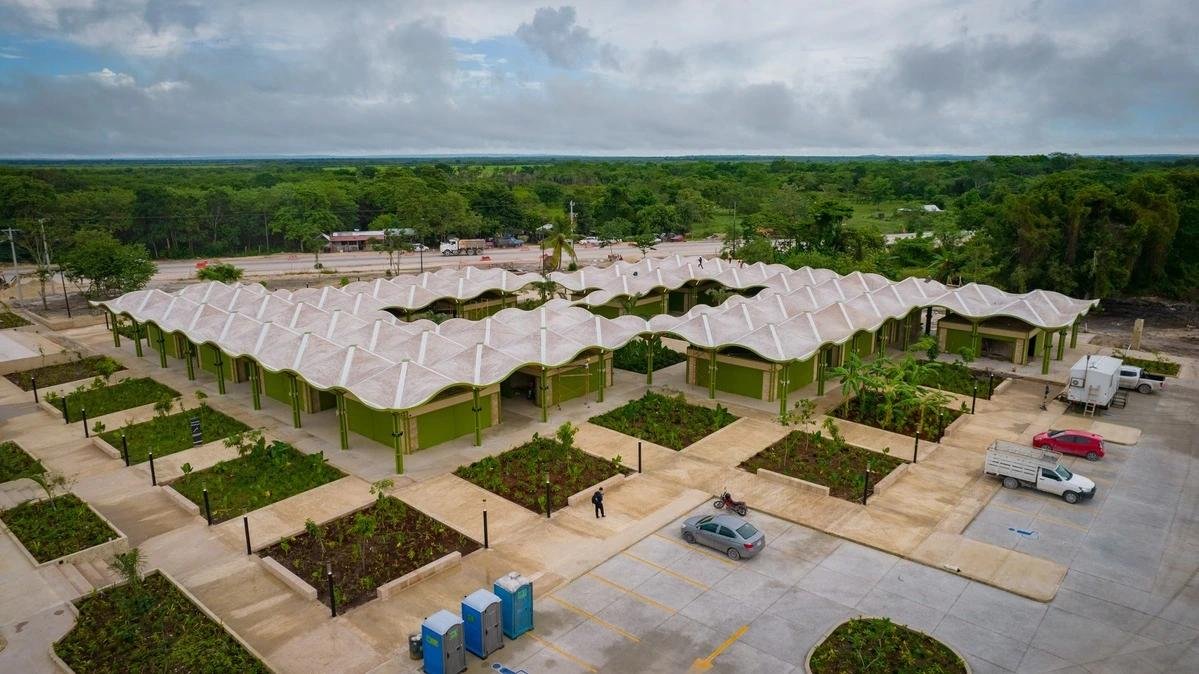
Nicolas Bravo, Quintana Roo — Five kilometers from town, surrounded by the silence of the jungle, a relatively new, brightly lit, and completely empty building stands as a daily reminder of a promise unfulfilled.
The Maya Wellness Market, built with more than 104 million pesos (about $5.2 million) in federal funds to capitalize on the arrival of the Maya Train in southern Quintana Roo, has never opened. Local producers — who sell cheese, livestock, honey, and crafts through traditional channels — were supposed to be its main beneficiaries.
In Nicolas Bravo, a community of 4,000 people marked by poverty, muddy streets, and limited opportunities, the market now symbolizes the disconnect between large government projects and the real needs of the population.
The town, part of the municipality of Othon P. Blanco and located on Federal Highway 186 near the Campeche border, has long lived off cattle ranches, dirt roads, and the surrounding jungle. Life revolves around pastures, artisanal cheese-making, and plots of corn, beans, and citrus. Residents take pride in a region that supplies much of southern Quintana Roo’s livestock and preserves more than 35,000 hectares of forest under voluntary conservation and carbon credit schemes.
But in 2020, the Maya Train project stirred both anxiety and hope. During construction, thousands of workers poured into the area. Hotels filled up. Families rented out rooms. Restaurants, mechanic shops, and small businesses saw an unusual economic boost. For the first time in years, money was circulating.
Expectations soared when the government announced the Nicolas Bravo/Kohunlich train station and a complementary project: the Maya Wellness Market. The idea was simple: let local producers, artisans, traditional cooks, and small vendors sell directly to tourists arriving by train. The market included dozens of commercial and food stalls and cost over 104 million pesos.
Two years after completion, the market has not opened. For many residents, it has become a monument to disappointment — and to what they see as a failure by Roman Meyer, former head of the Secretariat of Agrarian, Territorial, and Urban Development (Sedatu), to listen to the community and instead favor private interests.
Residents interviewed by Luces del Siglo agree on a key point: the train station and market were not originally planned for their current location. Faustino Reyes Herbert, a native ejido member, recalls that early meetings mentioned building both facilities near the town. “They told us it would be by the high school area, then they talked about another plot close to town. The idea was for people to benefit directly,” he said.
The logic seemed clear: if the station were near town, tourists would have to enter Nicolas Bravo, generating business for taxis, mototaxis, eateries, hotels, and artisans. But something changed. In an ejido assembly, government representatives announced that both the station and market would be built several kilometers away, at the junction leading to the Kohunlich archaeological zone.
The decision surprised many residents, fueling suspicions that outside interests drove the relocation. Official reasons were never clearly explained to the community.
Ribay Abiel Salazar Perera, a council member of the Nicolas Bravo mayor’s office, believes economic interests tied to land sales influenced the move. “The market was planned for another area. It would have worked there, but suddenly they moved it near the Kohunlich Hotel. I think personal interests related to land sales and decisions by the authorities at the time influenced it,” he said.
Faustino Reyes Herbert goes further, saying many residents believe the change benefited private interests, including those linked to Grupo Posadas, which owns the hotel near the archaeological site. “The intention was to benefit the town, but it ended up favoring other interests,” he said.
None of those interviewed provided documentary evidence, but the suspicions are part of the collective narrative now dominant in the community.
The most persistent criticism is not the location but the lack of community involvement. Eduardo Reyes Velazquez, a former ejido commissioner and historical leader in the region, says there was never a strategy to include local producers. “They never explained how the market would operate. We don’t know who will occupy the stalls, under what rules, or how to participate. The infrastructure was built, but they never worked with the community,” he said.
Reyes Velazquez stressed that the problem is not the physical building. “The investment is good, the market is nice, it’s well-lit, but it has no use. Since it was installed, it has had no activity.”
During a visit by Luces del Siglo, the building was indeed empty. Stalls were closed. There was no commercial activity, no tourists, no producers, no signs of operation.
The Cost of Distance
The distance has become an unexpected obstacle. The market and station are about five kilometers from Nicolas Bravo and even farther from communities like Ucum, Morrocoy, Carlos A. Madrazo, Sacxan, Tres Garantias, Caobas, Nuevo Becal, and Ejido Laguna OM, which were also supposed to benefit. For many rural producers, transporting goods daily — crafts, fruits, cheeses, or prepared foods — is a cost they simply cannot afford.
The problem also affects the Maya Train itself. Faustino Reyes Herbert explains that residents must pay for additional transport to reach the station. “A trip to the station costs about 100 pesos. The bus to Chetumal costs 80. People prefer to keep using traditional transport,” he said. The result is clear: the station sees little activity, and residents do not use it regularly.
Returning to their reality, residents question why a livestock-oriented town pins its hopes on tourism. That is the paradox: Nicolas Bravo does have something to offer. The region moves about 10,000 head of cattle between Nicolas Bravo and Morocoy. A SuKarne collection center operates here, and there is a strong tradition of artisanal cheese production. The ejido also protects more than 35,000 hectares of forest and participates in carbon capture projects with specialized organizations.
The area also boasts archaeological attractions such as Kohunlich, Dzibanche, and Kinichna, which could be integrated into a regional tourist route. That was the original bet of the Wellness Market: that Maya Train tourists would buy wooden crafts, farm products, honey, cheese, and regional foods. But that tourist flow has simply not arrived.
Among residents, a phrase repeats: “white elephant.” Ribay Salazar uses it to describe the market, comparing it to other projects launched with great expectations that ended up abandoned — like the old Caribbean rice mill, some ejido production projects, and agricultural infrastructure that never consolidated. “Development was promised, but it didn’t happen,” he summarized.
A Promise on Hold
While northern Quintana Roo concentrates hotels, airports, and millions of tourists each year, the feeling in Nicolas Bravo is different. Residents speak of abandonment and lost opportunities — a region that watches development pass by without stopping.
A few meters from the federal highway, between the jungle and the pastures, stands the Maya Wellness Market: a building that cost more than 104 million pesos, built to receive tourists who never came in the expected numbers. New, lit, equipped, and empty. The promise of prosperity that accompanied the Maya Train remains there, motionless, waiting for someone to explain how to turn it into reality.
More Politics
- US Navy Torpedo Lost During Training Ends Up in Mexican Waters Off Baja California
- Lee Heads to UN for Trump Talks, Then Mexico Summit
- Coparmex Urges INE to Strengthen Election Controls Ahead of 2027 Vote
- Quintana Roo Border Dispute Reaches Final Stage at Mexico’s Supreme Court
- Hunucmá Public Security Alderman Resigns After Woman Alleges Assault
More Chetumal
- Bamboo Growers From 13 Mexican States Form National Association
- Chetumal Chef Kevin Chávez to Represent Mexico at S.Pellegrino Young Chef Regional Final
- Diocese of Cancún-Chetumal Warns of Man Posing as a Priest in Chetumal
- Coparmex Backs Bid to Add Bacalar to Chetumal Airport Name
- Activist Demands Universal Accessibility at Quintana Roo Prosecutor’s Office in Chetumal