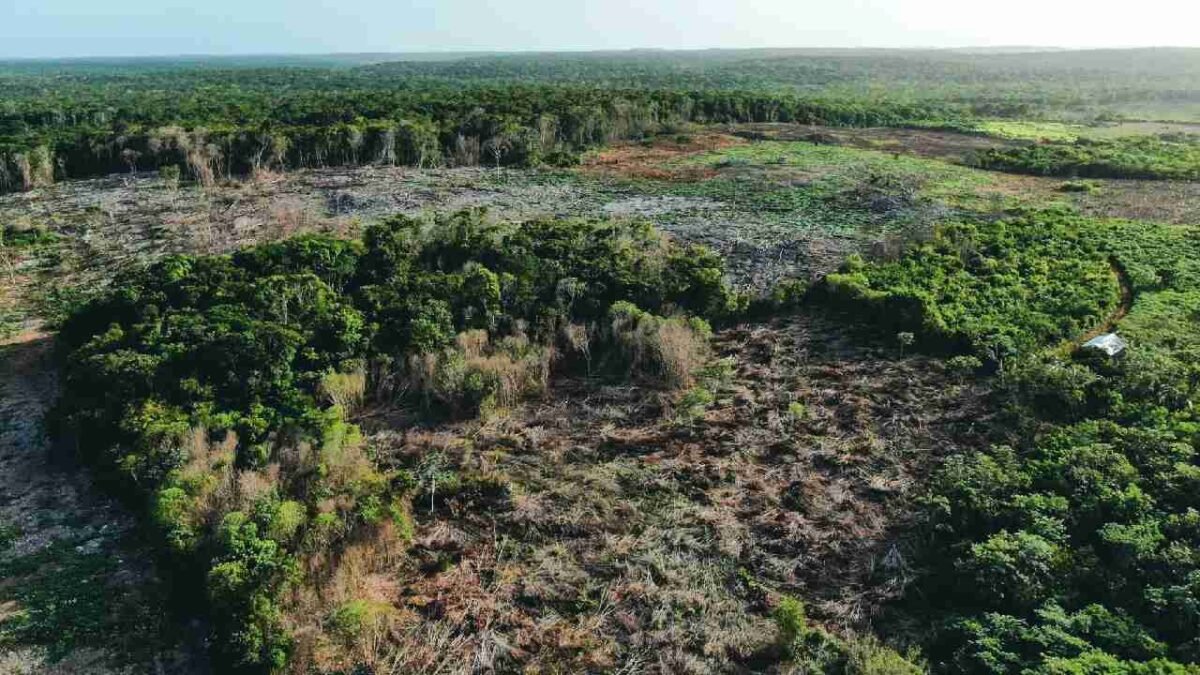
Bacalar, Quintana Roo — The municipality of Bacalar lost 25,060 hectares of forest cover between 2016 and 2025, an average of 2,784 hectares a year, according to data from the Forest Supply Chain Information System (Sicamfor) and the Mexican Civil Council for Sustainable Forestry (CCMSS).
The clearing is closely tied to land-use changes driven by agricultural and livestock expansion. Agroindustrial crops such as soy, sorghum and corn — grown mainly for animal feed — and extensive cattle ranching are among the principal causes.
Deforestation Concentrated in Agrarian Communities
The losses are not distributed evenly across the municipality. Instead, the data show clearing concentrated in a number of agrarian settlements. The largest affected areas were:
- Río Verde: 6,699 hectares
- Miguel Alemán: 4,349 hectares
- Paraíso: 1,836 hectares
- N.C.P.E. Río Hondo: 1,795 hectares
- El Bajío: 1,727 hectares
- Bacalar: 1,715 hectares
- Reforma: 1,685 hectares
- Altos de Sevilla: 1,644 hectares
- Blanca Flor: 1,426 hectares
- San Fernando: 1,271 hectares
The geographic pattern points to intense pressure in places where agriculture and cattle raising overlap. The conversion of forest to cropland and pasture is gradually transforming the rural landscape.
Land-Use Planning Under Scrutiny
The speed of forest loss has raised concerns about biodiversity, environmental services and water supplies. It also reduces the ability of local ecosystems to capture carbon.
The figures from Sicamfor and CCMSS underscore the need for stronger land-use planning, closer oversight of land-use changes and greater forest conservation. The pace of clearing during the nine-year period leaves Bacalar facing the challenge of balancing farm and ranch output with protection of its forest ecosystems.
More Environment
- Puerto Morelos launches weekly sargassum watch until 2026
- Quintana Roo Seeks Geographic Indication to Protect Melipona Honey
- Dengue Cases in Quintana Roo Jump 152 Percent
- Quintana Roo Hoteliers Push Regenerative Tourism Amid Beach Access Disputes
- Greenpeace Finds Contamination at 17 Yucatán Wells and Cenotes as Maya Communities Demand Action