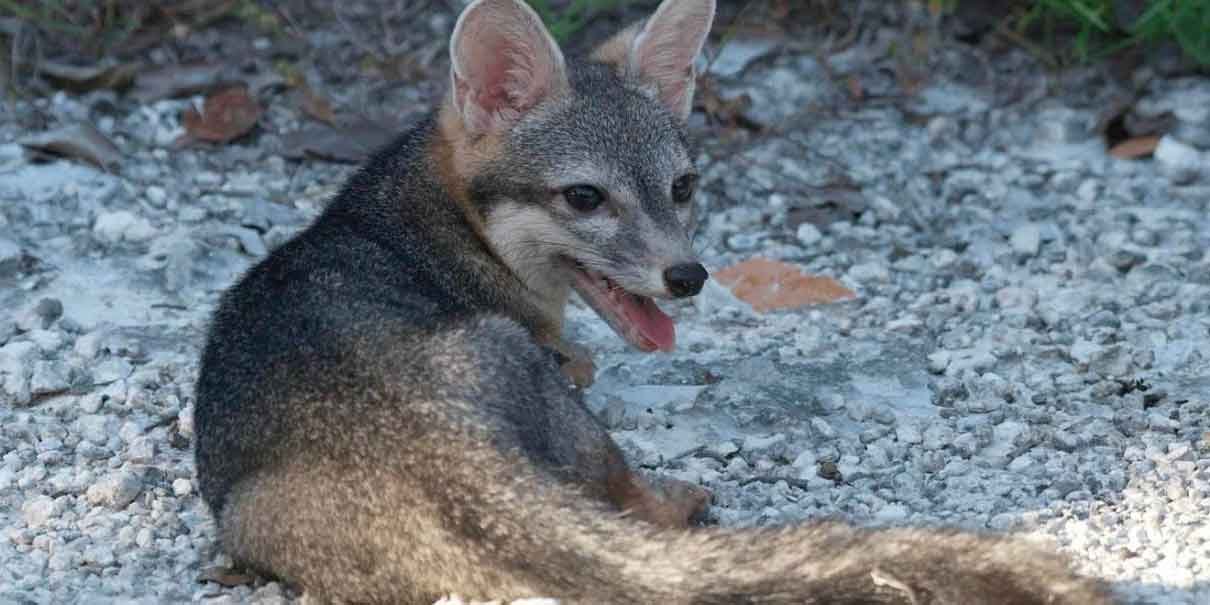
Cozumel, Quintana Roo — For more than two decades, the Cozumel dwarf fox existed mostly in fragments: scattered reports, old scientific references, subfossil remains, and local stories from one of Mexico’s most biologically unusual islands.
Now, researchers say the elusive animal has been photographed for the first time, confirming that the tiny fox still survives on Cozumel. The finding has renewed scientific interest in one of the rarest canids on Earth and raised urgent questions about whether the animal can be protected before it disappears.
The discovery was described in a 2026 study published in the journal Neotropical Biology and Conservation. The authors report that an adult male Cozumel fox was found on September 14, 2023, near the coastal highway on the eastern side of the island. After being safely recovered, observed, and assessed, the fox was released on September 17 into suitable habitat inside the Laguna Colombia State Reserve.
For researchers, the photographs are a major breakthrough. Until now, the Cozumel fox had never been documented alive with photographic evidence. The last reported sighting cited in the study dated back to 2001.
A Fox Science Barely Knows
The Cozumel dwarf fox is believed to belong to the genus Urocyon, the same group as the gray fox found on the mainland. But Cozumel’s long isolation appears to have shaped this island population into something much smaller and potentially distinct.
Scientists describe the fox as an example of insular dwarfism, a process in which animals isolated on islands evolve smaller bodies over time. Subfossil remains suggest that the Cozumel fox may be 60 to 80 percent smaller than its mainland relatives.
That alone makes the animal remarkable. But the mystery goes deeper.
Despite its apparent uniqueness, the Cozumel fox has never been formally described as a separate species. Researchers still do not have the genetic or morphological data needed to determine whether it should be recognized as its own species or treated as a highly distinct island population of the gray fox.
That means one of Cozumel’s most unusual mammals could vanish before science fully understands what it is.
An Island Shaped by Isolation
Cozumel is home to several animals that evolved differently from their mainland relatives, including the Cozumel raccoon and the Cozumel coati. The island’s separation from the Yucatán Peninsula created conditions where small, isolated populations could follow their own evolutionary path over thousands of years.
Previous research suggests the fox population may have been isolated for roughly 5,000 to 37,000 years. Some evidence indicates it may have been present on Cozumel before early Maya settlement in the region.
That long history makes the fox more than a rare animal. It is part of the island’s evolutionary record.
Why the Rediscovery Matters
The rediscovery is encouraging, but researchers are careful not to frame it as a recovery story.
One photographed fox does not mean the population is stable. It simply proves that at least one individual survived long enough to be documented.
The bigger question is how many remain.
At this point, scientists do not know the fox’s current population size, distribution, breeding patterns, or habitat requirements. That lack of information is one of the greatest obstacles to protecting it.
The study’s authors say future work should focus on determining where the fox still occurs on the island, how many individuals may be left, and whether genetic testing confirms its status as a distinct species.
A Fragile Future
The Cozumel fox faces the same pressures that threaten many island species, but with very little margin for error.
Urban development, road construction, habitat fragmentation, and land-use changes continue to alter parts of the island. Roads are especially dangerous for small wildlife, and an animal with a tiny population can be pushed closer to extinction by even a small number of vehicle deaths.
Invasive species are another serious concern. Feral dogs, introduced predators, and other non-native animals can compete with, prey on, or spread disease to island species that evolved without those pressures.
Extreme weather also remains a threat. Hurricanes and major storms can reshape habitat quickly on a small island, and a species with a limited range has few places to retreat.
For a fox that may already be critically endangered, the combined pressure of development, roads, invasive species, and climate-related events could be devastating.
A Second Chance, Not a Guarantee
The 2023 sighting gives scientists something they have never had before: modern photographic proof that the Cozumel dwarf fox is still alive.
But it also creates urgency.
If researchers can document where the fox lives, how many remain, and what habitats are most important, conservation authorities may still have time to design protections around real data rather than speculation.
The Laguna Colombia State Reserve, where the fox was released, could play an important role in that effort. So could stronger monitoring, better road-risk mitigation, invasive species control, and public awareness among residents and visitors.
For now, the Cozumel fox remains one of the island’s most mysterious animals. It has survived in the shadows for thousands of years, unseen by science for decades and never formally recognized as a distinct species.
Its reappearance is a rare conservation opportunity. Whether it becomes a survival story will depend on what happens next.
More Environment
- Mexican Army Nears Completion of 16-Kilometer Jungle Road Over Tulum’s Sac Actún Cave System
- Akumal Halts Turtle Swim Tours Through September
- Mexico Assigns $110 Million Navy Budget to Fight Sargassum in Quintana Roo
- Mérida Opens First Green Corridor to Fight Climate Change
- El Niño Keeps Atlantic Hurricane-Free, Setting Record for Latest First Storm in Decades
More Cozumel
- Leonardo Aguilar to Headline Free Cozumel Concert for Grito de Independencia 2026
- Cueva Popotitos: New Underwater Cave System Found South of Cozumel
- Armed Men Try to Abduct Woman on Cozumel; She Escapes on Her Motorcycle
- Cozumel Opens New Sustainable Tourism Trail in Island’s South
- Quintana Roo Mayors Tout Results as Residents Decry Persistent Gaps