
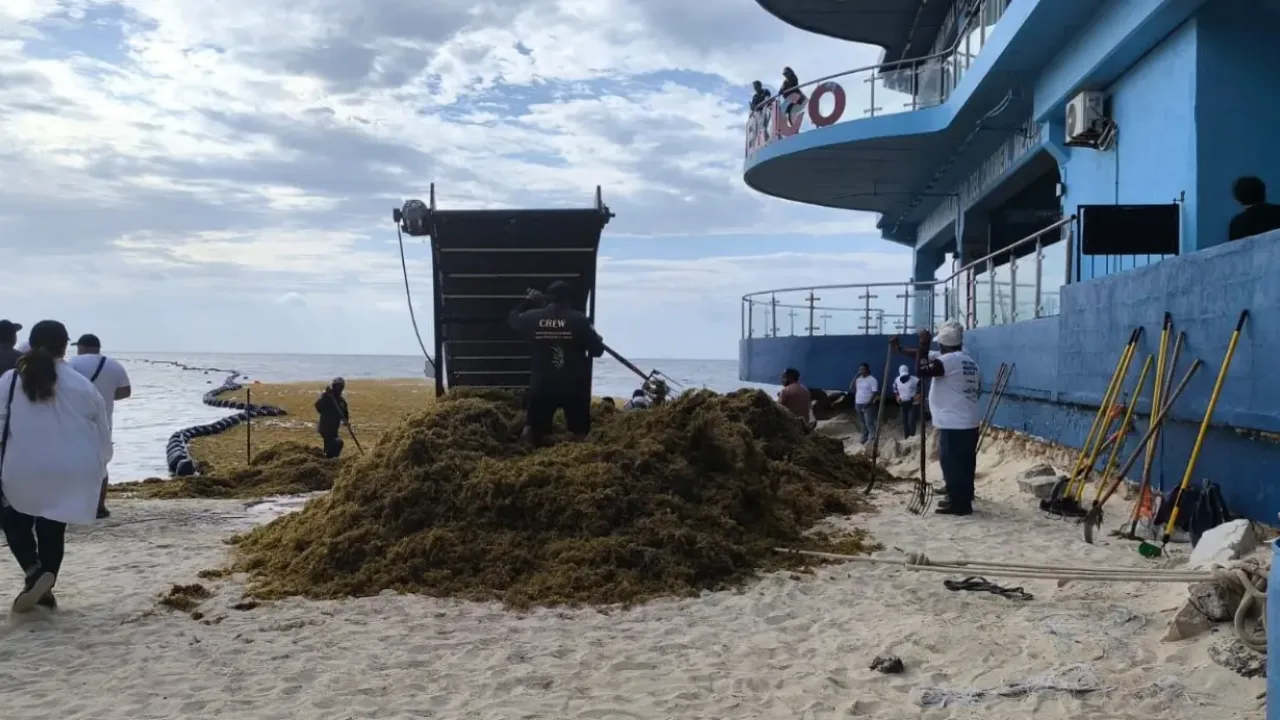
Playa del Carmen, Quintana Roo — Mexico’s national business confederation is asking the federal government for tax relief to help cover the cost of tackling sargassum in Quintana Roo, warning that hotels and smaller tourism businesses should not carry the entire burden of the cleanup.
Octavio de la Torre de Stéffano, the national head of Canaco-Servytur, said the group will set up a working table with the federal Finance Ministry, the Environment and Natural Resources Ministry (Semarnat), the Tourism Ministry (Sectur), state and municipal governments and the private sector to study fiscal incentives for sargassum management in Quintana Roo.
Members of Concanaco-Servytur also want a place in federally funded projects and commercial value chains, including the beach-cleaning program for sargassum removal, which carries public investment of more than 2.6 billion pesos, as well as the Mayan Train and the Cancún Financial and Technology District.
Circular Economy: 198 Sargassum Initiatives
De la Torre pointed to a growing circular economy built around the seaweed, with 198 initiatives already making use of sargassum, 11 of them with the potential to scale up to industrial level and at least 39 companies producing products derived from the algae.
He noted that tourism contributes around $12 trillion to the global economy, equivalent to 9.9 percent of world GDP, and supports roughly 376 million jobs — about one in every nine jobs worldwide.
Eight Points of Action
The confederation is putting forward eight points of action to pursue together with its member chambers and authorities. The first holds that sargassum is no longer a predictable seasonal phenomenon, so it requires permanent planning and prevention along with multiyear budgets.
De la Torre said every ton that reaches the coast can translate into lost bookings, lower spending and reduced revenue.
“Let’s treat sargassum as a shared responsibility, one that cannot become an invisible tax on tourism businesses,” he said.
More Than 96,000 Tons Removed
More than 96,151 tons of sargassum have been removed from Quintana Roo’s beaches, and estimates suggest the ocean holds a potential 40 million tons of biomass. De la Torre said the hotel sector spends more than $150 million a year dealing with the seaweed, a figure he called worrisome.
Wedding tourism has been hit particularly hard, with a drop in related tourist activity. The algae is not only an environmental problem but an economic one, he said, making it important to address the issue in order to keep bookings and spending at hotels strong.
Coordination With the Mayan Train and Cancún Financial District
De la Torre said his organization is coordinating with authorities on the Mayan Train and the Cancún Financial and Technology District to ensure neither harms the environment, with the aim of building a sustainable economy amid global warming — of which sargassum is one example.
He added that the Mayan Train could also be used to move freight, noting that rail transport ranks among the most important, efficient and safe modes in developed countries.
Municipal Government Promotes Sargassum Use
Estefanía Hernández, head of the municipal Secretariat of Economic Development and Investment Attraction in Playa del Carmen, said Mayor Estefanía Mercado’s administration is focused on turning challenges like sargassum into business opportunities. She said the problem is global and overwhelming, but also a commercial opening, since the algae is now a product; the goal is to convert what is collected from the beaches into biogas and plastics.
Hernández said the city is working in Playa del Carmen with the Yucatan Center for Scientific Research (CICY) on projects intended to benefit agriculture and the primary sector.
More Business
- Cancún’s Protected Natural Areas See Tourism Slump, With 600,000 Visitors Expected in 2026
- Bamboo Growers From 13 Mexican States Form National Association
- Quintana Roo Delivers Equipment to 77 Small Businesses Under Transforma Tu Negocio Program
- Cancún Bets on Health Tourism With New Forum
- Quintana Roo Expects 25% Surge in Cancún Flights Starting October
More Playa del Carmen
- Two Suspected Drug Dealers Arrested in Playa del Carmen
- Teen Pianist Amir Akil Makes Debut in Playa del Carmen With ‘Fractales del Viento’
- Up to 20 Sanctioned Offenders a Day Perform Community Service in Playa del Carmen
- Online Escort Ruse Ends in Attempted Robbery in Playa del Carmen
- Internet Installer Dies After Touching High-Voltage Cables in Playa del Carmen