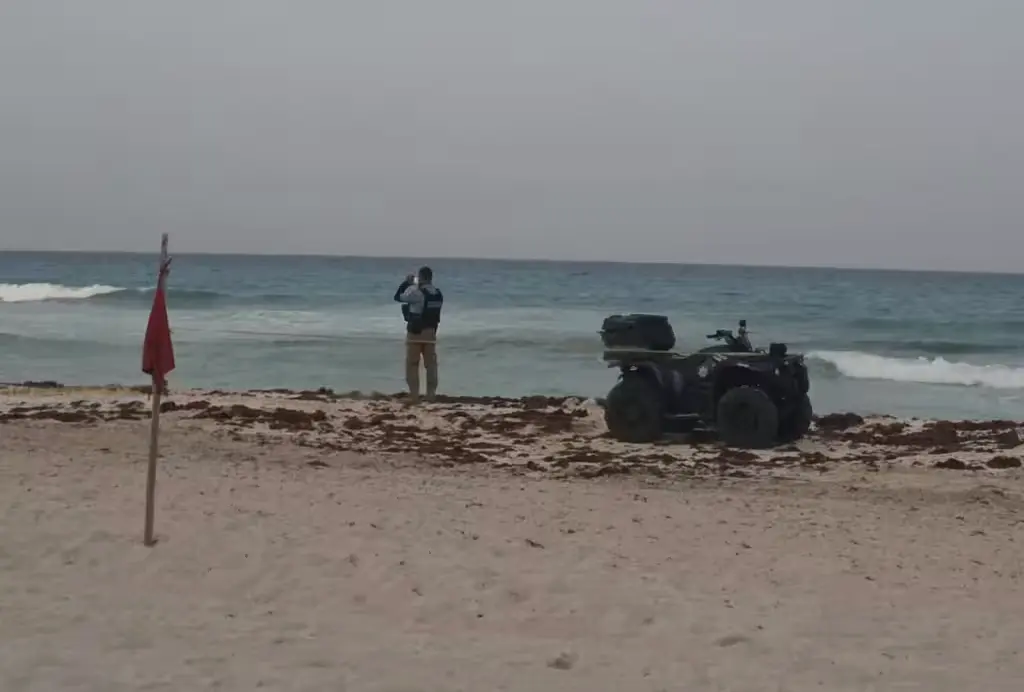
CANCÚN, Quintana Roo — A British tourist drowned Thursday after he and his two children were reportedly swept away by strong waves in Cancún’s Hotel Zone, prompting renewed warnings about dangerous surf conditions and questions from the family about the speed of the rescue response.
The incident occurred near the NYX Hotel Cancún, around kilometer 11.5 of Kukulcán Boulevard, in one of the busiest stretches of the Hotel Zone. According to witness accounts, red flags were flying at the time, indicating dangerous sea conditions and a prohibition on entering the water.
The man reportedly entered the ocean with his two children when strong currents pulled the group away from shore. Bystanders raised the alarm as the three struggled to return. The children were rescued alive, but their father remained in the water for several minutes before being located and brought back to the beach.
Emergency personnel performed CPR, but the man was pronounced dead at the scene. His identity had not been publicly released in the first reports.
Family members later criticized the rescue response, saying they asked a lifeguard for help when they saw the man struggling but believed there was a delay before someone entered the water. They said a second rescuer eventually went in to assist. Authorities had not issued a public statement addressing those allegations at the time of reporting.
The area was cordoned off while forensic personnel arrived to remove the body and begin the required legal procedures.
Red Flags Mean Do Not Enter the Water
Cancún’s municipal government uses a beach-flag system to alert swimmers to sea conditions. Under the city’s own public guidance, green indicates safe swimming conditions, yellow means caution because the sea may have currents or moderate risk, and red indicates danger and that entering the water is prohibited. The municipality has previously emphasized that prevention depends on visitors respecting those flags and following lifeguard instructions.
The United Kingdom’s travel advice for Mexico also specifically urges British travelers to follow coastguard and local-authority guidance on whether it is safe to swim.
That warning is especially relevant in Cancún’s Hotel Zone, where open-water conditions can change quickly. Beaches may look inviting from shore while still having strong currents, shorebreak or dangerous wave patterns.
Why Currents Can Become Deadly Quickly
The likely danger in incidents like this is often described broadly as “strong currents,” but many beach rescues involve rip currents.
NOAA defines a rip current as a localized current that flows away from the shoreline toward the open ocean. Rip currents can form at beaches with breaking waves and can pull swimmers away from shore faster than they can swim back directly against the flow.
NOAA advises anyone caught in a rip current not to fight directly toward shore. The safest response is to remain calm, float or tread water if necessary, signal for help and swim parallel to the shoreline until out of the current before angling back toward land.
That advice is easy to say and much harder to follow in panic, especially when children are involved. Strong surf can exhaust swimmers quickly, and attempted rescues by relatives or bystanders can become dangerous when more people enter the water without flotation equipment.
Lifeguard Coverage Under Scrutiny
Cancún officials have previously said municipal lifeguards are stationed at public beaches under municipal control, with a 2026 Holy Week safety announcement citing 45 lifeguards distributed across public beaches and operating from 9 a.m. to 7 p.m., with possible extensions depending on sea conditions and visitor volume.
Hotel-zone beaches, however, include a mix of public access points, concession areas and beachfront hotel zones, which can make the question of lifeguard responsibility more complicated for visitors. Many tourists assume that a hotel beachfront is constantly monitored, but the level of lifeguard coverage can vary by property, beach section and time of day.
The family’s allegation of a delayed response has not been confirmed by authorities. The investigation will need to determine where the lifeguards were positioned, who first received the alert, what rescue equipment was available, how long it took to enter the water and whether red-flag protocols were being enforced at the time.
A Familiar Risk in Cancún
Drownings and near-drownings are a recurring concern along the Mexican Caribbean, particularly when visitors ignore red flags or underestimate rough water.
Cancún authorities have previously carried out public rescue drills based on the scenario of people entering the sea despite red-flag warnings and being pulled away from shore by currents. Those drills involved lifeguards, Civil Protection, firefighters and ZOFEMAT personnel responding with rescue boards and flotation equipment.
The latest death occurred in a highly visible tourist area, making the case particularly sensitive for the destination. Cancún depends heavily on beach tourism, but the same open Caribbean water that draws visitors can become dangerous when winds, waves and currents intensify.
More Crime
- Puerto Morelos Mayor Denies Detention After Federal Search of Rented Home
- Man Sentenced to 108 Years for Raping and Sexually Abusing His Three Stepdaughters
- Isaías ‘N’ Sentenced to 140 Years for Murder of Teen William Hernández in Cancún
- Miss Universe Co-Owner Raúl Rocha Cantú Faces Second Arrest Warrant Over Nearly 3 Billion Pesos in Alleged Money Laundering
- Experts Warn of Cyberattacks on Tourism Sector as AI Advances
More Cancun
- Cancún Looks to Promote Its Cultural Heritage to Tourists
- AI and New Travel Trends to Headline AFEET Trends 2026 Summit in Cancún
- Cancún Businesswomen Organize Charity Walk for Breast Cancer Survivors
- Cancún Seaweed Firm Ensol Caribe Eyes Expansion Into Dominican Republic and Belize
- Cancún Bus Catches Fire on Avenida Tulum, No Injuries Reported