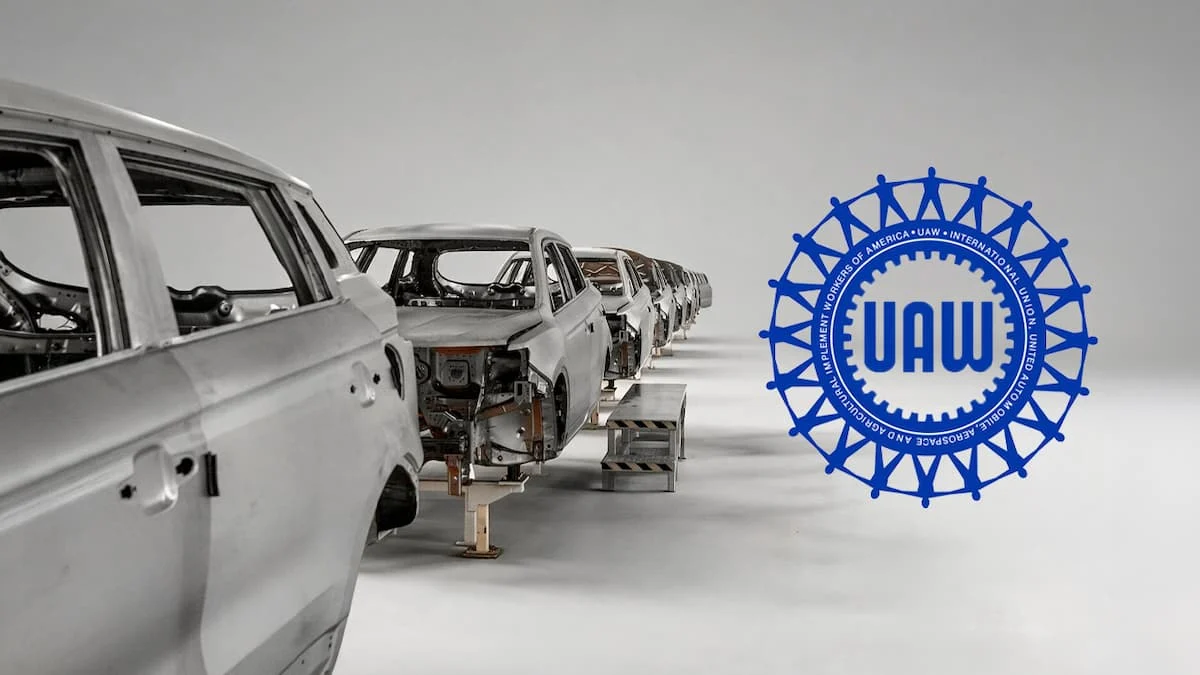
Washington — The United Auto Workers union is seeking to use the review of the U.S.-Mexico-Canada Agreement (USMCA) to rewrite trade rules that have allowed companies to move manufacturing to Mexico, warning that it will not back a new deal without stronger labor and economic commitments.
Jason Wade, the UAW’s deputy chief of staff and special adviser on trade negotiations, said the union wants to gradually align vehicle production with sales across North America so that by 2029 each country builds roughly as many vehicles as it sells.
“If you want to sell in the United States, you have to build here,” Wade said in an interview ahead of the fourth round of U.S.-Mexico trade talks.
The union has submitted a proposal to the Office of the U.S. Trade Representative calling for penalties against companies that move jobs abroad in sectors such as automobiles, heavy trucks, agricultural machinery, and aerospace, according to the Mexican newspaper Milenio.
Wade argued that companies have long used the threat of relocating to Mexico to suppress wage increases in the U.S., costing the country millions of manufacturing jobs.
“We have lost 5 million manufacturing jobs and we are simply fed up with it. We have to redefine the rules, and we are under pressure,” he said.
The UAW’s push comes as the Trump administration continues trade negotiations and keeps tariffs of up to 50% on strategic sectors including autos, steel, and aluminum.
The union also wants to narrow the wage gap between Mexican and American auto workers. Wade said automation has made plants in both countries increasingly similar, yet pay remains vastly different.
“Those days are over. Today, in a U.S. plant and a Mexican or German plant, people do practically the same work. But a German worker earns $40 or $50 an hour, while a worker in San Luis Potosí earns $2 an hour, and that is not fair,” he said.
The UAW is promoting the principle of “same work, same pay,” arguing that higher wages for Mexican workers would boost consumption and expand the country’s middle class.
Wade was a key figure in the union’s negotiations with Ford, General Motors, and Stellantis and played a central role in the 2023 Stand Up Strike, which won wage increases of about 25% over four and a half years.
The UAW also criticized Mexico’s implementation of USMCA labor protections, accusing the government of not devoting enough resources to enforce them. The union has supported complaints filed under the agreement’s Rapid Response Labor Mechanism and filed its own in 2022.
“If all those situations are what they understand as an agreement, then maybe we should not have an agreement,” Wade said.
More Economy
- US Lifts Limits on Flights From AIFA and AICM to US Cities
- HR Ratings Cuts Mexico and Pemex Ratings on Fiscal Deterioration and Debt Pressure
- Quintana Roo Youth Institute Seeks 13 Million Peso Budget Boost for Scholarships
- 35% of Quintana Roo Tourism Businesses Plan Loans to Cover Year-End Costs
- Chetumal Business Chamber Urges Employers to Update Contracts Ahead of New Workweek