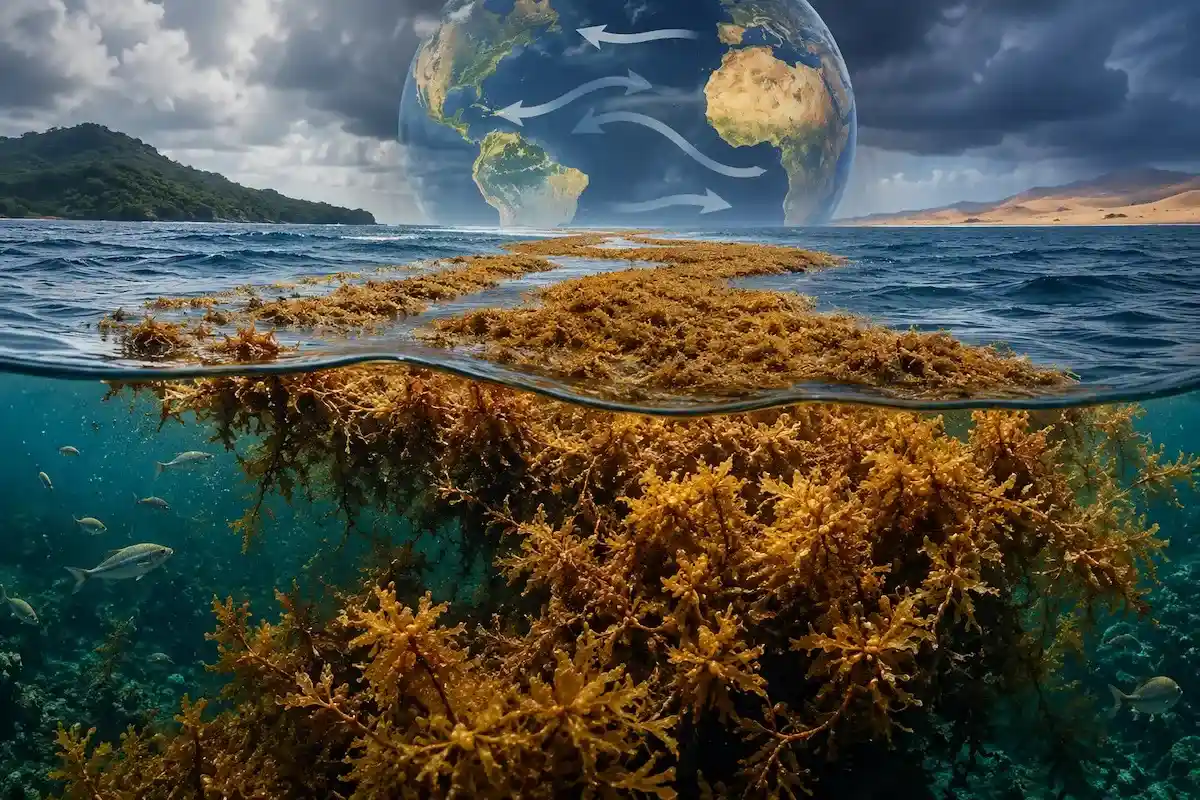
Cancún, Quintana Roo — The rapid growth of sargassum in the Atlantic Ocean poses one of the biggest environmental and economic threats to Caribbean tourist destinations, and experts say effective solutions must start at sea.
Ignacio Muñoz, executive director of The Seas We Love, said that since 2011, various factors have fueled the expansion of this macroalgae, creating a belt roughly 6,000 miles long stretching between Africa and Brazil. From there, millions of tons of sargassum are carried by ocean currents to Caribbean shores.
Muñoz pointed to fertilizers used in agro-industrial activities across Latin America, whose residues end up in the ocean, as a key cause. Rising sea temperatures linked to climate change also contribute to the algae’s growth.
“The problem comes to us from the sea, and it is in the sea where we must begin to find the solution,” Muñoz said, advocating for collection in open waters before the sargassum reaches beaches.
He also stressed the need to strengthen regulations to encourage investment in using this biomass. In August 2025, a decree classified sargassum as a fishery resource, allowing its capture at sea and subsequent commercialization, providing legal certainty for a new productive activity in Mexico.
Muñoz emphasized the importance of creating commercial demand for sargassum, which could stimulate investment in its collection and processing.
Business leaders in Quintana Roo have also voiced concern. Ramón Cárdenas González, president of the Riviera Maya Business Coordinating Council, said the phenomenon should be declared a natural disaster due to its economic impact on tourism.
Cárdenas noted an atypical arrival of sargassum this year, particularly in Playa del Carmen, significantly affecting tourism. He warned that without greater priority, economic consequences could persist and hinder recovery.
Authorities, business leaders, and experts agree on the need for measures to contain sargassum before it reaches the coast while also exploring its potential as a productive resource.
More Environment
- Mexican Army Nears Completion of 16-Kilometer Jungle Road Over Tulum’s Sac Actún Cave System
- Akumal Halts Turtle Swim Tours Through September
- Mexico Assigns $110 Million Navy Budget to Fight Sargassum in Quintana Roo
- Mérida Opens First Green Corridor to Fight Climate Change
- El Niño Keeps Atlantic Hurricane-Free, Setting Record for Latest First Storm in Decades
More Quintana Roo
- Quintana Roo Civil Protection Warns Against Fireworks Ahead of Independence Day
- Quintana Roo to Pilot Child Protection Protocol for Tourism Sector in October
- Sheinbaum Announces 187 Primary Care Clinics and Major Projects in Quintana Roo
- Quintana Roo Records 29,413 Sea Turtle Nests at Season’s Midpoint
- Quintana Roo Reports 1,200 Screwworm Cases as Officials Await Sterile Fly Release