
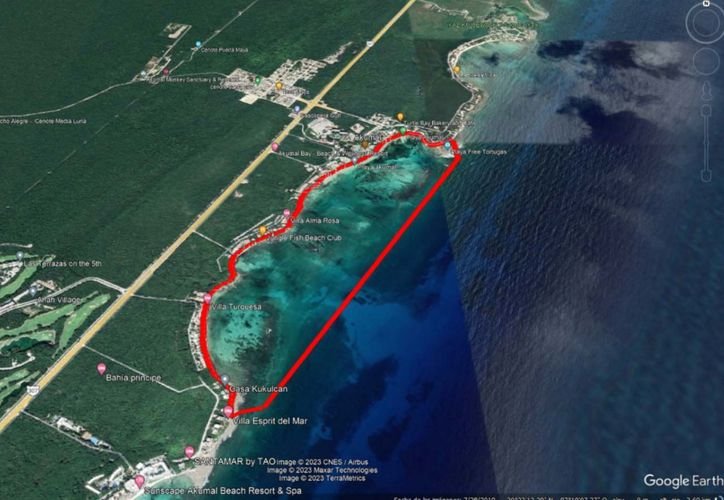
Akumal, Quintana Roo — Mexico’s Environment and Natural Resources Secretariat (Semarnat) has authorized a comprehensive project to restore the eroded beach strip at Hotel Secrets Akumal, on Akumal Bay in the Riviera Maya.
The resolution, issued by the agency’s General Directorate of Environmental Impact and Risk (DGIRA), calls for the construction and installation of two artificial, energy-dissipating reefs in the adjacent marine zone.
The northern module will cover 300 square meters and the southern module 650 square meters, for a combined 950 square meters designed to reduce the force of direct wave action hitting the coastline.
Sand to Be Moved From Nearby Accumulation Zones
Federal environmental officials also approved the controlled relocation of sediment from natural accumulation areas next to the site to the eroded stretch of beach, aimed at physically restoring the shoreline.
The approach rules out importing outside material or drawing on distant sand banks, ensuring that the bay’s native sediment balance and physicochemical composition are not altered.
The project carries an estimated investment of 27 million pesos. Construction is scheduled to last three years, followed by a 30-year operation and monitoring period.
Throughout that time, the tourism developer must submit semiannual progress reports so officials can track how the structures perform and how the coastline gradually recovers.
Seagrass Transplant Program
Alongside the physical works, the plan includes an active biological restoration program focused on rescuing and transplanting seagrass meadows (Thalassia testudinum).
Those efforts will be carried out in coordination with the National Commission of Protected Natural Areas (Conanp) to protect the habitat of marine species that feed and shelter local wildlife.
Because the development sits inside the Mexican Caribbean Biosphere Reserve, the authorization imposes strict seasonal conditions. Heavy machinery is banned outright on the beach and in the marine zone from April to October, shielding the months of peak nesting and hatching activity for the sea turtles that reach the bay.
The resort is seeking to hold back the retreat of its shoreline through soft-engineering and low-impact ecological restoration. Compliance with each measure will be monitored continuously to prevent collateral damage to natural reefs and to the biodiversity of the coastal ecosystem.
More Environment
- Chetumal Plans 836 Million Pesos in Stormwater Works to Curb Flooding
- Ten Rural Communities in Quintana Roo Form Community Conservation Territories
- Study Finds Cancún’s Laguna Manatí Mangrove Could Qualify for Carbon Credits
- Quintana Roo Signs Deal for First Formal Sargassum Fishery, Involving Up to 840 Boats
- Cancún Fumigates Cemeteries to Curb Dengue Ahead of Day of the Dead
