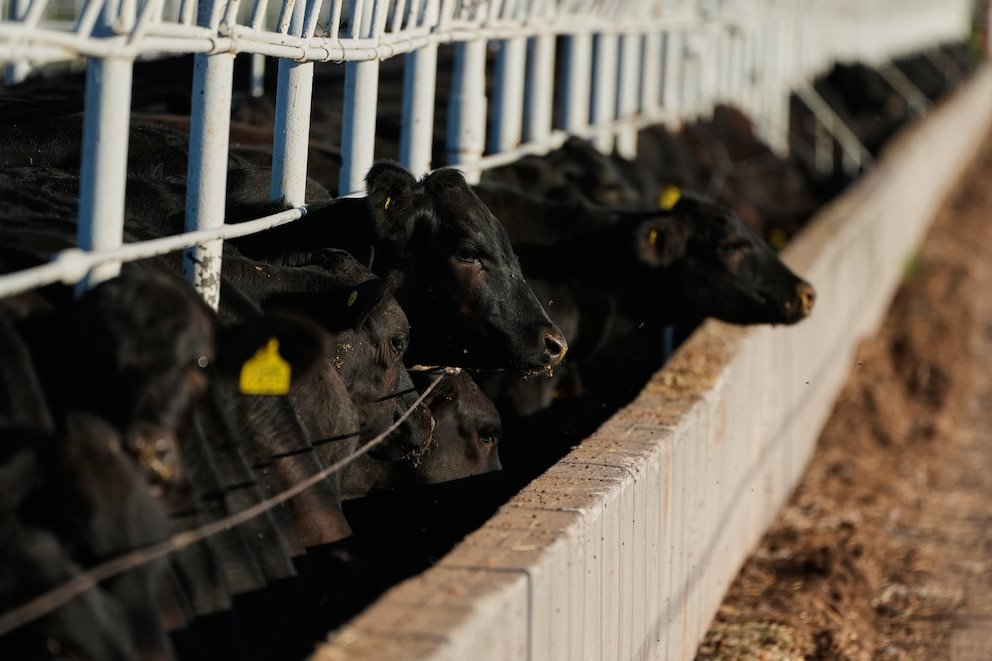
Douglas, Arizona — The United States reopened its border to Mexican cattle on Aug. 24, ending a 14-month suspension imposed over New World screwworm and restoring livestock exports from Sonora and Chihuahua.
The reopening at the Douglas and Agua Prieta crossings requires inspections from the point of origin to the final review on U.S. soil. All animals will be checked for signs of the parasite before entering the United States.
The border closure had been in place since the screwworm outbreak spread across Mexico. Senasica, Mexico’s animal health agency, reported 38,820 screwworm cases since November 2024 as of Aug. 18, with 1,963 still active. The outbreak has reached 30 of Mexico’s 32 states, leaving only Baja California and Baja California Sur without cases.
Sonora Gov. Alfonso Durazo confirmed the resumption of exports during a call with President Claudia Sheinbaum. Announcing the news from the Agua Prieta quarantine station, Durazo said the state had resumed shipments with strengthened sanitary capacity. He added that with federal support, the inspection facilities in Agua Prieta had doubled in capacity to handle a process covering everything from the animals’ origin to their delivery to U.S. authorities.
U.S. Ambassador to Mexico Ronald Johnson credited the reopening to joint efforts by both governments. In a message on Aug. 24, he said the decision was made under the leadership of President Donald Trump and Sheinbaum and described it as a step to protect animal health and benefit producers and consumers in both countries.
Reopening follows first Sonora case
The decision came after Sonora confirmed its first screwworm case last week in a bovine from the municipality of Álamos, about 10 miles (17 kilometers) from Chihuahua. With that detection, only Baja California and Baja California Sur remained free of the pest.
Following the detection, authorities and livestock organizations established a 12-mile (20-kilometer) sanitary cordon, released 36,000 sterile flies, and ordered preventive treatments for adult cattle and calves.
Agriculture Secretary Columba López Gutiérrez said Mexico will maintain traceability “from birth until we place the cattle on the other side.” She said the government would also step up dispersal of sterile flies in Chihuahua and Sonora.
Mexico has already dispersed 40.4 million sterile flies in Chihuahua, with operations running from July 26 to Aug. 21 across 14 municipalities.
Roque Caza, field operations director for U.S. Customs and Border Protection, said on social media that imports had resumed at the Douglas port after a one-year suspension over the screwworm threat. He said the agency verified that shipments met all import requirements.
Cattle account for most active cases
Senasica reported 876 active cases in cattle and 726 in dogs, making livestock one of the species hardest hit as border trade resumes.
The reopening initially benefits Sonora and Chihuahua, considered lower-risk states. All animals crossing into the United States will be inspected to rule out signs of the pest.
Juan Ochoa Valenzuela, president of the Regional Livestock Union of Sonora, thanked authorities for resuming the crossing and said producers would maintain the necessary measures to preserve the region’s sanitary status. The Douglas crossing is expected to be the first step before other border points are added.
More Business
- Starbucks Exits Tulum: Why the Hotel Zone Is Losing Its Buzz
- Canada Drives Mexican Caribbean Demand for Final Quarter of 2026
- Funeral Services in Cancún Can Top 100,000 Pesos, Workers Say
- Riviera Maya Forum Pushes Caribbean Mexico Toward Regenerative Tourism
- Xcaret Says It Will Abide by Any Supreme Court Ruling on Use of Maya Culture