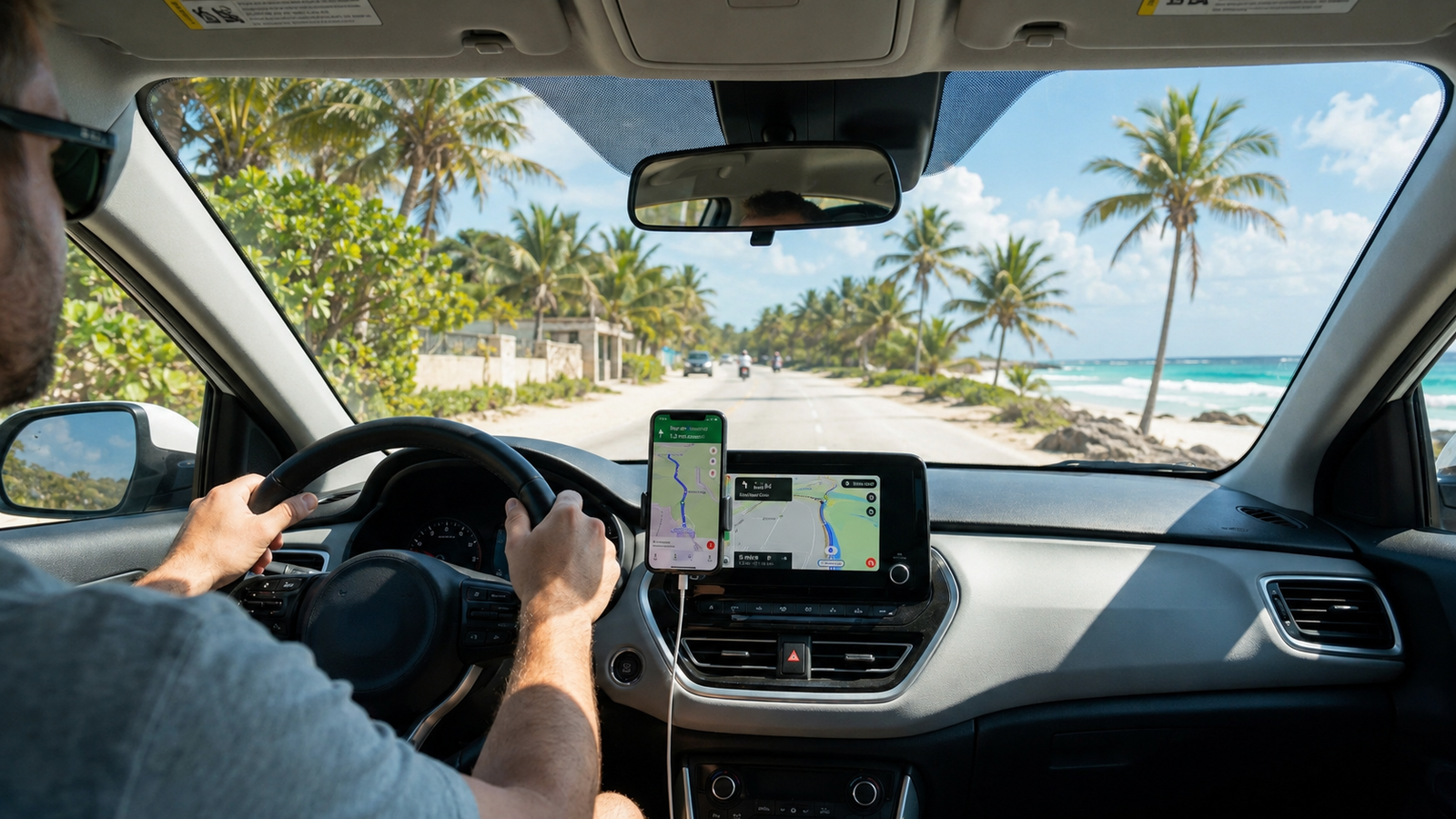
TULUM, Quintana Roo — Ride-hailing drivers in Tulum say they are facing a new wave of enforcement actions by state mobility authorities, including vehicle seizures and heavy fines, as Quintana Roo continues to struggle with one of the Mexican Caribbean’s most persistent tourism problems: how to regulate app-based transportation in a region long dominated by powerful taxi unions.
The complaints center on drivers who say they have tried to comply with state requirements by obtaining a B3 license, the license category Quintana Roo uses for private passenger transport contracted through digital platforms. IMOVEQROO, the state mobility institute, lists the B3 license as one of the required documents for drivers seeking to operate through authorized digital platforms, along with proof of registration on an authorized platform, vehicle ownership or legal possession documents, insurance coverage, proof of address, vehicle registration and a vehicle inspection record.
Drivers argue that the problem is not simply the existence of regulation. It is the difficulty of navigating a system where multiple requirements, platform authorizations, annual permits and local enforcement practices can leave operators unsure whether they are legally protected or exposed to fines.
Under Quintana Roo’s Mobility Law, private passenger transport contracted through digital platforms must be arranged through companies authorized by IMOVEQROO. The law also states that platform operators and drivers are subject to specific permits, registrations and vehicle requirements, including insurance and vehicle-age limits.
That framework reflects the state’s attempt to regulate a service that courts had already recognized as different from traditional taxi service. Uber announced in 2023 that a federal amparo confirmed the platform could operate in Quintana Roo without a public taxi concession, arguing that the service is private and mediated through technology.
The result has been a legal middle ground: ride-hailing is not simply banned, but neither is it completely free from state regulation. For drivers, that distinction matters. A person may have a B3 license and insurance, but still face enforcement if officials determine that the vehicle, platform registration, permit or documentation does not meet the current requirements.
The financial risk is substantial. IMOVEQROO has previously stated that failure to maintain required insurance can be treated as a serious violation under the Mobility Law, with sanctions ranging from 151 to 700 UMAs. In 2024, the agency calculated that range at roughly 16,394 pesos to 75,999 pesos, depending on the applicable UMA value at the time.
The larger concern in Tulum is that enforcement is playing out in a transportation market already shaped by years of tension between traditional taxi unions and digital platforms.
The dominant local taxi organization is the Sindicato de Taxistas “Tiburones del Caribe”. Like other taxi unions across Quintana Roo, it has long argued that app-based drivers compete unfairly because taxi operators face concession costs, union obligations and a more traditional regulatory structure. Critics, including many residents and visitors, counter that the lack of transparent pricing and limited alternatives have helped create the very demand that ride-hailing platforms now serve.
That tension has repeatedly spilled into public view. In January 2023, after Uber’s legal victory in Quintana Roo, the U.S. Embassy issued a security alert noting that disputes between app-based services and taxi unions in the state had sometimes turned violent and had resulted in injuries to U.S. citizens in some cases.
The problem did not end there. In December 2024, the Associated Press reported that three taxi drivers were arrested in Puerto Morelos after allegedly threatening a tourist who tried to use a ride-hailing app. The AP also noted that taxi drivers in Caribbean resorts had for years harassed or attacked ride-hailing users and drivers, and that high taxi fares had long been a point of debate in Cancún.
Tulum has had its own flashpoints. In August 2024, Eliazar Sagrero Ordóñez, then secretary general of the Tiburones del Caribe taxi union, was arrested in connection with an investigation into qualified homicide and attempted homicide involving four victims, according to local reporting. Authorities said the arrest was carried out under a court order, and the case generated strong reaction within the taxi sector.
In early 2025, Quintana Roo lawmakers moved to strengthen the legal response to transportation-related violence. State officials said reforms to the Penal Code and Mobility Law would allow damages and injury cases connected to transport services to be investigated de oficio, meaning prosecutors could act without waiting for a formal complaint from the victim. The reform was presented as a way to prevent impunity in conflicts involving public and private transportation services.
The same reform package was also reported to include changes allowing stronger penalties for attacks on transportation routes, technology and services, and measures tied to license or concession consequences in cases involving violence.
For app-based drivers in Tulum, however, the current concern is that enforcement appears to be focused more heavily on independent operators than on the broader mobility problems visitors and residents complain about: intimidation, lack of fare transparency, high prices, limited late-night options and the difficulty of moving between the airport, hotel zone, town center, archaeological zone and beaches.
The issue now overlaps with Tulum’s larger tourism recovery challenge. Federal officials visited the destination this month under the Tulum Renace strategy, which includes lower access fees at Parque del Jaguar and the archaeological zone, beach access improvements, tourism promotion and a new public transportation system for the town. In her July 17 press conference in Tulum, President Claudia Sheinbaum’s administration specifically described transportation as part of the effort to improve both daily life and the visitor experience.
That context is important. Tulum is no longer a small beach town with a limited local taxi market. It now has an international airport, Maya Train connections, a hotel zone with expensive and often congested access, and thousands of visitors who expect predictable transportation options. When those options are confusing, expensive or perceived as unsafe, the damage goes beyond drivers and taxi unions. It affects the destination’s reputation.
Opposition lawmakers have also raised broader concerns about Tulum’s tourism decline, insecurity and allegations of extortion, calling for federal intervention by President Sheinbaum and Security Secretary Omar García Harfuch. Those complaints include, but are not limited to, transportation problems.
What remains unclear is how many app-based drivers have been fined in the latest Tulum operations, how many vehicles have been seized and whether those cases involve missing permits, platform authorization problems, insurance issues, vehicle documentation or other alleged violations. IMOVEQROO has not publicly released a detailed breakdown of the recent Tulum complaints.
For now, the safest conclusion is that Tulum’s ride-hailing dispute is not a simple question of legal versus illegal service. It is a regulatory conflict layered over a long-running economic battle for control of passenger transportation in one of Mexico’s most valuable tourism markets.
Drivers say they need a clear and attainable path to comply with the law. Taxi unions say they want fair competition under comparable rules. Visitors want safe, transparent and reasonably priced transportation. And Tulum, already working to repair its image, needs a mobility system that feels modern, reliable and trustworthy.
Until those pieces line up, transportation will remain one of the weak points in Tulum’s recovery.
More Business
More Tulum
- Tulum’s Mureco Museum Adds 53 Archaeological Pieces From Across Mesoamerica
- 23 Tulum Police Officers Complete Initial Training Course
- Tulum-Miami Flights to End as American Airlines Adjusts Routes
- Uber Opens Driver Registration in Playa del Carmen and Tulum for Taxi and Motorcycle Services
- Playa del Carmen Officials and Transport Firms Meet After Fatal Tulum Crash