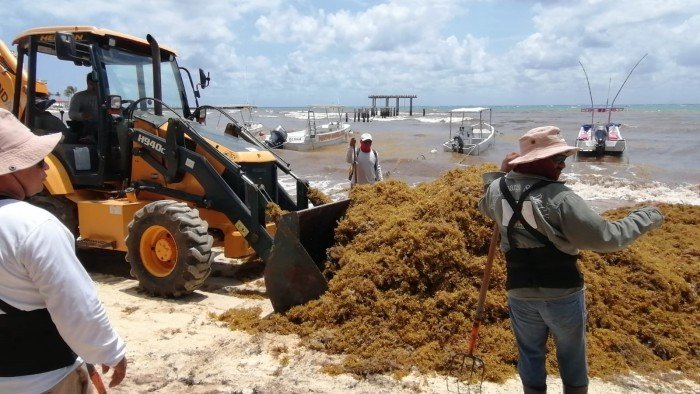
Cancún, Quintana Roo — The heavy arrival of sargassum on Quintana Roo’s coast is killing marine life in two distinct ways, in some cases reaching coral reefs, according to the official who oversees the Mexican Caribbean’s protected waters.
José Juan Domínguez Calderón, director of the Mexican Caribbean Biosphere Reserve, said the first type of die-off involves the fish and mollusks that travel inside the floating algae. When sargassum reaches the shore and begins to decompose, that ecosystem collapses and the animals die.
“In the sea, sargassum is an ecosystem; it’s like a floating jungle,” Domínguez Calderón said, noting that the pufferfish is a common species carried in the mats of algae and later found dead on beaches.
The second type of die-off is more troubling, he said. It involves organisms that live along the coast, above or beneath the sand, which suffocate when sargassum washes ashore and strips oxygen from the water. Many of these creatures rise to the surface in search of oxygen, only to die once outside their element.
“We’ve seen this in Mahahual two years in a row. We sent the samples to Ecosur,” he said, referring to El Colegio de la Frontera Sur, a regional research institute. “In Tulum as well.”
Coral at Risk Near Shore
The most serious damage is to coral, Domínguez Calderón said, because reefs that sit close to the coast are reached by contaminated brown water and can be killed by oxygen deprivation. That has been the case in Puerto Morelos and at some points in Sian Ka’an, he said.
Researchers are currently studying currents and the behavior of sargassum, mainly in the northern part of the state, he added. Carrying out that work requires only that the biosphere reserve be notified.
Collecting sargassum at sea requires a permit from Conapesca, Mexico’s fisheries agency, because the algae is classified as a fishing resource. Once it reaches the coast and becomes waste, no permit is needed to collect it.
More Environment
- Judge Halts Trump Border Barrier in Big Bend National Park
- US Coast Guard Seizes Cargo Ship Accused of Smuggling Fuel to Cuba
- Playa del Carmen to Renew Eight Blue Flag Beach Certifications, Eyes Two More
- Cancún Sets October Dates for Free Dog and Cat Sterilization Clinics
- Experts Highlight Social Memory as Key to Disaster Prevention in Quintana Roo
More Quintana Roo
- Quintana Roo Remains Far from Electronic Voting, INE Official Says
- Quintana Roo to Launch World’s First Formal Sargassum Fishery With 840 Fishermen
- INE Opens 2026-2027 Federal Electoral Process in Quintana Roo, Vows to Tackle Voter Apathy
- Quintana Roo High School System Aims to Install Cameras at All 44 Campuses
- Biometric CURP in Quintana Roo: Where to Apply, What to Bring and Whether It’s Mandatory