
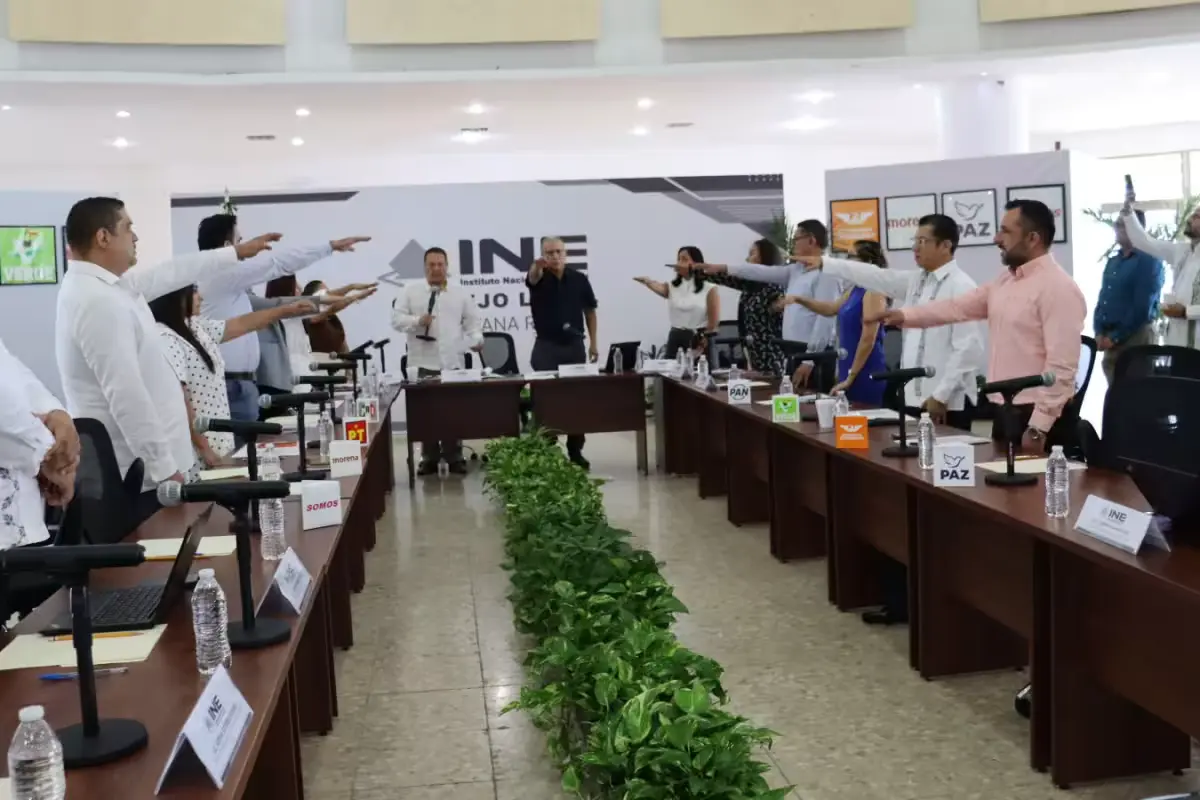
Cancún, Quintana Roo — Concerned about repeating the high abstention rates that marked the 2025 elections, the National Electoral Institute (INE) formally opened the 2026-2027 federal electoral process in Quintana Roo during the ordinary installation session of its state Local Council.
Sergio Ruiz Castellot, executive board member of the INE’s local office in Quintana Roo, said candidate spending will be audited, though the institute’s General Council will decide whether money already spent during internal party processes counts as campaign spending.
Voters in the state will choose 165 elected posts next year: the governorship, 15 plurality deputies, 10 proportional representation deputies, 11 municipal presidencies, 11 trusteeships and 117 council seats.
Low turnout is “the enemy to defeat,” Ruiz Castellot said, adding that the institute must persuade residents both to vote on June 6, 2027, and to serve as polling station officials.
He noted that the precampaign period does not begin until March 2027, but said the INE can already receive complaints about candidacies, precandidacies and “premature” campaign activity. Officials have so far received “four or five” such complaints, which have been forwarded to the relevant INE bodies.
Ruiz Castellot declined to comment on those who have been accused of early campaigning, saying they are not yet candidates and that the electoral calendar has not reached the stage for discussing candidacies.
The state’s nominal voter list currently includes 1,568,626 citizens, while the electoral roll stands at 1,588,805 people. The INE expects to install 2,624 polling stations, with a final figure to be set once the voter list closes and station officials are confirmed.
More than 204,000 people selected in the first drawing will be visited at home and invited to staff polling station boards. They will be assisted by 113 electoral supervisors and 672 trainers and electoral assistants working across the state.
Asked about the internal process of the ruling Morena party, Ruiz Castellot acknowledged that the electoral law has gaps regarding parties’ internal procedures, which fall to the Electoral Tribunal to judge.
“If the INE receives a complaint, it will be forwarded to the Electoral Tribunal once all the information has been compiled so that it can determine whether or not the law was violated,” he said.
He stressed that the institute can only build case files and send them to the corresponding Electoral Tribunal chamber in cases involving precandidacies or anticipated campaign acts.
Key dates for the 2027 election
According to the official calendar, precampaigns will run from Jan. 4 to Feb. 12, 2027; candidate registration from March 22 to April 3; and electoral campaigns from April 4 to June 2. Election day is June 6.
Electoral documents and materials will be delivered to polling station presidents one week before the vote. After voting ends, the ballot packages will return to district councils, where the official counts begin the Wednesday after election day. A quick count and the Preliminary Electoral Results Program (PREP) will provide early information to the public during the day.
More Politics
- Mexico Edging Closer to New US Trade Deals, Ebrard Says
- Senate Gives Defense and Navy Vote on Reviewing Foreign Investment in Mexico
- López Obrador Reappears With Video Message as Sheinbaum Marks Two Years
- Quintana Roo Congress Approves Single-Nationality Rule for Top Elected Offices
- Mexico’s Senate Approves ‘Anti-Meme’ Law With Five-Year Prison Terms
More Quintana Roo
- Quintana Roo High School System Aims to Install Cameras at All 44 Campuses
- Biometric CURP in Quintana Roo: Where to Apply, What to Bring and Whether It’s Mandatory
- Maya Council and Xcaret Push Supreme Court to Drop Indigenous Symbols Case
- Cancún Hosts 45 Nations at EU-Caribbean Summit on Sargassum
- Sargassum in Quintana Roo Sets Record With 138,000 Tons Collected in 2026