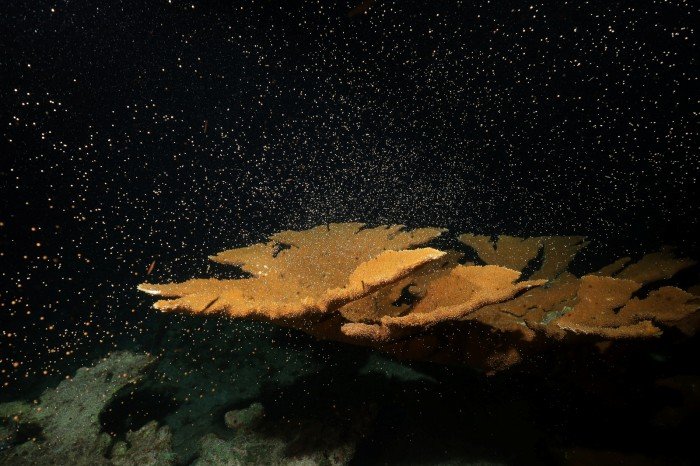
Xcaret, Mexico — Conservation specialists from Grupo Xcaret collected gametes from staghorn coral (Acropora palmata) during a spawning event on the night of September 3, marking the start of an assisted fertilization process aimed at restoring Mexican Caribbean reefs.
The spawning took place within the natural reproductive window for this species, which typically begins five to eight days after the August full moon. Divers and snorkelers from Grupo Xcaret’s conservation team collected the gametes released by the corals.
The biological material was then transferred to Grupo Xcaret’s coral laboratory, where assisted fertilization began. From that point, the process can extend for several years as the developing organisms are monitored and prepared before eventually being reintroduced to the reef.
Sexual reproduction as a restoration strategy
Rodolfo Raigoza, Grupo Xcaret’s conservation director, said sexual reproduction enables the incorporation of genetic diversity into restoration efforts, which is crucial for strengthening coral populations as environmental conditions shift. “These are medium- and long-term efforts, but the results confirm that this is a viable route for reef restoration,” he said.
The Acropora palmata conservation program began in 2011 and currently includes two marine nurseries that hold 396 coral fragments from different genotypes.
Through this work, the organization has reintroduced over 30 coral colonies to the reef using sexual reproduction, alongside institutions such as the Mexican Institute for Research in Sustainable Fisheries and Aquaculture (IMIPAS), the National Autonomous University of Mexico (UNAM) and SECORE International.
Corals under warming seas
The reproduction of this species carries added significance amid rising marine temperatures. In 2023, parts of the Caribbean experienced water temperatures up to 32 degrees Celsius (about 90 degrees Fahrenheit) for several days, placing considerable stress on coral ecosystems.
Corals produced through sexual reproduction and later reintroduced to the reef have shown resistance to high-temperature stress, according to the group. The observations offer data that can help refine restoration strategies in the coming years.
Beyond hosting biodiversity, coral reefs provide shelter and feeding grounds for many marine species and help dampen the impact of storms on coastlines. Deterioration of reefs therefore also affects the communities and economic sectors that depend on the sea.
A certified conservation program
Grupo Xcaret’s Acropora palmata conservation program is certified by the Latin American Association of Zoos and Aquariums (ALPZA), which evaluates efforts on conservation, research, welfare, education and sustainability.
For the specialists involved, each spawning season represents another chance to obtain genetically diverse corals, expand knowledge about the species and build populations that one day return to the reef.
More Environment
- Cozumel Coral Restoration Program Cares for 1,500 Fragments at Chankanaab
- Puerto Morelos launches weekly sargassum watch until 2026
- Quintana Roo Seeks Geographic Indication to Protect Melipona Honey
- Dengue Cases in Quintana Roo Jump 152 Percent
- Quintana Roo Hoteliers Push Regenerative Tourism Amid Beach Access Disputes