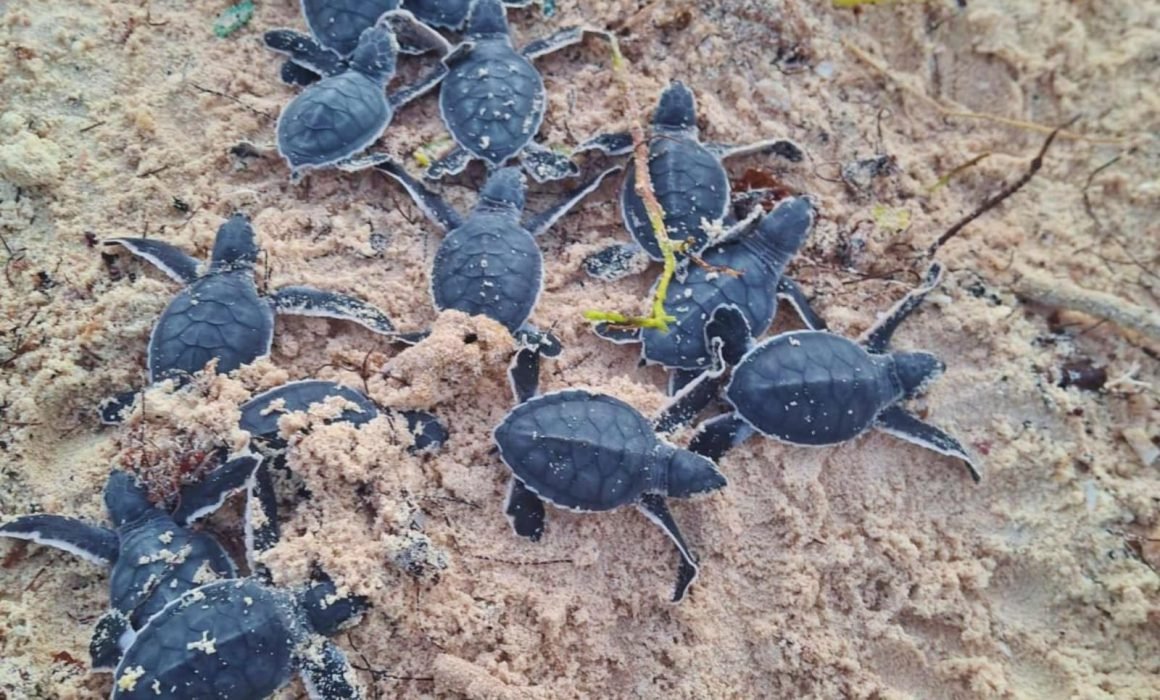
Akumal, Quintana Roo — The 2026 sea turtle nesting season is underway in Akumal, and early numbers suggest a strong start for one of the Riviera Maya’s most important coastal conservation areas.
During May, monitoring teams recorded 53 protected nests along Akumal’s beaches, according to the Centro Ecológico Akumal (CEA). Of those, 46 belong to loggerhead turtles (Caretta caretta) and seven to green turtles (Chelonia mydas).
The numbers are considered encouraging for the opening month of the season, which typically runs from May through October along much of the Riviera Maya coast. Akumal, whose name is commonly translated as “Place of the Turtle,” has long been one of the best-known nesting areas in Quintana Roo, drawing both conservation attention and tourism interest.
Héctor Lizárraga Cubedo, director of CEA, said the early results reflect coordinated work by biologists, specialized staff, and volunteer brigades who patrol the beaches, identify new nests, mark protected zones, and reduce risks from predators and human activity.
The nesting activity was concentrated in several key areas. Loggerhead nests were most numerous at Playa Tortuga and Bahía Akumal, with 17 nests each. Akumal Sur recorded eight loggerhead nests, while Bahía Media Luna reported four.
Green turtle nesting was lower but still significant. Four green turtle nests were recorded in Bahía Akumal, two in Playa Tortuga, and one in Akumal Sur. No green turtle nests were reported at Bahía Media Luna during May.
The distinction between the two species matters. Loggerhead turtles are known for their large heads and powerful jaws, which help them feed on hard-shelled prey such as crabs, conchs, and other marine invertebrates. Green turtles, by contrast, are largely herbivorous as adults and play an important role in maintaining healthy seagrass beds.
Both species are protected under Mexican law. PROFEPA notes that all sea turtles that reproduce in Mexico are listed under NOM-059-SEMARNAT-2010 in the “P” category, meaning endangered, and the extraction, possession, or commercialization of sea turtle products, parts, or derivatives is prohibited.
Akumal’s nesting beaches are especially important because they sit in one of the most visited coastal corridors in Mexico. Hotels, homes, restaurants, beach clubs, tours, artificial lighting, sargassum, erosion, and foot traffic all create pressure on nesting females and hatchlings.
Research on loggerhead nesting in Akumal has shown the area has supported long-term nesting activity for decades, with the highest activity typically occurring in the early summer months. That makes May’s count an important early indicator, but not the full picture. Monitoring is expected to intensify as more females arrive in June, July, and August.
Lizárraga Cubedo said the first weeks of data help conservation teams evaluate reproductive patterns and plan protection efforts across the beaches. Nighttime surveillance remains critical, as nesting females usually come ashore after dark to dig nests and deposit eggs above the high-tide line.
Environmental organizations and authorities are reminding residents, visitors, and businesses to follow basic rules during nesting season:
Respect marked nesting areas.
Do not use flashlights, phone lights, or camera flashes on the beach at night.
Keep a safe distance from turtles and never block their path.
Turn off or shield beachfront lights that face the sand.
Do not touch turtles, eggs, or hatchlings.
Keep dogs away from nesting zones.
The first protected nests of the season are a hopeful sign, but success will depend on what happens over the next several months. Each nest represents a long chain of risk, from the moment the female comes ashore to the night the hatchlings make their way to the sea.
For Akumal, protecting turtles is not just a conservation issue. It is part of the community’s identity, the local tourism economy, and the responsibility that comes with sharing the coastline with species that were here long before the Riviera Maya became a destination.
More Environment
- Cancún to Host Climate Change Colloquium With Experts From Mexico, Guatemala and New York
- Tulum Records Over 6,000 Sea Turtle Nests as Beach Furniture Threatens Hatchlings
- Lab Coral Restoration Urgent as Caribbean Reefs Decline, Expert Warns
- Quintana Roo Bolsters Sargassum Strategy With Satellite Monitoring and Research
- Stationary Front to Bring Rain Across Yucatán on Tuesday