
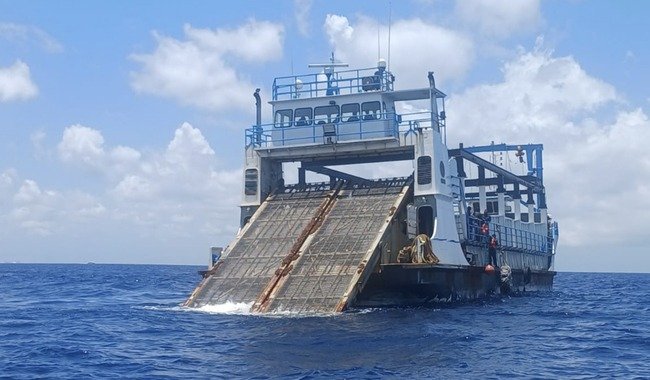
Chetumal, Quintana Roo — At what may become one of the most difficult sargassum seasons in recent years, several of the Mexican Navy’s specialized seaweed collection vessels are out of service for maintenance, just as new waves of macroalgae are expected along the Quintana Roo coast.
Rear Admiral Javier Mendoza Rosales of the XI Naval Zone confirmed that the vessels are currently at the Chetumal repair facilities undergoing preventive and corrective maintenance. The units could remain out of operation for up to a month, leaving containment efforts at sea dependent on other available resources.
The timing is difficult. The Navy has already reported the collection of more than 63,000 tons of sargassum along Quintana Roo’s coast so far this year, and officials say additional arrivals are expected in the coming weeks. Oceanographic monitoring has also pointed to large volumes of macroalgae moving across the Caribbean, with the Great Atlantic Sargassum Belt continuing to create serious pressure for coastal communities from West Africa to the Gulf of Mexico.
The vessels now in maintenance include shallow-water Aquamarina-type sargassum boats, which are especially useful close to shore, where seaweed can quickly overwhelm barriers, beaches, and cleanup crews. These boats are designed to operate in areas where larger vessels cannot work as easily, making them an important part of the response when sargassum gets near the coastline.
The Navy’s full sargassum response has included one transoceanic vessel, one coastal sargassum vessel, 22 smaller boats, and the shallow-water Aquamarina-type vessels. While those specialized shallow-water units are in the shop, the larger vessel and smaller support boats remain active. Officials say they are also studying new strategies to strengthen open-water interception before the seaweed reaches the containment barriers installed off the state’s beaches.
Those barriers remain one of the main lines of defense. More than 9,000 meters of anti-sargassum barriers have been installed in several coastal municipalities, including Benito Juárez, Puerto Morelos, Playa del Carmen, Tulum, and Mahahual. The system was put in place through coordination between the Navy, state and municipal authorities, hotels, and other coastal stakeholders before the heaviest part of the season.
Still, the barriers are not a complete solution. In heavy years, sargassum can overrun containment systems, reach the beach, pile up along the shoreline, affect swimming and fishing, create foul odors as it decomposes, and increase cleanup costs for hotels, beach clubs, restaurants, and municipal crews.
This season has already shown how uneven the impact can be. Mahahual has faced some of the most persistent landings, with the Navy maintaining two brigades of 25 personnel each for ongoing beach cleaning and collection. Playa del Carmen and Tulum have also reported heavy concentrations, while other areas, including Puerto Morelos, rely on a combination of barriers, cleanup crews, and local geography to reduce the impact.
In Puerto Morelos, the reef running parallel to shore can help break up and intercept some sargassum mats before they reach the sand. But even there, natural protection is not enough during intense seasons. In more exposed areas, the challenge can be greater and the recovery slower.
That is why the loss of nearshore collection capacity matters across the state. Barriers help. Manual cleanup helps. Offshore monitoring helps. But nearshore removal is a key part of keeping large mats from reaching beaches in the first place. Once sargassum lands, cleanup becomes slower, more expensive, and more disruptive.
For Quintana Roo, the next few weeks will be important. Authorities have active vessels, barriers, beach crews, and monitoring systems in place, but they are temporarily without some of the specialized shallow-water tools normally used to fight sargassum close to shore.
The larger issue is clear. Sargassum is no longer an occasional nuisance. It is a recurring environmental, economic, and tourism challenge for the Mexican Caribbean. The maintenance of the Navy’s vessels may be routine and necessary, but in a season this intense, the timing could not be worse.
More Environment
- Cancún Orders Removal of Grounded Boats From Nichupté Lagoon
- Profepa Shuts Down Work Damaging Coastal Dune in Yucatán
- Yacht Grounded on Mahahual Reef Caused No Coral Damage, Conservationists Say
- Playa del Carmen Awaits Federal Approval to Return 20,000 Tons of Sand Recovered from Sargassum
- Playa del Carmen Councilor Questions Semarnat’s Indigenous Consultation Requirements
More Quintana Roo
- Cancún Mayor Ana Paty Peralta Says She Will Finish Her Term and Skip ‘Gino’ Segura’s Campaign
- Tren Maya Finds Reshape Understanding of the Maya ‘Collapse’
- Quintana Roo Enacts ‘Ley Nicole’ Banning Cosmetic Surgery on Minors
- Drought Crisis Forces Quintana Roo Wildlife to Seek Water Near Roads and Towns
- Quintana Roo to Add 10,000 Hotel Rooms by 2028
