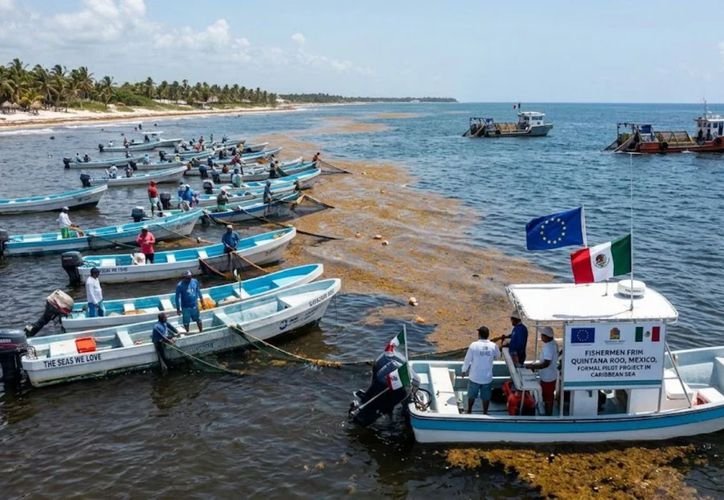
Cancún, Quintana Roo — Officials signed an agreement on Wednesday to launch Quintana Roo’s first formal sargassum fishery, a plan that could bring as many as 840 boats from the state’s fishing cooperatives into the effort to contain the seaweed.
The deal was signed at the start of the European Union–Caribbean Global Gateway Conference on Sargassum, held in Cancún, following a preparatory event titled Building Technical Partnerships for the Sustainable Management of Sargassum.
Ignacio Muñoz, director of The Seas We Love, said the initiative brings fishermen and cooperatives into sargassum containment in an organized way, including many who had been unable to take part until now. The goal is to validate an engineering pilot that has already been tested, with funding from the European Union, and put it into practice in the coming months.
Under the plan, small boats would operate from Xcalak to Puerto Morelos across more than 1,500 square kilometers of territorial sea, organized into seven collection nodes to gather the algae in the water before it reaches shore.
A Complement, Not a Replacement
The model does not replace work by the federal or state government but complements it with a different, traceable volume of seaweed, according to the project’s backers. They say the activity could generate income for communities hit hard by sargassum, which have limited capacity to recover and are affected by increasingly long bans on other fisheries such as shrimp and lobster.
Manuel Jesús Puerto Mocoroa, head of the regional center of the Mexican Institute for Research in Sustainable Fisheries and Aquaculture (Imipas) in Puerto Morelos, said his agency is working with The Seas We Love because its proposal involves fishermen along the coastline rather than large companies.
“When lobster season ends, the cooperatives will be able to fish sargassum as an alternative economy every year,” he said.
The plan aims to have fishermen treat sargassum as a commercial catch and report earnings from it. Puerto Mocoroa called the issuance of permits to harvest the seaweed viable, since the fishermen themselves would own the resource.
He said it is still too early to set a price for sargassum, arguing that officials must first organize the activity, test the fishing gear, measure how much biomass can actually be extracted, and assess processing capacity and operating costs.
More Environment
- Maya Frog and Toad Shell Pendants May Reveal Ancient Trade Routes
- Heavy Rains to Soak Quintana Roo as Unstable Weather Moves In
- Brain-Eating Amoeba Found in Six Artificial Lakes in Mérida; Water Contact Restricted
- Semarnat Approves Artificial Reefs and Sand Relocation for Akumal Hotel
- Chetumal Plans 836 Million Pesos in Stormwater Works to Curb Flooding
More Puerto Morelos
- Puerto Morelos Plans Boat Procession, Altars and Contests for Mar de Almas
- Mexico’s Environment Agency Rejects Four Major Tourism Projects in Quintana Roo
- Semarnat Denies Environmental Permit for GL Dreams Subdivision in Puerto Morelos
- Quintana Roo Environment Agency Accepts Federal Ruling in Alux 33 Case
- Puerto Morelos to Expand Sargassum Barrier and Restore Six Kilometers of Beach