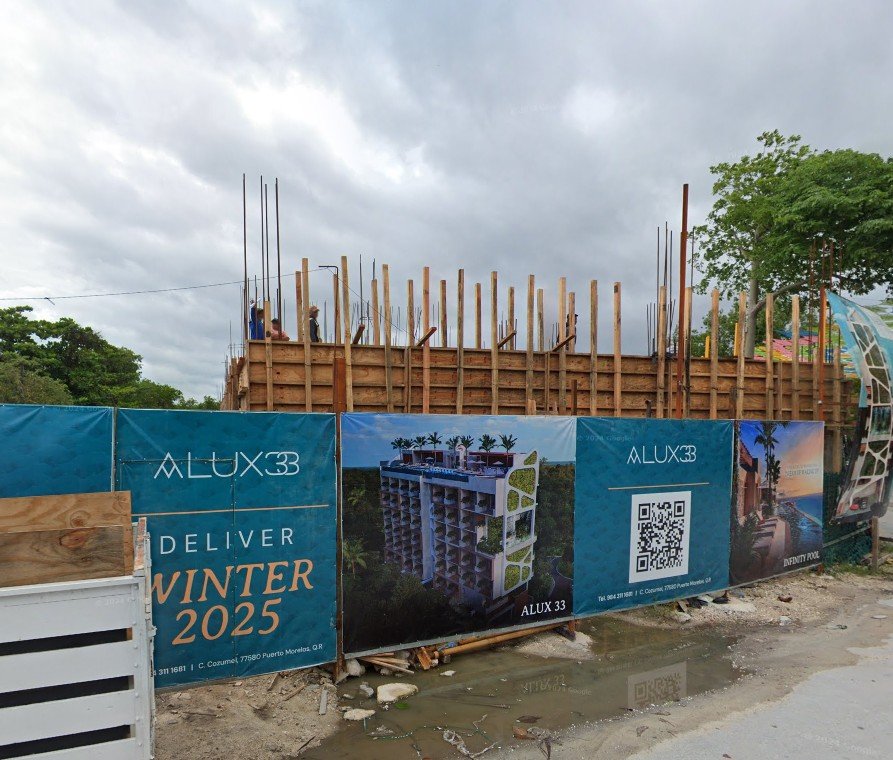
Puerto Morelos, Quintana Roo — The Quintana Roo Environment and Ecology Department (SEMA) says it has complied with a federal court ruling that stripped it of jurisdiction over the Alux 33 development in Puerto Morelos and voided the environmental authorization it had granted for the project.
The case returned to public attention in recent days after environmental groups disclosed the court decision suspending construction of the building, prompting questions about how SEMA had handled the file. The agency then released its own account of the events.
The dispute centered on which level of government had the authority to carry out the environmental review. SEMA argued that the characteristics of the site and the technical information available at the time placed the procedure under state jurisdiction. The judiciary later adopted a different standard, finding that because the project interacts with a coastal ecosystem, the review belonged to the federal government. That ruling became final and the state agency complied.
“As far as the rulings reviewed show, the decision did not establish acts of corruption, bribes, influence peddling or undue benefits attributable to SEMA officials. Its purpose was to resolve a dispute over environmental jurisdiction,” the agency said in a statement.
The disagreement stems from the division of powers set out in law. The federal government reviews developments that affect coastal ecosystems, while states can handle those that fall outside those criteria. In the Alux 33 case, the question was whether the site’s environmental conditions and its interaction with its surroundings put it under state or federal authority.
SEMA said it based its initial position on official INEGI mapping, historical records for the land, urban development instruments, existing infrastructure and conditions observed in the area. According to the file, the state authority considered the site to sit inside an urbanized area and concluded that the available evidence allowed it to treat the project as a matter of local jurisdiction.
New information was added and further analyses of the site’s environmental conditions were carried out as the administrative process advanced. Technical criteria were updated along the way, producing different assessments at different stages and ultimately a legal dispute over which authority should decide.
The Ninth District Court resolved that dispute. On Aug. 25, 2026, it ruled that Alux 33 interacts with a coastal ecosystem and that jurisdiction therefore lay with the federal government. It ordered the state authorization voided and directed SEMA to declare itself without competence to continue the procedure.
“The sentence later became final and SEMA complied with what the court ordered. The scope of the ruling is relevant to understanding the case. A court finding that an authority lacked jurisdiction to decide a procedure is not legally equivalent to establishing that it acted under a corruption scheme,” SEMA said.
Another point of contention has been the regularization procedure used after the developer began work without first obtaining an environmental authorization. The file itself acknowledges that construction started before the permit was issued. It also notes that Quintana Roo law provides a mechanism to evaluate works begun without authorization, identify the impacts caused and set mitigation, rehabilitation and compensation measures, regardless of any sanctions that may apply.
Alux 33 now has a concrete legal definition. There were differing views on the site’s environmental characteristics and on which authority was empowered to review it. The dispute went to a federal judge, who ruled in favor of federal jurisdiction. SEMA complied with the ruling and voided its authorization.
More Courts
- Cancún Raid Uncovers Arsenal of Rifles, Handguns and 1,000 Rounds at Suspected Safe House
- Power Outage in Chetumal Forces Closure of Quintana Roo Labor Courts
- Five Men Sentenced To Up To 50 Years For Killings In Cancún And Felipe Carrillo Puerto
- Mexico’s Senate Votes 96-0 to Curb Telemarketing Harassment With New Do-Not-Call Registry
- Mexico’s Senate Unanimously Approves Tourism Law Reform to Combat Child Sexual Exploitation
More Puerto Morelos
- Puerto Morelos to Expand Sargassum Barrier and Restore Six Kilometers of Beach
- Puerto Morelos Launches Biometric CURP Registration Drive
- Volvo EX30 Fire Snarls Traffic at Puerto Morelos Highway Entrance
- Federal Court Voids State Permit for Coastal Condo Project in Quintana Roo
- El 19, 3 Others Arrested in Puerto Morelos Extortion Case