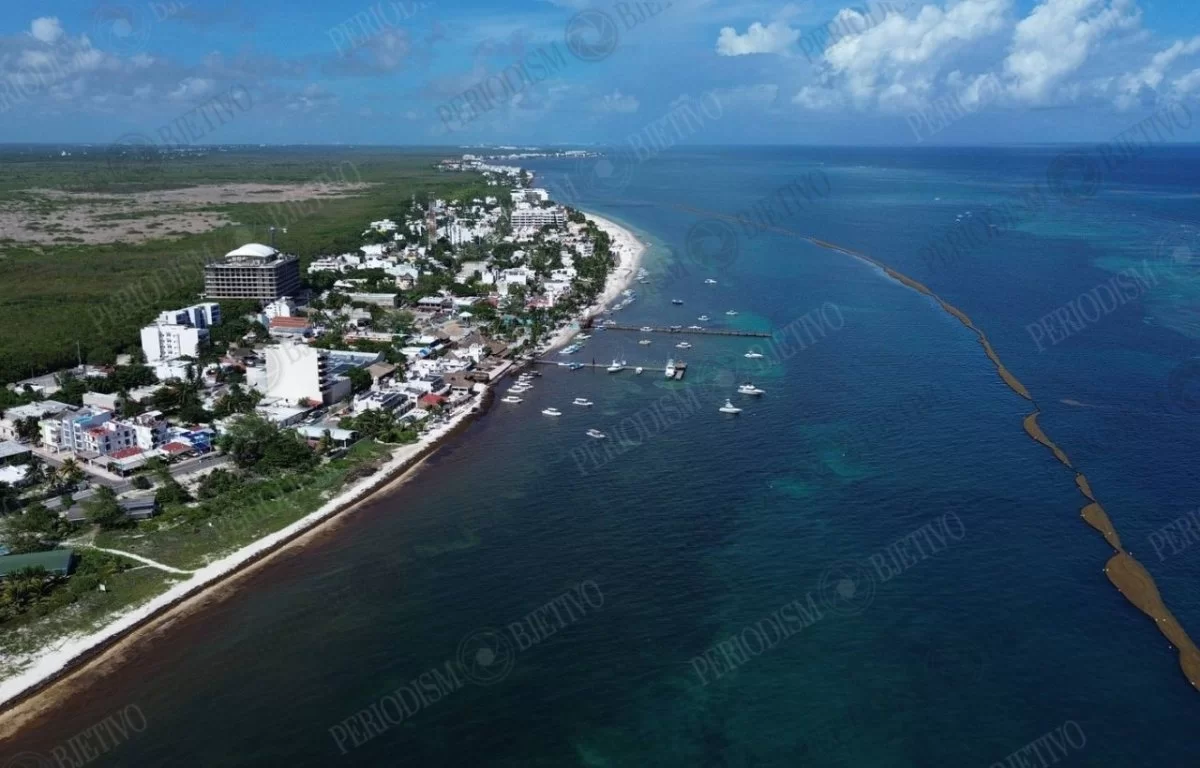
Puerto Morelos, Quintana Roo — Puerto Morelos is preparing to extend its sargassum barrier and study how to restore more than six kilometers of shoreline, two projects that could affect the beaches residents and visitors use most. The barrier extension is moving toward installation; the beach restoration remains in the planning stage.
Mayor Blanca Merari Tziu Muñoz said the municipality’s Environmental Sanitation Trust has authorized the purchase of anchors for another 1.5 kilometers of anti-sargassum barrier, to be installed with support from the Mexican Navy. She wants barrier coverage to reach 10 kilometers of the municipality’s roughly 18-kilometer coast over time, taking into account systems already operated by hotels.
The new section would add to existing protection. In March, the municipality inspected 2.2 kilometers of barrier between the fiscal pier and The Fives hotel. That stretch fronts public beach areas around town, including Ventana al Mar and Ojo de Agua. Officials have not announced the exact position or installation date for the additional 1.5 kilometers, so it is too early to say which other beaches it would protect.
Barriers are meant to intercept floating seaweed before it washes ashore, where it can pile up and decay. They still require collection crews: NOAA guidance on sargassum barriers says trapped algae must be removed frequently. Puerto Morelos already relies on that combined approach. The municipality reported removing more than 4,000 tons of sargassum from January through May 2026, using municipal crews and equipment alongside Navy vessels and personnel. The figure shows the scale of the work; it does not predict conditions on any particular beach day.
A Longer-Term Plan for the Sand
Separately, Tziu Muñoz said officials are studying the restoration of just over six kilometers of beach, from the entrance to Puerto Morelos to a point beyond the El Cid hotel. Sand replenishment and dredging are among the possibilities, but the method has not been selected.
The trust’s 2026 operating plan was amended to include barrier anchoring and the first stage of a beach-recovery project. That approval funds planning work; it is not a timetable for dredging or a guarantee that construction will follow. The studies are to be paid for with revenue from the Environmental Sanitation Fee.
How the work is designed matters in Puerto Morelos, where the shoreline borders a protected reef system. The mayor said specialists and the National Commission of Protected Natural Areas, or Conanp, will be involved in assessing possible effects on the reef, mangroves and coastal dunes. Conanp describes the reef and dunes as natural defenses that help reduce wave energy and coastal erosion.
For now, visitors should expect ongoing beach cleaning rather than an immediate transformation of the shoreline. The next milestones are a location and installation schedule for the new barrier section, followed by the technical findings that will determine whether and how the proposed beach restoration can proceed.
More Environment
- Tulum Ranks Second as Mexico Claims Six Spots on Best Beaches List
- University of the Caribbean Unveils Crocodile Coexistence Manual in Cancún
- Quintana Roo Braces for Record Sargassum Season as 2027 Forecast Tops 86 Million Tons
- Playa del Carmen Residents Blast Six-Year Illegal Dump
- Cozumel to Host 18th Island Bird Festival Oct. 7-11
More Puerto Morelos
- Puerto Morelos Launches Biometric CURP Registration Drive
- Volvo EX30 Fire Snarls Traffic at Puerto Morelos Highway Entrance
- Federal Court Voids State Permit for Coastal Condo Project in Quintana Roo
- El 19, 3 Others Arrested in Puerto Morelos Extortion Case
- Park Hyatt to Open in Riviera Maya on December 3 With 148 Rooms