Cancun, Quintana Roo — Authorities in Quintana Roo said they will maintain and reinforce their sargassum containment strategy over the coming months, even as the volume of seaweed washing ashore begins to ease.
Esteban Amaro, director of the Sargassum Monitoring Network, said the state is at the peak of the annual phenomenon, but satellite data shows floating biomass is starting to decline. He predicted the arrival of sargassum would taper off gradually through September and October.
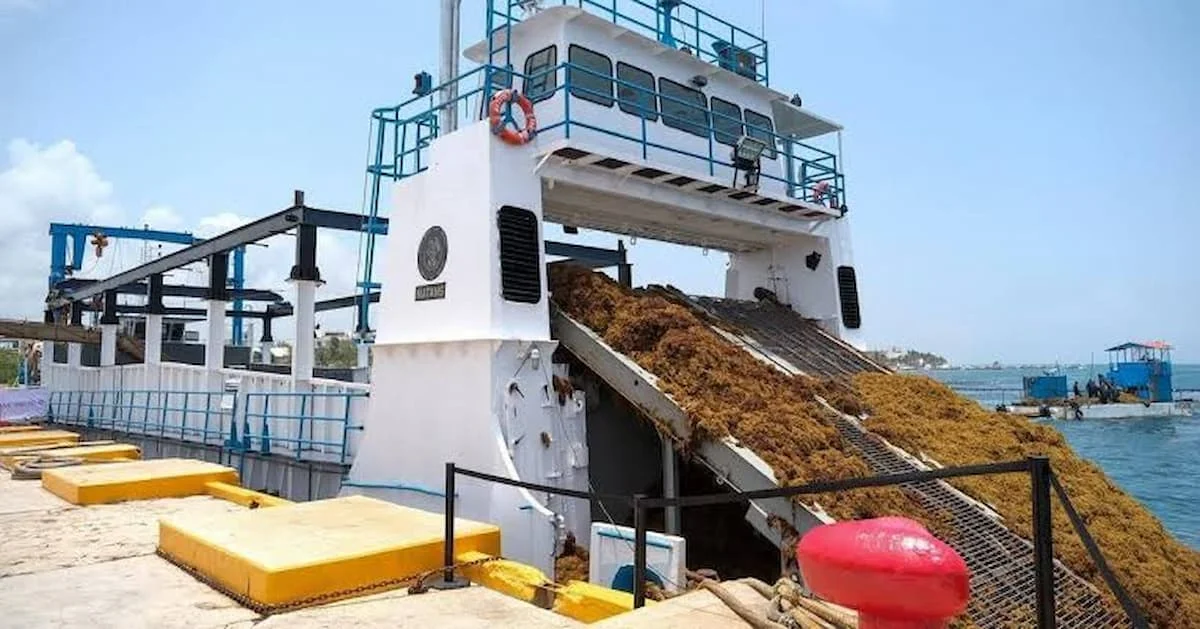
As part of the response, Amaro announced that a new large-capacity ocean vessel will soon be added to collect sargassum offshore, joining the containment barriers and boats already operating in the region.
He added that the rainy season and cyclones should help disperse the macroalgae and naturally clean beaches, after an extended drought that had made sanitation work more difficult.
The hardest-hit areas remain Tulum, Cozumel’s eastern coastline and parts of Playa del Carmen, Amaro said, driven by the path of ocean currents. In contrast, Cancun and Puerto Morelos are in better condition thanks to ongoing cleanup brigades and containment barriers.
Amaro stressed that the problem is not unique to Mexico, with roughly 30 Caribbean countries and territories experiencing one of the most intense sargassum seasons on record, including the Dominican Republic, Cuba, Jamaica, Barbados and the Bahamas.
Cancun will host an international meeting on Oct. 1-2 organized by the European Union alongside Mexico, Barbados, the Dominican Republic and Martinique to exchange experiences and strengthen regional cooperation on the issue.
He also highlighted that Quintana Roo has become a benchmark in sargassum monitoring, using artificial intelligence, satellite imagery, cameras connected to the C5 security center and new European Space Agency satellites to anticipate the macroalgae’s movements and improve operational response.
“We’re already starting to see a slight decrease, and that’s good news because in a month or two we’ll have much less sargassum,” Amaro said.
He said the next challenge is to consolidate circular economy projects that use sargassum as raw material and to begin preparing the strategy for the 2027 season this year.
More Environment
- Texas’ Big Bend Becomes Border Wall Battleground
- Contemporary Maya Sculpture Installed in Sacalaca Cenote to Draw Community Tourism
- Mexico to Review Private Events Held Inside Tulum National Park
- Cancún Sargassum Arrivals Ease in September, but Officials Watch the Winds
- Mexico Holds Second National Earthquake Drill; Alerts to Sound at Noon
More Quintana Roo
- Quintana Roo Tightens Rules for Scuba Divers Arriving With Specialized Gear
- Rafael Martínez Ruiz Named New Head of Mexico’s Migration Institute in Quintana Roo
- Quintana Roo Regulates Rental Golf Carts With New Inspection Rules
- Mexico Drill Saturday Will Sound Alerts on 80 Million Phones
- Cancun Hotels Look to 2027 for Rate and Occupancy Rebound