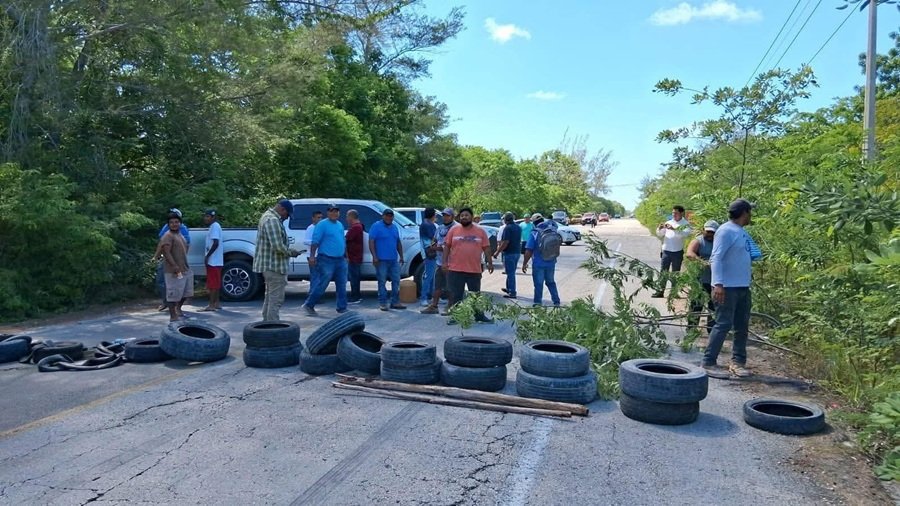
Chetumal, Quintana Roo — Quintana Roo recorded the highest number of highway and bridge blockades in Mexico last year, according to data from the National Institute of Statistics and Geography (INEGI), placing it ahead of all other states in the country.
The 2025 National Census of Federal and State Public Security, released by INEGI, shows that the state accounted for 21.9 percent of all such blockades nationwide, with 490 incidents in 2024. Oaxaca followed with 13.6 percent, and Hidalgo with 10.5 percent.
The report highlights repeated power outages by the Federal Electricity Commission (CFE) as one of the main triggers of protests in Quintana Roo, where residents have frequently taken to the streets to demand a reliable electricity supply.
Among the blockades documented in 2024 were several that drew widespread attention. In January, residents of the Pedro A. Santos ejido in Bacalar stopped trucks linked to the Maya Train construction project, demanding that authorities build a promised livestock crossing.
In February, ejido members, residents of irregular settlements, and service providers blocked roads using heavy machinery and other objects to demand basic services, an end to land seizures, and measures against corruption and the monopolization of cruise ship piers.
In May and July, residents of the El Ideal community blocked the Cancún–Mérida highway, calling for the road to be widened and better maintained. They said the highway has suffered lane reductions and is the site of frequent accidents.
In Cancún, more than 300 people from irregular neighborhoods blocked Avenida López Portillo and a road known as “Gas Auto” to demand street paving and other essential services.
Unlike violent demonstrations seen in other parts of Mexico, the blockades in Quintana Roo were generally peaceful and drew no reports of casualties, according to the census data. Local and federal authorities managed the situations through dialogue.
More Government
- Trump to Fed: Cut Rates or I’ll Halt Trade With Deficit Nations
- Paseo de las Sirenas Becomes a New Isla Mujeres Attraction
- Sheinbaum, Trump Near USMCA Deal but New Demands Emerge
- Mexico Drill Saturday Will Sound Alerts on 80 Million Phones
- Playa del Carmen Opens One-Stop Shop to Streamline Business Permits
More Quintana Roo
- Cancun Hotels Look to 2027 for Rate and Occupancy Rebound
- Beach Weddings Plummet as Sargassum Swamps Quintana Roo
- Quintana Roo Business Group Seeks Public Dashboard for Sargassum Spending
- Cancún Mayor Ana Paty Peralta Says She Will Finish Her Term and Skip ‘Gino’ Segura’s Campaign
- Tren Maya Finds Reshape Understanding of the Maya ‘Collapse’