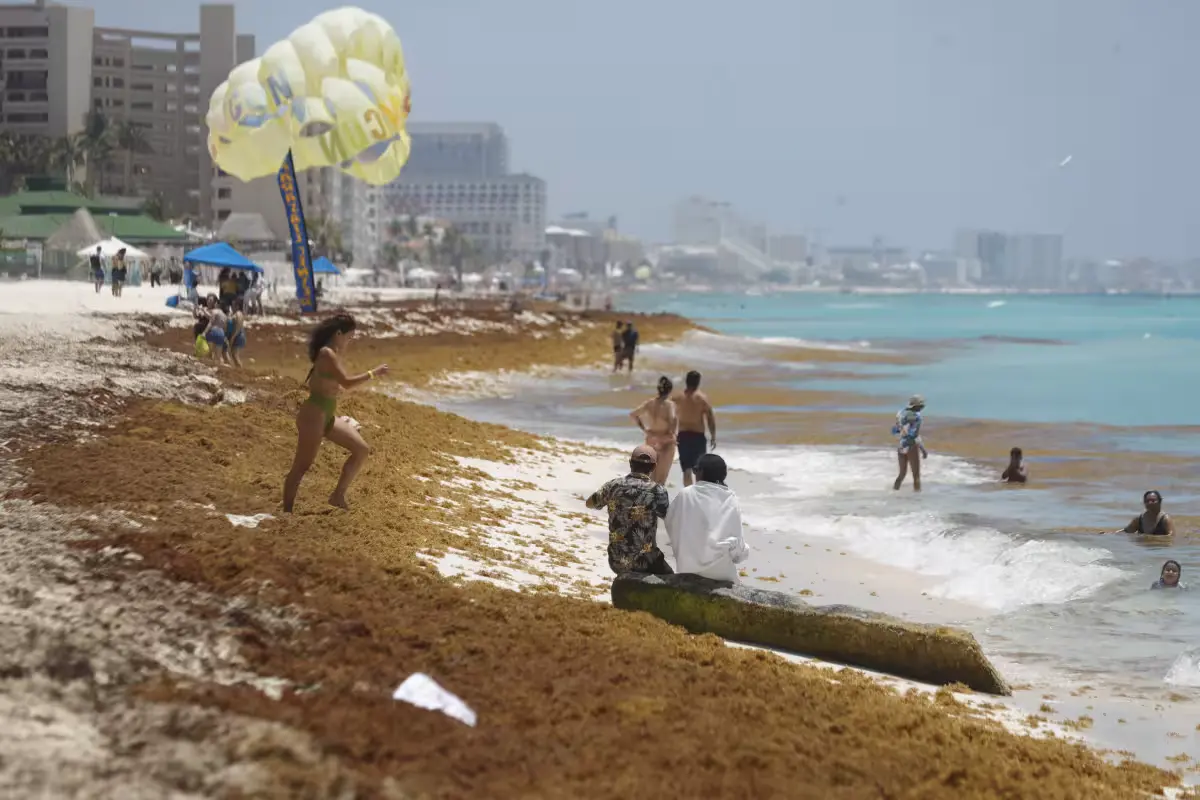
Cancún, Quintana Roo — Quintana Roo is on track to break its record for sargasso seaweed collection this year, with officials reporting that more than 87,000 metric tons have already been removed from its beaches. The state could surpass the 92,500 tons collected in 2025, according to Óscar Rébora Aguilera, head of the state’s Ecology and Environment Department. He warned that the heaviest seaweed landings are expected between August and October.
“During those three months, we will see the greatest arrival of sargasso to the coasts of the Mexican Caribbean, so containment and cleaning efforts will be intensified,” Rébora Aguilera said.
According to the Oceanographic Institute of the Gulf and Caribbean Sea, there are currently 10 sargasso clusters off the Mexican Caribbean, with an estimated biomass of 256 tons located just a few kilometers from the coast, indicating that more seaweed could arrive in the coming hours.
The seaweed has already impacted local tourism. Claudia Olvera, a housekeeper at a hotel in the Riviera Maya, said many tourists avoid entering the water due to the accumulation and foul smell. Alfredo Vázquez, a waiter at a Cancún beach club, noted that when the phenomenon intensifies, the number of customers drops significantly, affecting their income.
Rébora Aguilera explained that sargasso is growing rapidly in the Atlantic, doubling in volume every three days. The amount that reaches the beaches will depend on winds, ocean currents, and tides, so authorities are maintaining constant monitoring using satellite images and tracking systems. He added that the estimate of floating sargasso has decreased from 60 million to about 40 million tons, as part of it has been carried by currents toward the Gulf of Mexico and Florida, while the rest continues moving toward the Caribbean.
The Oceanographic Institute keeps the alert level at red due to the high concentration of the macroalgae, based on images from the University of South Florida used for daily reports.
Rébora Aguilera acknowledged that anti-sargasso barriers face limitations against strong waves, which have damaged some infrastructure in Cancún and Playa del Carmen. He said the state government is working with suppliers to develop more resistant containment systems. Currently, 9,450 meters of barriers are in operation in Puerto Morelos, Playa del Carmen, Tulum, and Mahahual, as part of a project that aims to install 16,030 meters to face the 2026 season.