
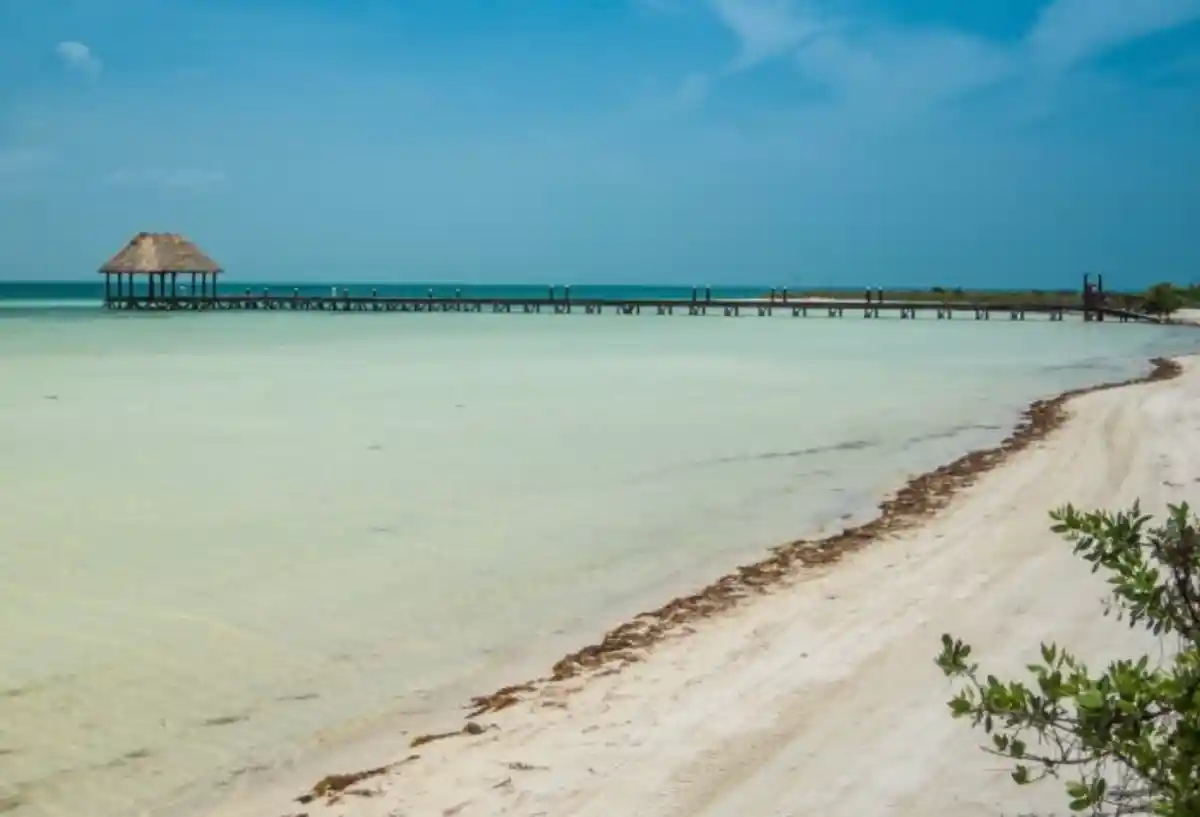
Chetumal, Quintana Roo — Quintana Roo’s environment chief said 2026 has been one of the most intense years on record for sargassum in the Mexican Caribbean, with arrivals three to four times higher than in previous years — but 100 beaches are now free of the seaweed.
Óscar Rébora Aguilera, head of the state Secretariat of Ecology and Environment (Sema), said that with forecasts pointing to another massive landfall in 2027, the federal government is looking at whether to place sargassum on the United Nations agenda at international climate change conferences. The aim is to secure support and financing through a multilateral agreement that would allow the seaweed to be fought at its origin in Africa, reducing the thousands of tons that reach the Quintana Roo coast.
“We are very pleased to announce that we have more than 100 beaches without sargassum — that is great news, and we have not stopped working,” Rébora said. “At the United Nations climate change conference of the parties, which begins November 9 in Turkey, one of the points is to put the sargassum issue on the international agenda. It is a phenomenon that affects every country in the Caribbean and has to be addressed through a multilateral, international agreement so that it is fought at its origin in Africa and far less of it reaches us. I think that is the great challenge for the federal government.”
Of the more than 2.2 billion pesos announced for the fight against the algae, the first 700 million pesos have been allocated to buy a second vessel twice the size of the Natans, capable of collecting about 700 tons in open water.
“The first 700 million pesos have already been put up for this ship, which is called Sargassum, but you don’t buy a ship today and have it arrive tomorrow — the whole fitting-out process has to happen,” Rébora said. “The ship is already in Mexico, at Salina Cruz in Oaxaca, according to the Navy, and the sargassum-collecting bands are being installed at an investment of 40 million pesos. But we are continuing with the same strategy of containment barriers: another 15 kilometers of barrier are coming, plus more coastal sargassum boats, more amphibious equipment and more personnel to give us greater capacity and equipment.”
He acknowledged that outfitting the vessel is a lengthy process and that no date has yet been set for it to enter service.
So far this year, more than 156,000 tons of the seaweed have been removed from the state’s coastline. The Mexican Navy alone has collected more than 70,640 tons at sea and on beaches, quadrupling its 2025 total.
More Environment
- Playa del Carmen’s Water Pollution Rules Exist but Go Unenforced, Activist Says
- Conapesca Has Issued No New Commercial Fishing Permits in Playa del Carmen for 17 Years
- Environmentalists Denounce Road and Gate Built in Cozumel Mangrove Tied to Royal Caribbean Project
- Mincho, the Dolphin Whose Injury Helped Change Mexican Law, Dies in Cancún
- Quintana Roo Bat Expert Warns of Research Gaps and Cave Damage From Urban Growth
More Quintana Roo
- Quintana Roo Nautical Association Pursues Maritime Alliance With Belize
- Quintana Roo Bets on Diving, Gastronomy and Air Connectivity to Revive Tourism Growth in 2027
- Quintana Roo Women’s Secretariat Reports 60% Rise in Services
- Quintana Roo Cyber Police Take Down 10 Pages and Groups, 286 Profiles Over Online Scams
- Quintana Roo Schools to Ban Cellphones During School Day From November 3
