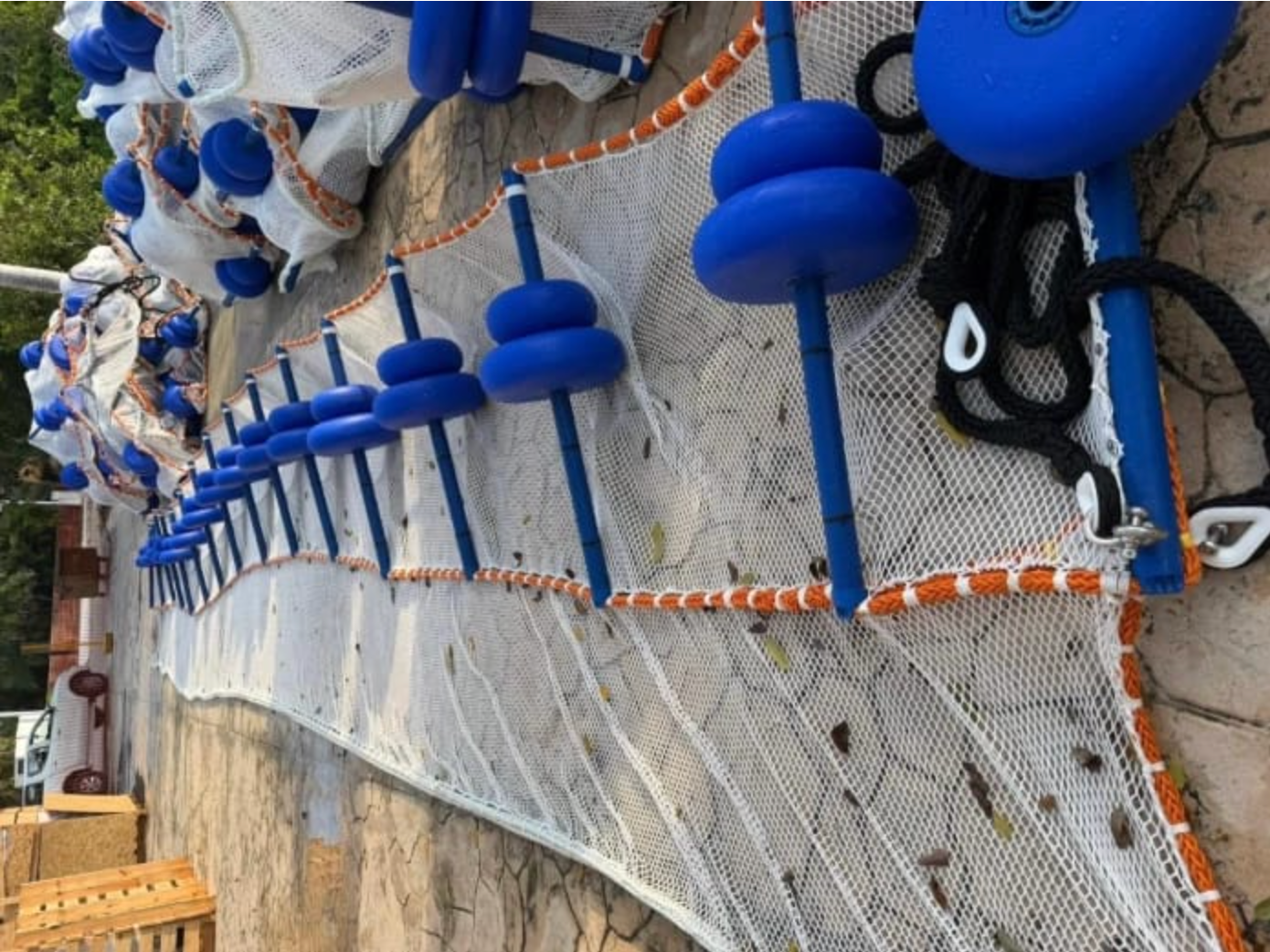
Puerto Aventuras, Quintana Roo — The sargassum barrier intended to protect Puerto Aventuras’ Bahía de Fátima is finally in the community after months of manufacturing and shipping. It has yet to be deployed: rough seas have held up the work needed to secure it in place.
The Puerto Aventuras Association of Colonos says its sargassum committee met with the supplier on October 9 to inspect the delivered equipment and plan the next stage. Specialized divers are expected to carry out anchoring work while crews wait for conditions that will allow them to place the floating barrier at sea. The association has not announced a date for completing installation or putting the system into operation.
The equipment was manufactured in Bulgaria by Okeanis and entered Mexico through the port of Progreso, Yucatán, before reaching Puerto Aventuras in early October. The association identifies Okeanis–Inmar Caribe as responsible for manufacturing, supplying, installing and maintaining the barrier.
Its arrival ends one part of a long wait. Property owners approved the community-funded project at an extraordinary assembly in February. The manufacturer reported that the barrier was ready for collection in June, but shipping and import procedures pushed back its delivery. Now the schedule depends on the sea: crews need suitable conditions to position the barrier and complete the anchoring work.
Property Owners Fund the Barrier and Its Upkeep
The project is being paid for through the Association of Colonos, rather than a government construction budget. In its July treasury report, the association said it had paid 4,877,637 pesos for the barrier by May, using money raised through an extraordinary sargassum assessment on property owners. The association set a 6.6-million-peso fundraising target for the broader project; that figure should not be confused with the amount paid for the barrier itself.
Keeping it working will bring continuing costs. Members approved a separate monthly fee in March for the barrier’s operation and maintenance. Although installation was still pending, the association began collecting that fee and said it was temporarily putting the money toward beach cleaning and sargassum removal. It said specialized cleaning services would be needed because its own staff could no longer carry out that work directly under union arrangements.
That spending is part of the barrier’s purpose, not an unrelated expense. A deflector is designed to steer floating sargassum away from a protected area or toward a collection point; it does not remove the seaweed by itself. U.S. National Oceanic and Atmospheric Administration guidance explains that sargassum held by barriers must be collected regularly before it decomposes and sinks. The installation will therefore need crews and vessels as well as routine attention to the barrier and its anchors.
The system is designed primarily to reduce sargassum entering Bahía de Fátima, with smaller barriers planned for the Club de Yates and Kantenah coves. It will not shield all of Puerto Aventuras’ shoreline, and the association has yet to publish a final installation map showing precisely which beaches will benefit. The barrier is still awaiting full deployment, so its real coverage and effectiveness remain to be seen.
Navy Support Planned for Collection
The association says it is also working with Mexico’s Navy. After a meeting between association president Alfonso Serrano Gómez and Rear Admiral Topiltzin Tlacaelel Flores Jaramillo, the group announced plans for Navy assistance, including a dedicated sargassum vessel and personnel and equipment for collection at sea and on the beach. It said the Navy would be able to help safeguard the barrier if severe weather required its temporary removal.
Those arrangements have been described by the residents’ association; a separate Navy announcement setting out when its vessel and crews will be deployed was not identified. The Navy’s expected operational support also does not replace the property owners’ funding for the barrier and its upkeep.
For now, the barrier’s arrival is progress, but it has not changed conditions on the beach. The first visible test will come when the equipment is installed and collection operations begin. Its lasting value will be measured by how much sargassum the combined system can keep from accumulating in Bahía de Fátima through future heavy arrivals.
More Environment
- Playa del Carmen to Review Legal Status of Chen Zubul Property
- Quintana Roo Braces for Four Days of Heavy Rain and Flooding
- Sheinbaum Allocates 2 Billion Pesos to Fight Sargassum in Quintana Roo
- Five Ejidos Seek Alliance to Protect Chichankanab Lagoon in José María Morelos
- Maya Frog and Toad Shell Pendants May Reveal Ancient Trade Routes
More Puerto Aventuras
- Playa del Carmen Mayor Responds to Puerto Aventuras Mayor’s Arrest on Extortion Charges
- Puerto Aventuras Mayor Arrested in Alleged Extortion of Merchant
- Playa del Carmen Health Center in Villas del Sol to Close Two Days for Maintenance
- Mara Lezama Delivers 288 Infonavit Homes in Puerto Aventuras as Quintana Roo Targets 76,000
- Playa del Carmen Bars New Developments Without Electrical Investment, Mayor Says