
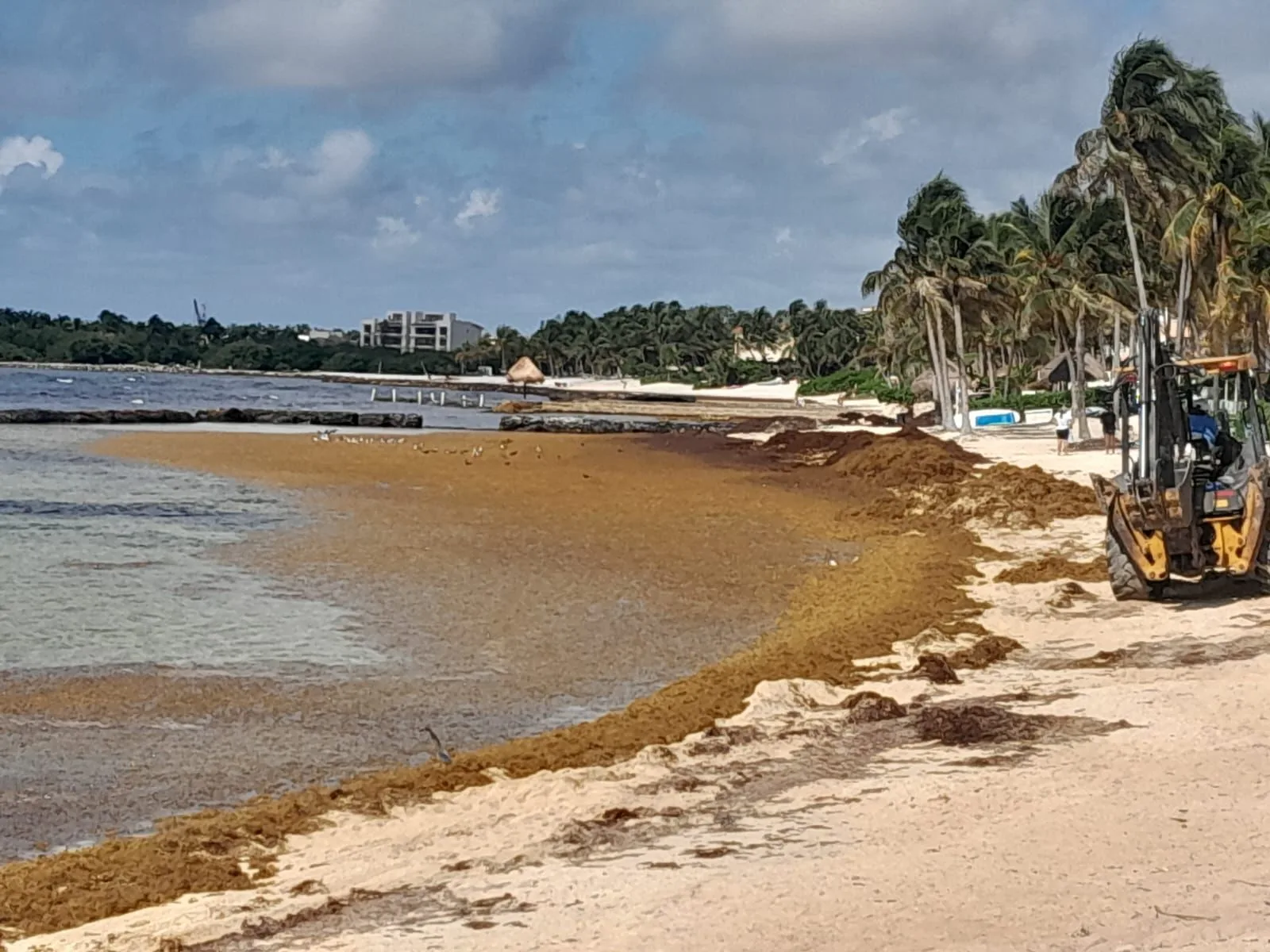
Puerto Aventuras, Quintana Roo — A privately funded sargassum barrier purchased by the Puerto Aventuras Residents Association has been completed, but its arrival in Mexico has been delayed by customs procedures, leaving local cleanup efforts to continue by hand, boat, and truck as the community waits for the system to be released.
The Residents Association reported that the delay is related to new customs procedures and requirements involving certain metallic components incorporated into the barrier structure. The equipment is now in the process of being cleared for transfer to Mexico.
The barrier was approved by members of the association earlier this year as a direct response to the heavy sargassum arrivals affecting Puerto Aventuras’ beaches, canals, marina areas, vacation rentals, and tourism activity. The project was approved at a cost of more than 6 million pesos. Earlier reports described the broader plan as a system of approximately 900 meters of floating barrier for Bahía de Fátima, with additional smaller sections planned for areas near the Yacht Club and Caleta Kantenah.
The provider selected for the Puerto Aventuras project is Okeanis / INMAR Caribe. According to the Puerto Aventuras Colonos assembly materials, an independent Sargassum Committee carried out a formal evaluation process, inviting eight specialized companies and receiving seven formal proposals. The proposals were compared based on experience, technical solutions, warranties, cost, and operational feasibility before Okeanis / INMAR Caribe was recommended as the provider.
The goal is not to eliminate sargassum entirely, but to reduce the amount that reaches the shoreline and navigation areas. Floating barriers are designed to intercept or redirect the seaweed before it washes ashore, where it begins decomposing, creating odor, staining the water, and making beach cleanup more difficult and expensive.
The delay has already pushed back the original installation timeline. In the meantime, Puerto Aventuras has relied on a combination of manual removal, local coordination, private support, and assistance from the Secretaría de Marina, or SEMAR.
According to the Residents Association, by the end of June more than 1,100 tons of sargassum had been removed from the community, requiring more than 450 dump truck trips to keep the beaches in better condition. Those figures show how quickly the cost and labor of sargassum response can grow when the seaweed reaches shore.
Last week, members of the maritime community also organized their own cleanup effort, using various vessels to remove sargassum from the seabed and from areas around the marina, canals, and navigation routes. Boat owners, tourism service providers, and residents joined the work, reflecting growing concern about the impact on recreation, marina activity, and the local visitor experience.
These efforts will continue while the community waits for the customs issue to be resolved.
Puerto Aventuras is not alone. Across Quintana Roo, sargassum has become one of the most expensive and persistent environmental challenges facing coastal communities. The problem is no longer limited to a few bad weeks in summer. Scientists have warned that the 2026 season arrived earlier than usual, with first reports in January and February and expectations of a particularly intense year.
Historically, sargassum floated in the open Atlantic and served as habitat for fish, turtles, and other marine life. But since roughly 2009 and 2010, the pattern changed. Large blooms began forming in the tropical Atlantic, fueled by a mix of ocean currents, warmer waters, winds, and nutrient-rich runoff. Once the seaweed reaches the coast, it becomes a very different problem.
In the water and on the beach, large accumulations can block sunlight, damage seagrass beds and reefs, lower oxygen levels, and create the murky “brown tide” that affects both marine life and beach conditions. As it decomposes, sargassum can release hydrogen sulfide, the gas responsible for the rotten-egg smell. It can also contain heavy metals, which is why disposal has to be managed carefully.
Local governments and federal authorities have shifted more of their strategy toward offshore interception. SEMAR has been coordinating the state’s sargassum response with vessels, smaller boats, barriers, and beach collection. Quintana Roo’s environmental authorities have reported an operating strategy that includes an ocean-going sargassum vessel, specialized collection boats, smaller support craft, and thousands of meters of floating barriers installed or planned along the coast.
Different communities are trying different combinations of response. Playa del Carmen, Cancún, Puerto Morelos, Tulum, Cozumel, Mahahual, and other coastal areas have relied on beach crews, machinery, barriers, and offshore collection, with varying results depending on currents, wind direction, beach exposure, and available resources. Some hotels and private developments have also invested in their own barriers, collection crews, and monitoring systems.
But barriers are not a simple fix. They require the right placement, strong anchoring, constant maintenance, and regular removal of the accumulated seaweed. If too much sargassum builds up against a barrier without being collected, the weight can push the system down or allow the seaweed to pass over or under it.
That is why Puerto Aventuras’ project matters. The community is trying to move from emergency cleanup to prevention, or at least reduction. If the barrier performs as planned, it could lessen the pressure on beaches, improve conditions around the marina and caletas, and reduce the need for constant truck-based removal.
For now, the project remains in a holding pattern. The barrier is complete, but not yet in place. Until the customs delay is resolved, Puerto Aventuras will continue doing what it has been doing all season: removing what it can, coordinating with SEMAR, and relying on residents, workers, and the maritime community to keep the coastline as clear as possible.
More Puerto Aventuras
- Playa del Carmen Reports Over 11,000 Permits and 46 Closures for Environmental Violations
- Burned-Out Taxi Found on Dirt Road in Playa del Carmen, Deepening Drivers’ Unease
- Molotov Cocktails Firebomb Taxi Union Offices in Puerto Aventuras
- Playa del Carmen Official Says State Prosecutors Must Handle Armed Men at Puerto Aventuras Ranch
- Armed Individuals Reported on Land South of Puerto Aventuras
