
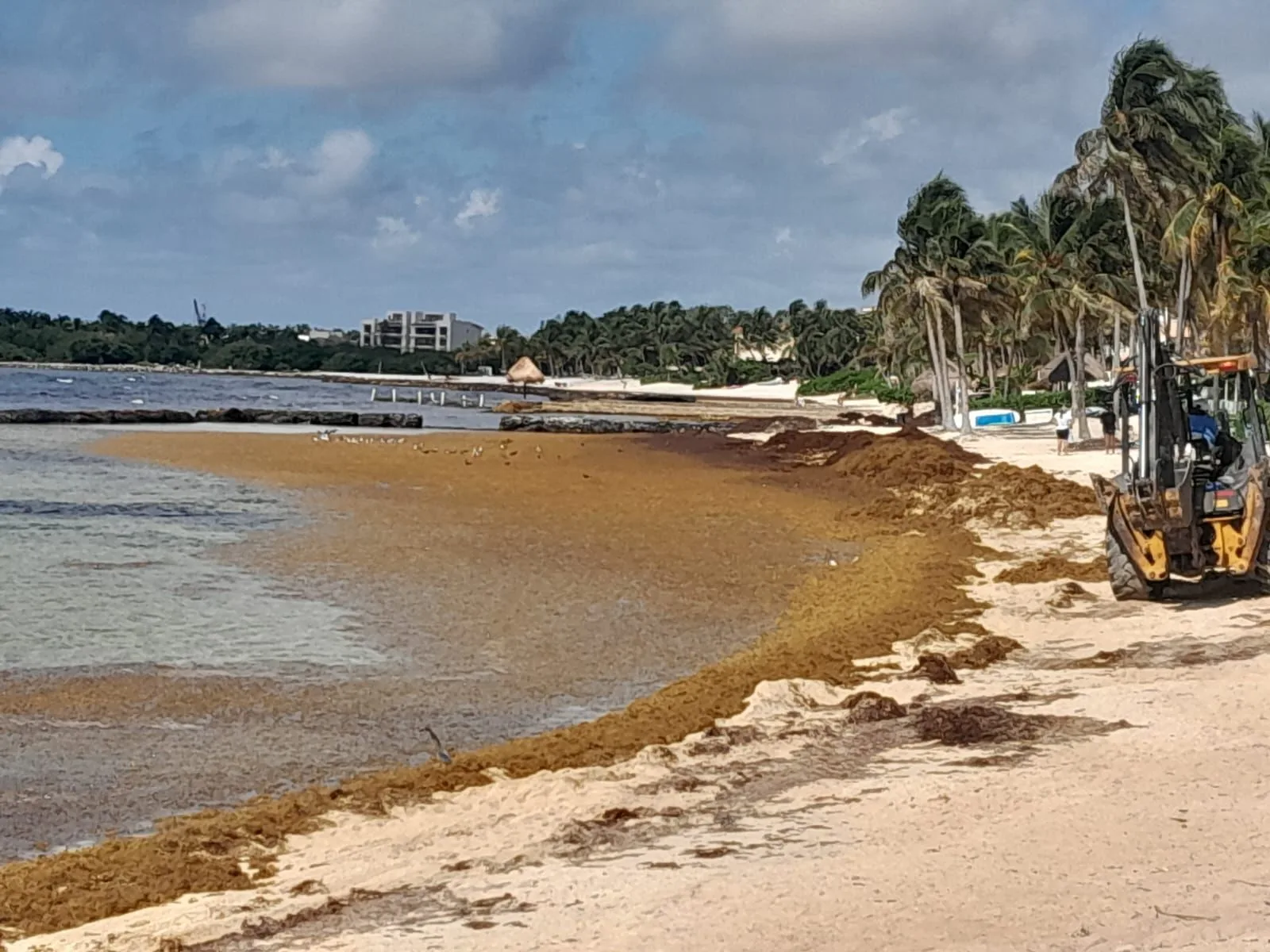
PUERTO AVENTURAS, Quintana Roo — A community-funded barrier intended to divert sargassum away from Fatima Bay is expected to reach Mexico in early September, but its installation will require coordination with municipal and federal authorities.
The barrier was manufactured in Bulgaria by Okeanis and completed on June 17. According to the Puerto Aventuras Association of Colonos, the equipment is now in transit and is scheduled to arrive at the Port of Progreso, Yucatán, on September 2. It must then clear the port and be transported overland to Puerto Aventuras. No installation date has been announced.
Irving Lili Madrigal, director of Playa del Carmen’s Federal Maritime-Terrestrial Zone office, or Zofemat, said the association must meet with his department and Rear Adm. Topiltzin Flores Jaramillo, coordinator of the Mexican Navy’s sargassum response strategy, before work can proceed.
The meeting is expected to address the location and anchoring of the barrier, its relationship to existing sargassum operations and access for vessels entering and leaving Fatima Bay.
Community approved a multimillion-peso project
Puerto Aventuras property owners approved the barrier project during an extraordinary assembly on February 15. The proposal presented to owners placed the initial investment at approximately 6.6 million pesos, with projected operating and maintenance expenses of about 193,000 pesos per month.
The association subsequently collected a special assessment from property owners to finance the system.
Unlike a conventional containment boom that holds sargassum in place for later collection, a deflection barrier is positioned to use currents and wind to guide the floating seaweed away from a protected area. Its effectiveness will depend on its placement, local marine conditions and ongoing maintenance.
The project is intended to protect Fatima Bay, the community’s principal beach and a key part of Puerto Aventuras’ tourism economy. Sargassum accumulation has affected swimming conditions, the appearance and odor of the shoreline, hotel occupancy and vacation rentals.
The barrier will not eliminate sargassum throughout Puerto Aventuras, nor can any barrier guarantee that the bay will remain clear during an extreme arrival. Sargassum can move around, beneath or over floating systems during strong winds, waves and currents. Material that reaches the inside of the barrier will still require collection.
Shipping delays pushed back the project
The barrier’s journey to Mexico has taken longer than originally anticipated. Okeanis said the completed system was initially scheduled to ship July 7 and was later moved to July 15. The manufacturer subsequently reported that Maersk could not accept the cargo because of limited capacity and unavailable space aboard the vessel.
Earlier delays were also attributed to customs and shipping arrangements. The September 2 arrival is therefore the latest projected port date rather than a guaranteed installation date. Customs clearance, transportation, final technical work and government coordination must still be completed.
Preparatory work for the system began in Fatima Bay earlier in the year, but reports that the barrier itself had already been installed were premature. The principal equipment remained overseas while the shipping issues were resolved.
Latest Navy forecast included Puerto Aventuras
The project is arriving during an exceptionally difficult season for the Mexican Caribbean.
The Mexican Navy’s August 12 sargassum bulletin estimated 25,299 tons of sargassum within the Mexican Caribbean, up from 18,229 tons five days earlier.
Of the ten floating groups closest to Quintana Roo, the Navy identified one containing an estimated 10 tons with a probability of reaching Puerto Aventuras within 24 hours. Other groups were forecast to move toward Cancún, Puerto Morelos, Punta Maroma, Playa del Carmen, Tulum, Boca Paila and Xcalak.
Those figures are short-term estimates based on satellite observations, winds and surface currents. They do not mean the entire 25,299 tons will reach the coast or that every projected group will land where initially forecast.
The Navy classified the statewide sargassum situation as “excessive,” its highest warning level.
The Association of Colonos reported that approximately 100 tons were removed from Fatima Bay during the previous week. That figure has not been independently confirmed by Zofemat or the Navy, but it illustrates the scale of the cleanup facing the community while it waits for the new system.
Puerto Aventuras project joins a wider municipal response
Puerto Aventuras’ barrier is being privately funded and managed by the community, but it will operate within the broader coastal strategy coordinated by Zofemat and the Navy.
The Playa del Carmen government announced earlier this month that it now has five kilometers of barriers protecting the central coastline between Playa Fundadores and Punta Esmeralda. Municipal crews and Navy personnel also continue collecting sargassum from the water and beaches.
The need for official coordination in Fatima Bay is particularly important because the area is not simply a swimming beach. It also serves vessels connected to the Puerto Aventuras marina, requiring the barrier system to divert sargassum without obstructing navigation.
If the equipment reaches Progreso as planned, Puerto Aventuras will move one step closer to deploying the most ambitious community-funded sargassum project it has attempted. For residents and tourism businesses, however, the important date will not be the barrier’s arrival at the port, but the day it is fully installed and operating in Fatima Bay.
More Environment
- Cave Divers Find Ancient Animal Bones in Yucatán Cave
- Pre-Hispanic Bee House Unearthed in Tulum Sheds Light on Ancient Maya Homesteads
- Cozumel Crocodile Sightings Rise With Rains and Habitat Changes, Biologist Says
- Quintana Roo Whale Shark Season Closes With Up to 400 Sightings
- Mara Lezama Unveils Quintana Roo Sustainable Tourism Master Plan Through 2050
More Puerto Aventuras
- Playa del Carmen Official Says State Prosecutors Must Handle Armed Men at Puerto Aventuras Ranch
- Armed Individuals Reported on Land South of Puerto Aventuras
- Mexico’s Environment Ministry Rejects Energy Storage Project Near Playa del Carmen
- Puerto Aventuras Migrant Shelter Issues Urgent Call for Food and Basic Supplies
- Man Detained in Puerto Aventuras After Allegedly Setting Fire to Home During Argument