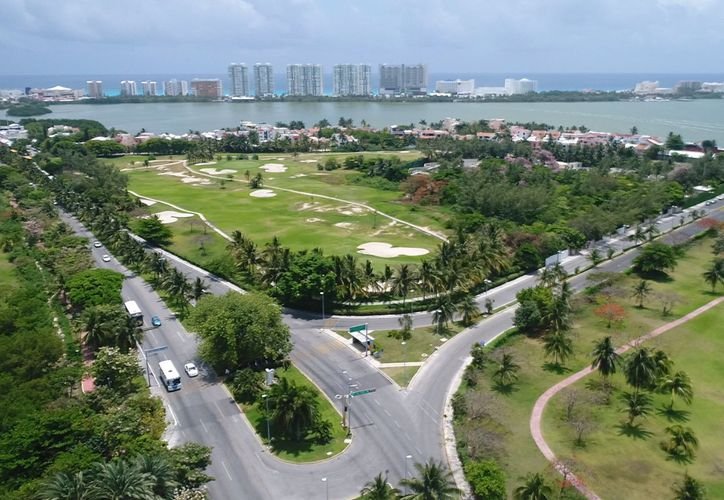
Cancun, Quintana Roo — Residents of the Pok Ta Pok neighborhood are demanding that the Cancun city government preserve the historic golf course in the Hotel Zone, arguing that it is integral to the original master plan that created the city.
“We want the golf course to continue, because that was the spirit of the original project,” said Mercedes Hernandez, a former city councilwoman and former president of the Cancun chapter of Coparmex (Mexican Employers’ Confederation), who lives in the area. She spoke after a meeting between residents and representatives of the Municipal Planning Institute (Implan) and the Urban Development Department of Benito Juarez.
The Pok Ta Pok golf course — about 57 hectares (140 acres) in the heart of the Hotel Zone, the largest remaining green space — operated for three decades under a trust derived from Fonatur (National Tourism Promotion Fund) that required the land to be used as a golf course, consistent with the original design of the resort.
That trust expired in 2021, and since then, the landowners have promoted a condominium tower project that residents have fought with protests and legal injunctions, including those filed against the 2022 Cancun Urban Development Program, which incorporated a special action polygon that would allow the density the landowners want.
The defense of the golf course is not a landscaping whim, Hernandez said. During the meeting, she explained, they discussed the original planning of Cancun — the foundational design that assigned each zone a specific purpose — and how successive modifications to urban development plans have blurred that vision, with land use and occupancy coefficients that, she alleged, are not respected. “There are always negotiations to alter them,” she said.
Residents are not opposing for the sake of opposing, Hernandez clarified. They have watched the green heart of the residential area deteriorate for years.
“All of us who bought there did so because they sold us a golf course and a little plot next to it. And then some clever people come, take over, and buy that course. How much did the land cost back then? 100 pesos per square meter,” she recalled.
Facing the real estate project that aims to densify the polygon, the position expressed in the meeting was blunt: “No to this development.”
Hernandez explained with urban arithmetic: “If you put a 25-story tower on a 400-square-meter plot, you know what that multiplies. Where will all the discharge from the buildings go?”
Services, she warned, are already insufficient for what exists: “We have power outages, water is rationed. I want to see how they will manage with 1,700 homes.”
As a way forward, the municipal authorities committed to receiving the opinion of the group of residents who have promoted the injunctions, “to see how the situation could be unblocked and reach something more appropriate that improves the area.”
A next meeting was agreed upon, though no date has been set. “Let us hope and trust that it will be the best for the people of Cancun and for the place,” Hernandez said. “Everything falls on the city government’s court.”
More Development
- Cozumel Boardwalk Renovation to Keep Historic Features and Traffic Flowing
- Quintana Roo Hoteliers Push Regenerative Tourism Amid Beach Access Disputes
- Cancún’s Route 17 Leona Vicario Draws More Than 16,000 Riders on First Free Day
- Quintana Roo Beaches Lose Up to 14 Meters of Sand a Year as Restoration Plan Advances
- Meliá Invests €50 Million in Paradisus Cancún Renovation
More Cancun
- Hells Angels Leader Arrested in Cancun Over Cartel Drug Trade
- Tourist Boat Traffic Slumps Across Quintana Roo Ports in September
- Cancún Waives 100% of Fines and Surcharges to Help Businesses Get Licensed
- Puerto Morelos Mayor Says Cancún Mansion Raided by Federal Agents Was ‘Lent’ to Her
- Mothers Keep Up Protest at Cancún Middle School Over Alleged Attack on Student