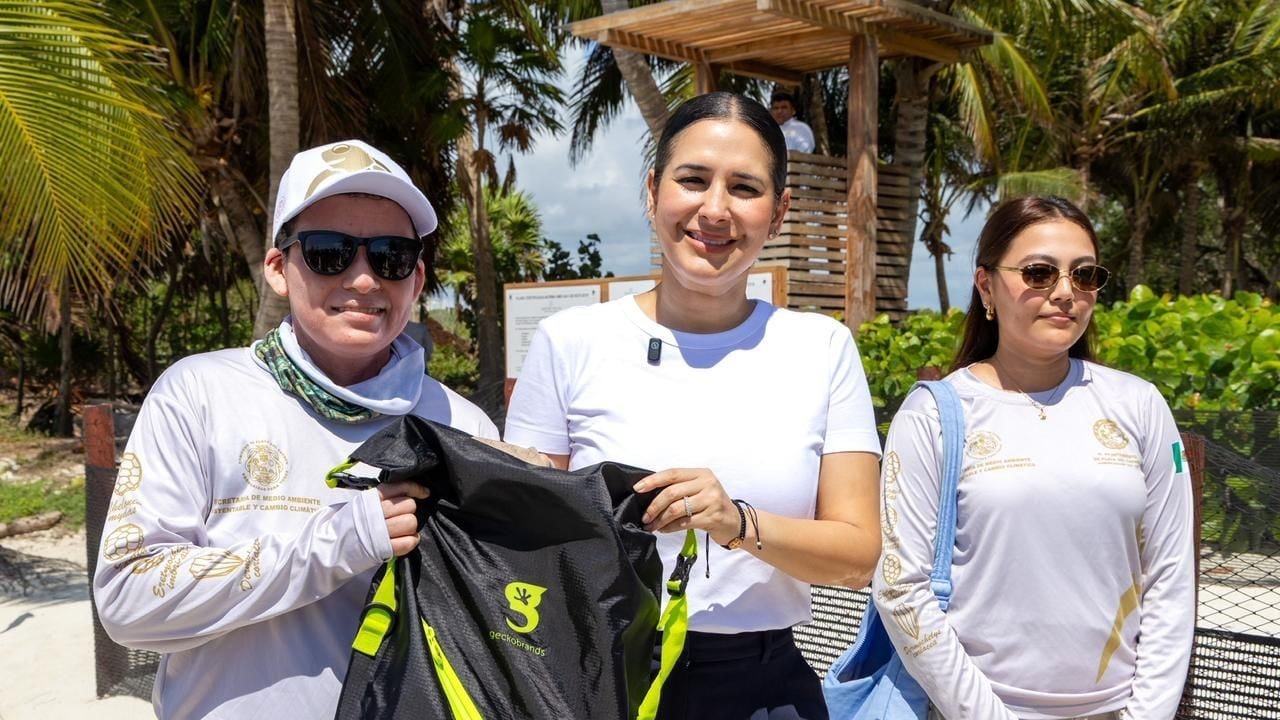
Playa del Carmen, Quintana Roo — Municipal authorities have reinforced the sea turtle protection program as the 2026 nesting season officially begins, delivering equipment to technical staff tasked with monitoring and safeguarding nests along the coastline.
Mayor Estefanía Mercado led the equipment handover ceremony at the Grand Velas hotel beach, one of the sites where turtle nests have already been detected in the early weeks of the season.
Officials reported that more than 30 nests have been recorded at various points along the municipality’s coastal strip, marking the start of a critical period for the conservation of these protected species.
Accompanied by Kandy Mendoza Ramírez, secretary of Sustainable Environment and Climate Change, the mayor emphasized the need for coordination among federal, state, and municipal authorities, as well as stronger participation from civil organizations, volunteers, academic institutions, and private companies linked to the tourism sector.
“In Playa del Carmen, we are committed to protecting our natural wealth and caring for the species that are part of our environmental heritage. Sea turtle conservation is a shared responsibility that requires the participation of government, society, and the private sector to ensure a sustainable future for our coasts,” Mercado said.
The Municipal Program for the Protection and Conservation of Sea Turtles has been operating since 2012 under the coordination of the Sustainable Environment and Climate Change Secretariat. A specialized committee was added two years later to strengthen conservation strategies and serve as an advisory body on environmental matters.
Playa del Carmen has 87 kilometers of coastline, where four species of sea turtles — loggerhead, green, hawksbill, and leatherback — arrive each year to nest. All four are protected under Mexican Official Standard NOM-059, which lists species at risk, and are subject to specific management and conservation protocols under NOM-162.
Program activities include identifying and safeguarding nests, nighttime beach monitoring, protecting hatchlings during their release, surveillance to prevent poaching or human interference, and environmental education for residents and tourists.
The equipment delivery took place at the Grand Velas Riviera Maya beach. The municipal government noted that the program also has an important social component, involving citizens, environmental associations, students, tourism service providers, and volunteers who collaborate in surveillance and conservation efforts throughout the season.
In addition to promoting ecological awareness, the measures aim to increase hatchling survival rates, particularly for species classified under some risk category.
Authorities said the nesting season will continue over the coming months, during which patrols and monitoring work will proceed on various beaches in the municipality.
More Environment
- Playa del Carmen Residents Blast Six-Year Illegal Dump
- Cozumel to Host 18th Island Bird Festival Oct. 7-11
- MarAlliance Launches Free MARAP App to Track Marine Wildlife in the Mexican Caribbean
- Playa del Carmen Seeks Million-Dollar Investment for Sargassum Processing Plants
- Yucatán Officials Rule Out More Brain-Eating Amoeba Infections at Mérida’s Plaza La Isla
More Playa del Carmen
- Playa del Carmen Expands HIV Testing and Prevention Push
- Playa del Carmen Offers Business Incentives, Courts Investment in Low Season
- Playa del Carmen Logs 915 Animal Abuse Complaints, Only 18 Sent to Prosecutors
- Why Quintana Roo’s Sewer Gap Is Polluting Cenotes and Coasts
- Calica Mine Lands to Become Ecological Restoration Zone, Conanp Says