
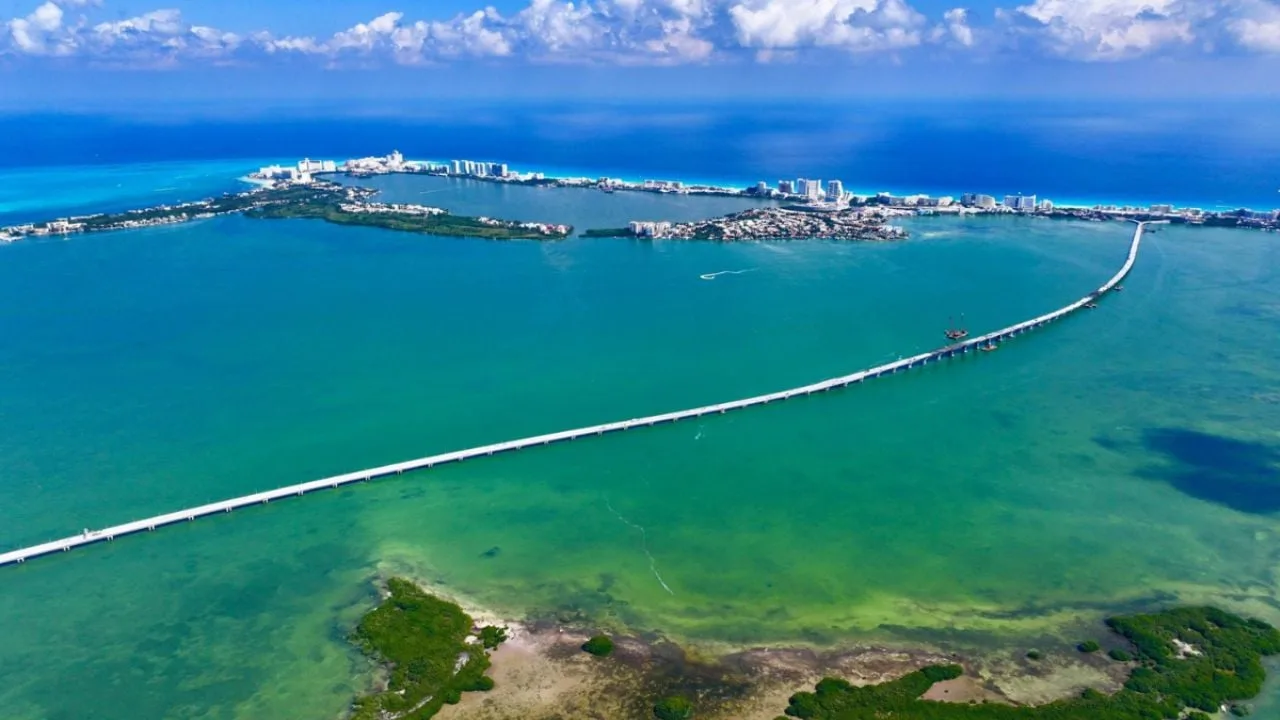
Cancún, Quintana Roo — The Nichupté Bridge officially opened to traffic on May 6, marking a new chapter in mobility for Mexico’s top Caribbean tourist destination. Authorities from the Quintana Roo government and the federal Infrastructure, Communications and Transport Secretariat (SICT) have established clear regulations to ensure safety and efficiency on the mega-structure.
“This bridge is a step toward social justice and efficient mobility,” said Governor Mara Lezama Espinosa.
Hours, Speed and Cost
The bridge operates under a controlled scheme during its initial phase. Daily lane opening begins at 6:30 a.m., with a speed limit of 60 km/h (37 mph) across the entire span, allowing drivers to cross the Nichupté Lagoon in about nine minutes. Use of the bridge is free of charge.
However, there is an initial nighttime restriction: the roadway operates from 4:30 a.m. to midnight. From midnight to 4:30 a.m., it will remain closed for maintenance and final adjustments.
Reversible Lane System
One of the bridge’s most innovative features is its intelligent reversible lane, designed to adapt to traffic flow.
- From morning until 4:00 p.m., two lanes run toward the Hotel Zone and one lane exits.
- From 4:30 p.m. until midnight, the scheme reverses: two lanes head toward the city center, while one lane leads into the Hotel Zone.
- Between 4:00 and 4:30 p.m., a controlled transition supervised by operational staff ensures the lane change occurs safely.
Drivers must pay attention to lane signals, which use green arrows or red indicators to show which lanes are open.
Who Can Use the Bridge and What Is Prohibited
The bridge was designed for shared mobility but with specific restrictions to prevent accidents. It includes an exclusive bike lane for bicycles and human-powered vehicles, including e-bikes that do not exceed 25 km/h, protected by separators. Only motorcycles with engine displacement greater than 600 cc are allowed. Heavy cargo vehicles, scooters, skateboards, pedestrians in vehicle lanes, and visibly defective vehicles are prohibited.
Constant Monitoring and Zero Tolerance for Corruption
The bridge features a continuous monitoring system with cameras connected to the C5 security center, allowing real-time traffic supervision. Preventive operations will be implemented to encourage compliance with speed limits, with no immediate fines during the initial stage, prioritizing driver awareness. Authorities urged the public to report any corruption or attempted bribery by traffic officers.
The new infrastructure aims to significantly reduce travel times between the urban area and the Hotel Zone, while providing a safe alternative during emergencies. Officials recommend driving cautiously, respecting signage, and adapting to the new system to fully benefit from the bridge.
More Cancun
- Cancún Mayor Ana Paty Peralta Delivers Second Government Report
- Cancún Drivers Accuse Quintana Roo Mobility Institute of Abusive Inspections and Impound Fees
- Puenteando Festival Returns to Cancún’s Nichupté Bridge for Third Edition
- Cancún Ranks Second in Mexico for Food Waste as Residents Discard 260 Grams Daily
- Quintana Roo Hotel Zone to Close Year With 226 Million Pesos in Spending: Infratur