
Cancún, Quintana Roo — Mexico’s federal government is proposing another increase to the non-resident fee charged to foreign visitors as part of its 2027 economic package, a move President Claudia Sheinbaum insists will be modest and will not dampen tourism.
Speaking at her daily morning press conference, Sheinbaum confirmed the hike is included in next year’s budget proposal and said the additional revenue would be earmarked specifically for modernizing immigration processing at Mexico’s points of entry.
“Yes, there is a percentage increase, but that will be used to digitize the entire migration process. It is a tagged resource for the digitization of all migration processes at all of the country’s migration entry points,” she said.
Sheinbaum Dismisses Impact on Arrivals
The president later stressed that the increase would not be large and rejected the idea that it could deter international visitors.
“It’s not very high. It won’t have an impact on tourism,” she said.
The new adjustment would come on top of the increase applied to the fee this year. In 2025, the charge stood at roughly 861 pesos per person; for 2026 it rose to 983 pesos, an increase of about 14.2%.
Jet Fuel Prices Called the Real Pressure Point
While downplaying the effect of the higher fee, Sheinbaum acknowledged that another factor has weighed on the tourism industry: the international rise in jet fuel prices.
“In any case, this year there is some impact on tourism — the increase in the price of jet fuel around the world,” she said.
Costlier aviation fuel has driven up airline operating expenses and put additional pressure on fares and air connectivity.
In Mexico, industry reports indicate the average price of jet fuel climbed from 11.77 pesos per liter in February to 17.43 pesos in March 2026, a monthly increase of nearly 48%. The price later topped 20 pesos per liter.
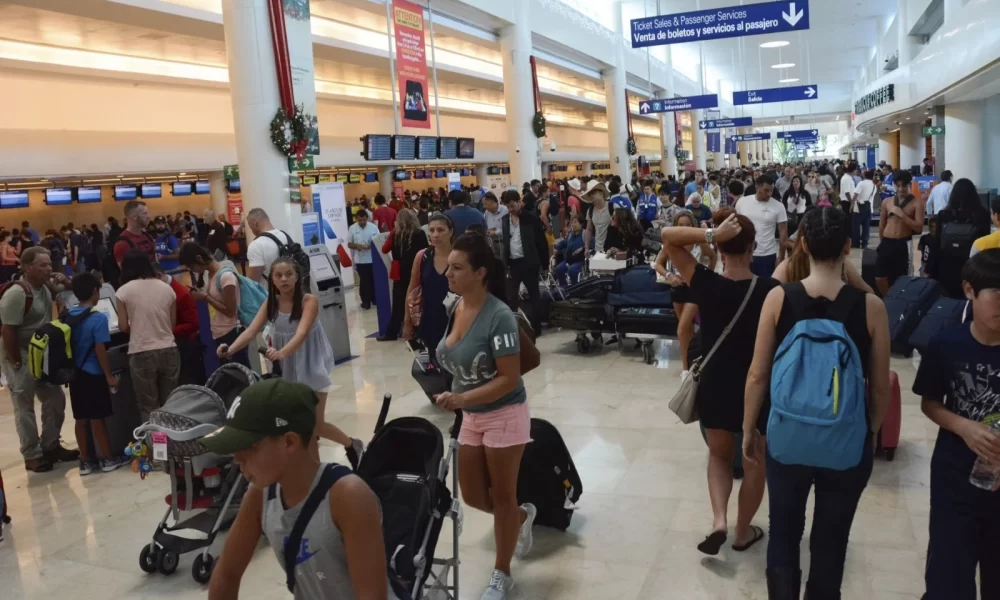
The strain on the aviation industry is also visible in traffic at Cancún International Airport. Between January and August 2026, the terminal recorded a 5.7% drop in passengers compared with the same period in 2025, according to the airport operator ASUR. The decline was sharper in August, when international traffic fell 15%.
The non-resident fee is established under Mexico’s Federal Fees Law and applies to foreign visitors who enter the country without permission to carry out paid work. Hotel operators have repeatedly raised concerns about increases to the charge.
Cancún Hoteliers Warn of Lost Competitiveness
Rodrigo de la Peña, president of the Cancún, Puerto Morelos and Isla Mujeres Hotel Association, said raising taxes on travelers could erode Mexico’s competitiveness against other international destinations, particularly in a market where tourists constantly compare the cost of their trips.
“An additional increase to the non-resident fee undoubtedly reduces competitiveness,” he said, warning that the tourism industry already carries a heavy tax burden and that adding to travel costs is not advisable.
De la Peña also questioned how the revenue from the fee has been used over the years. He recalled that the charge was once directed to tourism promotion through the now-defunct Mexico Tourism Promotion Council, which funded major institutional campaigns in international markets.
“This fee that was previously earmarked for promotion, when we had the Mexico Tourism Promotion Council, gave us very important institutional promotion,” he said.
The funds were later redirected to infrastructure projects, including the Tren Maya, he noted, without disputing the value of those works. He argued, however, that the tourism sector needs clarity on how the money paid by foreign visitors is spent.
“The most important thing is promotion. We have a major problem with a lack of promotion in the country,” he said, adding that the fee should once again be earmarked for its original purpose.
Hoteliers also point out that although the charge falls on the visitor, hotels act as withholding agents and could end up absorbing part of the increase to avoid affecting the guest experience or the final price.
“There are many taxes for which we are withholding agents, taxes that the tourist supposedly pays, but we hand them over to the government,” De la Peña said. He urged authorities to study the proposed increase carefully to prevent it from directly hurting tourism businesses.
More Tourism
- Chetumal Police Purge Tourist Unit After Officers Accused of Handing Youths to Organized Crime
- Quintana Roo Turns to AI as Tourism Arrivals Plunge
- Mariachis in Quintana Roo Struggle as Tourist Numbers Drop
- Cancún Extends Public Transport Hours for Grito de Independencia Celebrations
- Cancún Officials Say Dead Turtle Hatchlings Came From an ‘In Situ’ Nest
More Cancun
- Cancún Reveals Full Grito de Independencia Schedule, With Lucero and Mijares Headlining Free Concert
- Cancún Has Assisted More Than 5,900 Victims of Violence, Officials Say
- Quintana Roo Reports 367 Confirmed Measles Cases in 2026
- Federal Defenders Aid 20 Migrants a Day at Cancún Legal Module
- Control Judges Bind Three Men Over for Trial in Cancún Homicide Cases