Cancún, Quintana Roo — Journalist Lydia Cacho asked a federal judge in Cancún on Thursday to impose the maximum sentence on former Puebla governor Mario Marín Torres, whom she accuses of ordering her torture more than 20 years ago, and to order him to apologize publicly.
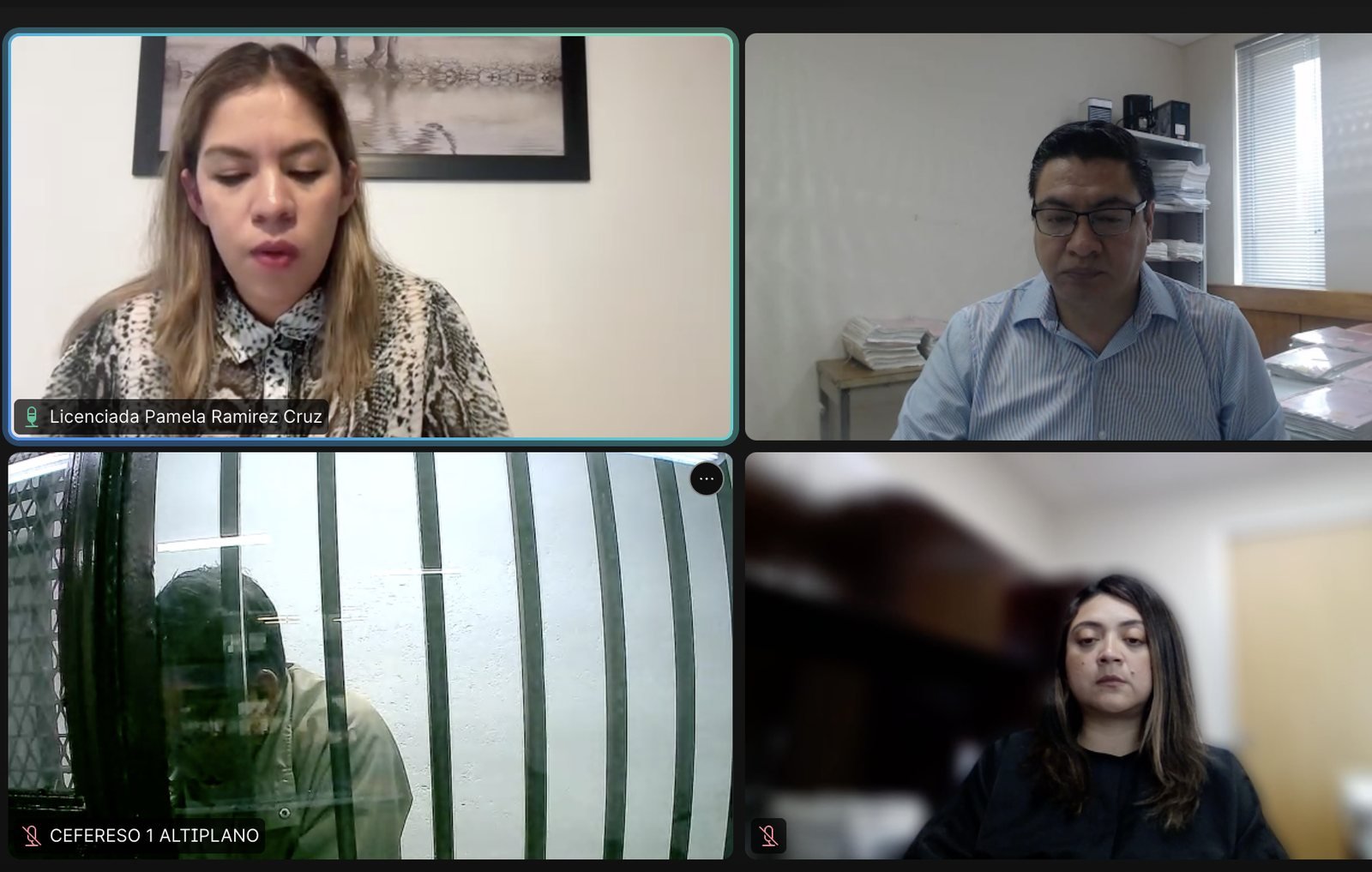
Cacho, who lives in Spain, made the request during a hearing of just over two hours held by videoconference before Judge María José Pech Sáenz of the Fourth District Court in Cancún. Marín followed the proceedings from the Cefereso No. 1 federal prison in El Altiplano, in the State of Mexico.
The case stems from Cacho’s detention in Cancún by Puebla state judicial police after the publication of her book “Los demonios del Edén” (“Demons of Eden”), which exposed a child sexual exploitation network.
Marín was arrested on Feb. 3, 2021. Under the laws in force when the offense was committed, the maximum sentence for torture is 12 years, meaning he would be released in early 2033 if he receives the full term.
“It is the first time in my life that I have come face to face with former governor Mario Plutarco Marín Torres,” Cacho said as she began her closing arguments, naming him as part of a network that protected businessman José Kamel Nacif Borge and Jean Succar Kuri, a convicted pedophile who has since died.
She recalled that in 2003 she began interviewing girls who were victims of trafficking and commercial sexual exploitation carried out by Succar Kuri, Nacif and many others linked to the case, which she ultimately won in court and which prompted several people to flee, including the former governor. “What was he afraid of when he fled, if not that he was guilty?” she asked.
Cacho said she promised the victims in 2003 that she would not give in to violence and threats until the case was won, because her battle is collective rather than individual.
Responding to the defense’s use of fragments of recorded telephone calls to discredit the proceedings, she said it leaves out the most important parts. She recalled that Marín appeared voluntarily on Televisa’s news program to discuss the calls, and that Nacif himself told the media that his wife had recorded them, that they were genuine, and that the governor was his friend and had done him the favor.
“It seems ridiculous and absurd to me that in an international-level trial for torturing me, the defense and you look the other way when I am speaking to you,” she said. “They omit that his protection was tied to the sexual exploitation of girls and boys, not only Mexican but from other countries.”
Addressing Marín directly, she said: “You do have to read your defense on paper. I don’t need to read anything to tell you that you are responsible for torturing me. The police officers spoke of you and the orders you kept giving them by telephone, and when they said ‘change of plans, we have to bring her in alive,’ it was because you received a call. You know that very well.”
“You ordered my punishment, you celebrated it, you mocked me along with Kamel Nacif. You had them give me what he calls a smack on the head and what we and the law call torture, to punish me for being a good journalist, a good defender of children and a brave citizen,” she added.
She said she will file a written request for full reparation of the damage, with the main demand that Marín apologize publicly for ordering her torture and illegal detention, and that he also apologize to the people of Puebla.
“We are fed up with a single citizen having to put her body, her voice and her dignity on the line to defend victims while the state systematically persecutes, runs over and violates them,” she said.
“This is not a media case because I am Lydia Cacho. I am known because I told the truth and the state apparatus punished me. The governor is behind bars, and he fled because he knows he is responsible for a network that protects organized crime and trafficking rings,” she concluded.
Speaking over a poor audio connection, Marín asked for an acquittal and denied ordering that pain or suffering be inflicted on the journalist. He said his only involvement in the events was authorizing two telephone calls to the judiciary so the matter would be handled within the state.
He said the first call came on a Sunday at about 3:30 p.m., tied to an event held by the state prosecutor’s office, and that he was later told an arrest warrant for defamation and slander had indeed been executed. The second, between 7:30 and 8:00 p.m., was to request that the detainee be attended to preferably by women so she would feel more comfortable, he said.
He argued that there is no reliable, conclusive evidence that he instigated, ordered or forced the judicial police involved in Cacho’s detention and transfer to inflict physical or psychological torture. “In none of the statements of the officers who took part in the detention and transfer, nor of their superiors, is it established that I gave orders or instructions to cause the aforementioned person serious pain and suffering,” he said.
His defense cited a Nov. 14, 2006 expert report by the then-Federal Prosecutor’s Office on the telephone conversation attributed to him and Nacif, along with a circuit court ruling in amparo 143/2021 and a Jan. 4, 2025 resolution in direct amparo 2022, which, according to his account, established that the conversation does not show he ordered a punishment over the book.
On those grounds he asked the judge to apply the principle of res judicata, arguing that there has already been a ruling on the same facts, the same crime and the same defendant. “The presumption of innocence requires that the Public Prosecutor’s Office bear the burden of proving intent beyond all reasonable doubt. There is not enough reliable evidence to destroy the presumption of innocence,” he said.
Federal prosecutors countered that it was established that Marín, as governor of Puebla and at the top of a governmental power structure, took part as an indirect perpetrator through his subordinates in the Puebla Judicial Police. They said that after the book’s publication an arrest warrant was executed in Cancún and that during the 20-hour trip to Puebla the journalist was subjected to psychological and moral violence, hostile remarks, death threats, interruption of medical treatment, exposure to abrupt temperature changes, inadequate clothing, a lack of food and water, and cramped conditions in the vehicle.
They added that once in Puebla, a man was allowed to push her, pull her hair, bang her head against a wall and touch her body. Prosecutors asked for the maximum penalty, with a gender perspective, because she is a woman journalist attacked for exercising her freedom of expression.
They also asked the judge to take into account the 2018 UN ruling against the Mexican state in this case and to weigh the defendant’s conduct since then, including violations of internal rules at the Benito Juárez prison that led to his transfer to El Altiplano, and the revocation of a change in his precautionary measure because of the risk that he would flee. They requested the suspension of his civil and political rights, a public reprimand and full reparation of the damage.
At the close of the hearing, the judge said she would issue her ruling as soon as her workload allows. She has up to 60 days to deliver the sentence after studying the 66 volumes in the case file.
More Courts
- Former Puerto Aventuras Mayor Files Injunction After Extortion Arrest
- Xcaret Withdraws Injunction Bid Over Use of Maya Symbols at Supreme Court
- Quintana Roo Opens Case Against Taxi Concession Holder Over Uber Confrontation in Tulum
- Two Suspects Bound Over for Trial in Tulum Environmental Damage Case
- Searching Mothers Protest at Cancún’s Kilometer Zero Over Delays in Ex-Prosecutor Case
More Cancun
- Cancún’s Catrinas Parade Set for Friday Night at Puerto Juárez
- Cancún Authorities Investigate Death of 9-Year-Old Boy Found in Villas del Mar 3 Home
- Two Men Shot Outside Cancún Middle School in Región 228
- Cancún Police Arrest ‘La Comandanta,’ Notorious Paperwork Fixer, for Violating Restraining Order
- Cancún Launches MOBI Route Linking Villas del Mar to Playa Delfines