
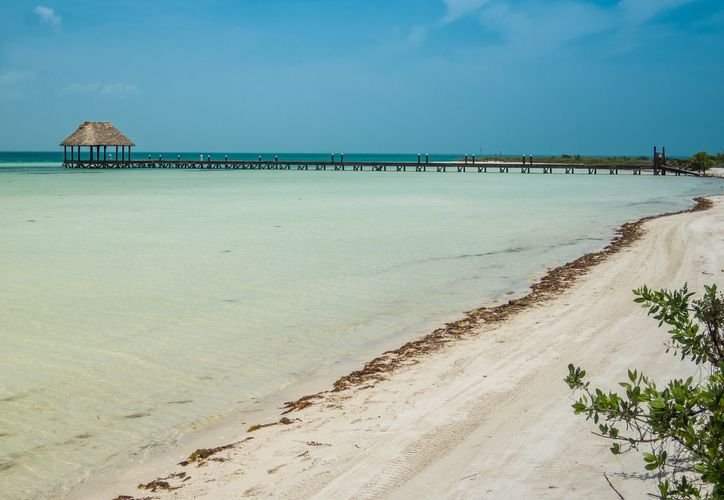
Holbox, Quintana Roo — Isla Holbox continues to enjoy sargasso-free beaches, setting it apart from other areas of the Riviera Maya and attracting visitors seeking a pristine Caribbean destination.
Christian Stenta, president of the Holbox Hotel Association, attributed the favorable conditions to the island’s geographic location. He explained that sargasso affecting other parts of the Mexican Caribbean does not reach Holbox because the northern tip of Cabo Catoche acts as a natural barrier, diverting currents and preventing the seaweed from impacting the island’s shores.
Stenta noted that the island is currently in low season, with hotel occupancy at 45%. Hoteliers use this period for maintenance work on hotel structures and to give staff vacations.
“We normally use this time to start rotating vacations for our employees and to perform maintenance on hotel structures,” Stenta said.
The absence of sargasso provides a competitive advantage, especially during the low season, allowing visitors to enjoy clean, well-maintained beaches.
Stenta added that hoteliers are working closely with local authorities to preserve this condition through constant monitoring of ocean currents and preventive cleaning programs.
“This builds trust among visitors and reinforces Holbox’s reputation as one of the cleanest and best-preserved destinations in the region,” he said.
Despite the optimism, Stenta acknowledged that the World Cup has so far not generated the expected influx of tourists to the island.
More Environment
- Cave Divers Find Ancient Animal Bones in Yucatán Cave
- Pre-Hispanic Bee House Unearthed in Tulum Sheds Light on Ancient Maya Homesteads
- Cozumel Crocodile Sightings Rise With Rains and Habitat Changes, Biologist Says
- Quintana Roo Whale Shark Season Closes With Up to 400 Sightings
- Mara Lezama Unveils Quintana Roo Sustainable Tourism Master Plan Through 2050
