
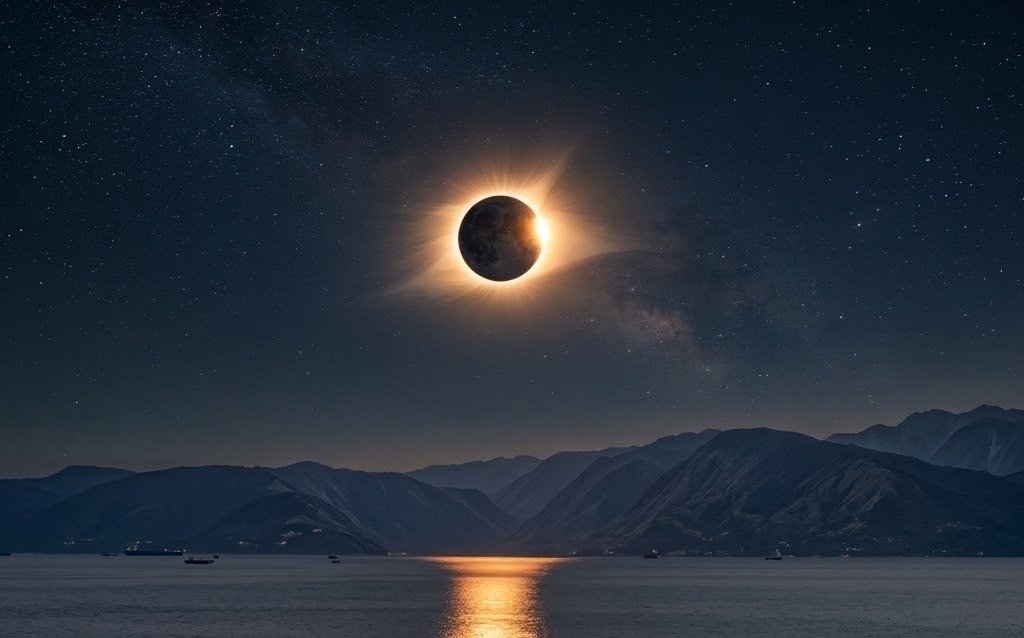
Madrid, Spain — Skywatchers are being treated Wednesday to one of the most striking astronomical phenomena of the year: a total solar eclipse, in which the Moon passes directly between the Sun and Earth and momentarily blocks all sunlight.
The distinction between a partial and a total eclipse is significant. Even when only a thin sliver of the Sun remains visible, its intense brightness can mask the phenomena that emerge during totality. When the Moon fully covers the solar disk, the corona — the Sun’s outer atmosphere — appears as a glowing halo around the Moon’s silhouette.
In the moments around totality, observers may also see the diamond ring effect and Baily’s beads, created as the last and first rays of sunlight thread through the valleys and irregularities along the Moon’s edge.
The eclipse is not the only celestial attraction this week. On the night of Aug. 12, the Perseid meteor shower reaches its peak, and favorable conditions are possible across the Northern Hemisphere. The coincidence makes the day a particularly enticing one for astronomy fans.
Total solar eclipses are not a permanent feature of the sky. The Moon is moving away from Earth at a rate of about 3.8 centimeters (1.5 inches) per year. Astronomers estimate that in roughly 600 million years, the Moon’s apparent size will no longer be large enough to fully obscure the Sun, and only annular eclipses — in which a bright ring of sunlight remains visible around the Moon — will occur.
More Environment
- Cave Divers Find Ancient Animal Bones in Yucatán Cave
- Pre-Hispanic Bee House Unearthed in Tulum Sheds Light on Ancient Maya Homesteads
- Cozumel Crocodile Sightings Rise With Rains and Habitat Changes, Biologist Says
- Quintana Roo Whale Shark Season Closes With Up to 400 Sightings
- Mara Lezama Unveils Quintana Roo Sustainable Tourism Master Plan Through 2050
