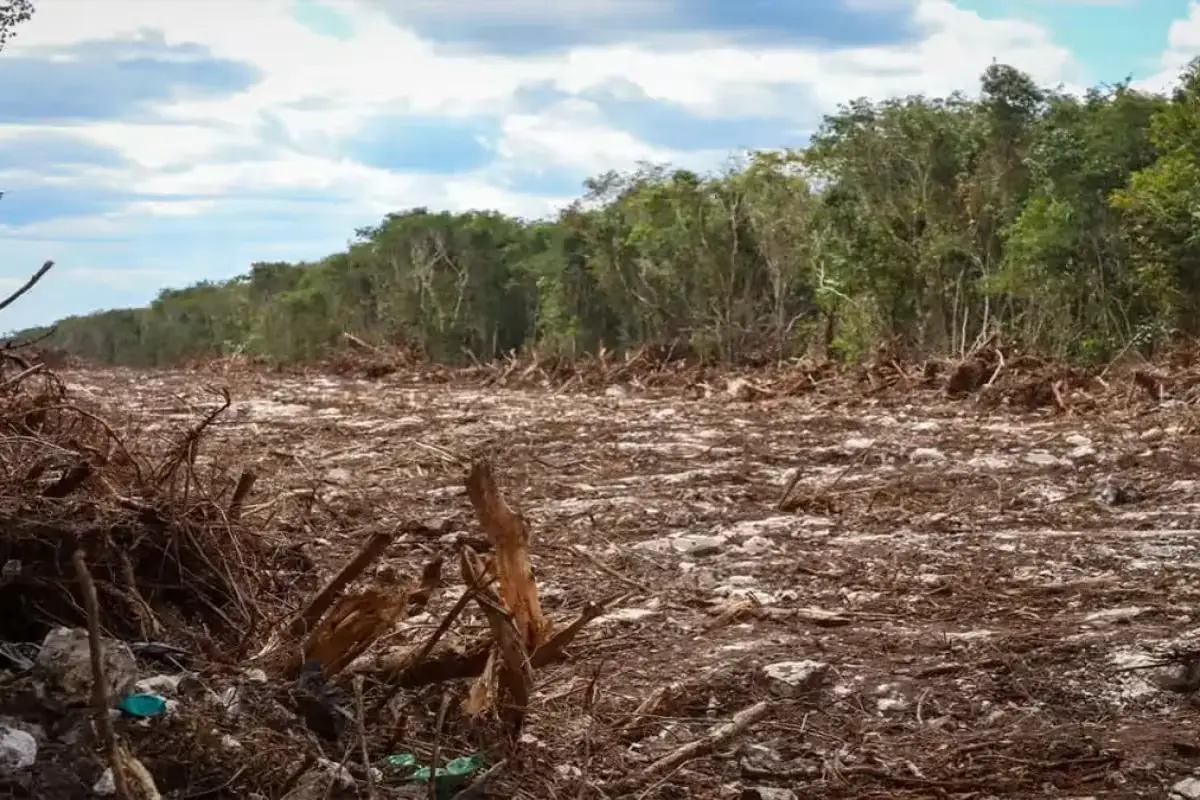
Mérida, Yucatán — The Yucatán Peninsula lost 285,580 hectares of forest between 2019 and 2023, an area nearly twice the size of Mexico City and the region’s highest deforestation rate in decades, according to the Mexican Civil Council for Sustainable Forestry (Ccmss).
Peninsula’s deforestation rate four times the national average
The council’s analysis, based on the Forest Cover Change Information System, found the peninsula lost an average of 71,395 hectares per year — about 196 hectares a day. That puts the annual deforestation rate at 0.4%, four times the national rate of 0.1%.
Nationally, Mexico lost more than 4.88 million hectares of forest between 2001 and 2024, according to the National Forestry Commission (Conafor). The peninsula accounts for a disproportionate share of that loss. Conafor’s own estimates for 2001–2018 put the peninsula’s average annual loss at 47,597 hectares, mostly from land converted to pasture (66%) and farmland (30%).
Campeche leads losses, Yucatán state follows
Among the three states that make up the peninsula, Campeche lost the most: 117,124 hectares over the four-year period, or 29,281 hectares per year, concentrated in the municipalities of Hopelchén, Candelaria, Carmen and Calakmul. Yucatán state lost 110,077 hectares, averaging 27,519 hectares a year, with the largest losses in Tizimín, Panabá, Tekax and Sucilá. Quintana Roo lost 58,379 hectares.
Additional pressure points in Yucatán include Hunucmá, where housing developments and large-scale pig and poultry farms are advancing; Progreso, where port infrastructure is expanding; and northern Mérida, where new subdivisions are replacing forest cover.
Ranching, agriculture and megaprojects drive the clearing
As in the rest of Mexico, the main drivers are livestock and agriculture. Soybean and other grain farming have transformed large forest areas in Tizimín, Tekax and Campeche’s Hopelchén, which are among the peninsula’s top grain-producing regions. Tourism and real estate also play a role, particularly along the coast and around Mérida.
The Ccmss also attributed 5,610 hectares of the peninsula’s losses directly to the Tren Maya, Mexico’s flagship railroad project, with the biggest impacts in segments 5, 6 and 7.
Loss of forest threatens water supply and wildlife
Yucatán has no surface rivers. It depends entirely on a karst aquifer that is recharged by rainfall filtering through the forest floor. Deforestation disrupts that process, reduces carbon storage, fragments habitat for species like the jaguar, and affects Maya communities whose livelihoods are tied to the jungle.
At the national level, warm-humid tropical forests account for 42% of all deforestation since 2001, followed by warm-dry tropical forests — the dominant vegetation across much of Yucatán — at nearly 27%. Together, these two forest types represent almost 70% of Mexico’s total cleared area.
Reforestation efforts lag behind losses
In August 2026, Yucatán launched the National Reforestation Campaign, planting more than 64,000 native trees — including pich, maculís, ciricote, jabín, ceiba and huano — across 292 hectares in municipalities such as Izamal. The effort involved over 18 million pesos in funding from Conafor, the federal Sembrando Vida program and the state’s sustainable development secretariat.
But the scale of the response highlights the gap: 292 hectares reforested against an average 27,519 hectares lost each year. Researchers at the Ccmss warn that without effective limits on agroindustry, livestock, tourism and infrastructure expansion, the peninsula will keep posting the highest deforestation rate in its modern history, with direct consequences for water, biodiversity and local communities.
More Environment
- Polo strengthens to a Category 5 hurricane off Mexico’s Pacific coast in Record Time
- Cozumel Launches Rabies Vaccination Drive With 3,000 Free Doses for Pets
- Sargassum Collection in Quintana Roo Tops 133,000 Tons, Setting New Record
- Isla Mujeres Collects Over 160,000 Tons of Waste in Five Years
- Tulum Beach Cleanup Pulls 32 Kilos of Marine Debris From Playa del Pueblo
More Quintana Roo
- Quintana Roo Climbs 12 Spots to 9th in Competitiveness Index
- Quintana Roo Courts European Airlines to Boost Winter Flights to Cancún
- Mayan Council Urges Mexico’s Supreme Court: Don’t Decide About Us Without Us
- Quintana Roo Construction Demand Jumps 40% on Hotel Renovations
- Mexican Caribbean Sets Its Sights on Panama to Diversify Tourism