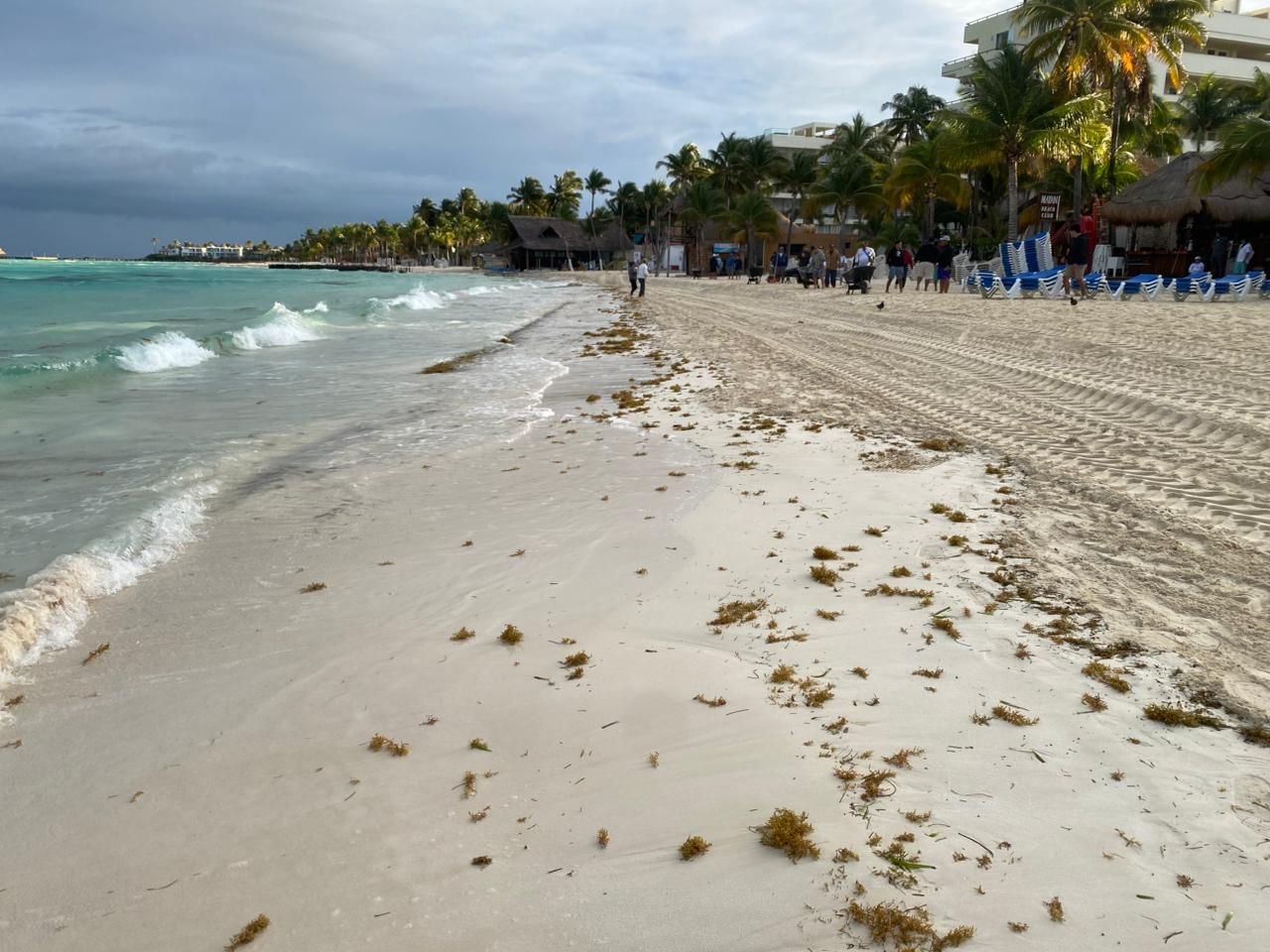
Isla Mujeres, Quintana Roo — Crews removed more than 110 tons of sargassum from Playa Norte in recent days after an unusually heavy buildup of the seaweed in the area known as El Riito prompted stepped-up clean-up operations to keep the island’s main tourist attraction in good condition.
The algae piled up over several days and required an immediate response from staff with the Federal Maritime Terrestrial Zone (Zofemat). Left on the sand, sargassum can produce foul odors, release gases as it decomposes, harm coastal wildlife and leave visitors with a poor impression.
Municipal officials said the operation was aimed at preserving the quality and appearance of the beaches, which are the centerpiece of the local economy and a major source of income for hotels, restaurants, tour operators, boat owners, merchants and other tourism-related businesses.
The 110 tons of seaweed — equal to roughly 110,000 kilograms — is a sharp spike for Playa Norte, where crews normally gather between 300 and 350 kilograms of debris per day. That means the sargassum removed during this event weighed about the same as the typical take from 314 to 366 days of routine beach cleaning. Officials noted the comparison is by volume only, since sargassum requires different handling than solid waste.
Economic and environmental significance
The cleaning effort was not just about looks. Playa Norte is one of the most visited public spaces in Isla Mujeres and forms part of the image the destination uses to compete in national and international tourism markets. Along with Playa Centro, Playa Norte holds Blue Flag certification for the 2026-2027 season, a designation that evaluates water quality, environmental management, cleanliness, safety, visitor services and environmental education.
A loss of environmental quality or prolonged deterioration of the beaches would directly hurt the destination’s reputation and the economic activities that depend on visitors. On Isla Mujeres, the white sand, clear water and swimming conditions are the core tourism product around which lodging, dining, boating, transportation and retail services are built.
Data from the Quintana Roo Tourism Department underscores the region’s reliance on beach tourism. In 2024, the state welcomed 20,993,000 tourists and generated an estimated $19.573 billion in revenue. Nearly 94.4 percent of visitors went to northern destinations, where Isla Mujeres is located.
Keeping Playa Norte clean, in other words, protects an essential part of the municipal economy and the livelihoods of thousands of families tied directly or indirectly to tourism.
Routine maintenance and rapid response
Isla Mujeres’ coastline is not only tended during sargassum emergencies. Zofemat reports a staff of 144 workers responsible for cleaning, sand sifting and waste removal at 13 public beaches on the island and the mainland portion of the municipality. Routine shifts run daily from 5 a.m. to 11 a.m. Playa Centro typically yields about 400 kilograms of waste per day, while Playa Norte averages 300 to 350 kilograms.
The arrival of 110 tons of sargassum temporarily changed that workload, forcing crews to concentrate their efforts at El Riito to prevent the algae from sitting on the shore for an extended period.
Speed is critical in these situations. Once sargassum is on the beach, it begins to lose moisture and decompose, so it must be removed carefully to avoid pulling up large amounts of sand or destabilizing the coastal zone.
The cleanup restored conditions at Playa Norte and reduced the visual and environmental impact of the buildup, but the unusual influx also underscored the need for permanent operational readiness to respond to natural events that can arrive with little warning.
More Environment
- Cave Divers Find Ancient Animal Bones in Yucatán Cave
- Pre-Hispanic Bee House Unearthed in Tulum Sheds Light on Ancient Maya Homesteads
- Cozumel Crocodile Sightings Rise With Rains and Habitat Changes, Biologist Says
- Quintana Roo Whale Shark Season Closes With Up to 400 Sightings
- Mara Lezama Unveils Quintana Roo Sustainable Tourism Master Plan Through 2050