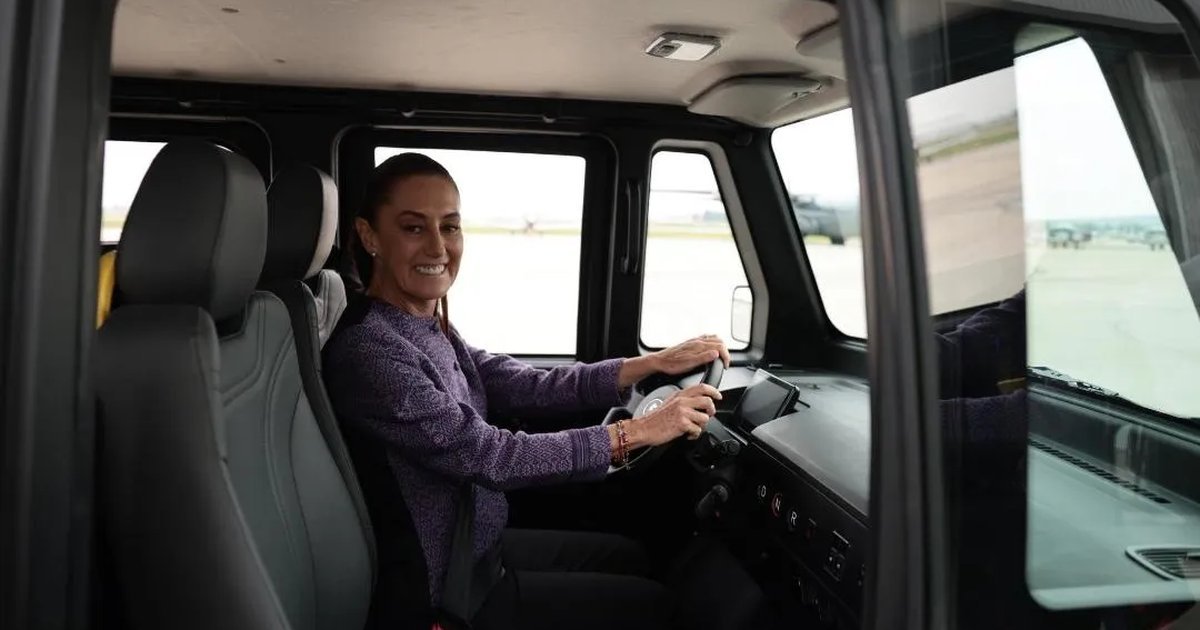
Mexico City — President Claudia Sheinbaum officially unveiled Olinia, the Mexican government’s electric car project, and even drove one of the units during the event.
Olinia, whose name comes from the Nahuatl word ollin meaning “movement,” is a compact mini-vehicle that is 100% electric and low-cost. The federal government-backed design aims to solve daily urban and last-mile travel needs.
According to officials, the vehicle will cost less to operate than a motorcycle and can be charged using any standard electrical outlet.
Speaking at the ceremony held at the Santa Lucia Air Base, Sheinbaum emphasized that the project goes beyond simple automotive manufacturing.
“Olinia is a simple but very powerful idea: that the intelligence and creativity of young Mexicans can become innovation, technological development, and well-being for our people,” Sheinbaum said.
The president stressed that the achievement disproves the notion that Mexican talent is only good for assembling foreign parts. “They told us innovation was reserved for other places, that Mexico was only meant for maquiladoras, that our role was to receive technology, not develop it. But that is false,” she stated.
Sheinbaum described the project as the beginning of a new innovation ecosystem built from the ground up. “Olinia is the hope of a Mexico that recognizes in its youth the strength of its present and future. Because when Mexico trusts in the intelligence and creativity of its people, there is no limit that can stop it. Yes, we can,” she said.
Roberto Capuano, the project director, highlighted the magnitude of the achievement, noting that 18 months ago the vehicle did not exist even as parts or prototypes. “Olinia was born as a national decision so that Mexico stops being an observer in the world’s technological transition and instead participates and leads it from our own capabilities,” Capuano said.
He added that the government placed “the country’s largest public scientific network” at the service of the project.
More Business
- Playa del Carmen Taps HR Directors to Boost Local Hiring
- Hospital O’Horán Performs First Robotic Appendix Surgery; Patient Treated Free of Charge
- Mexico Hoteliers Warn of 1.1 Million Air Tourist Loss as U.S. Arrivals Slump
- Cadillac Launches Escalade-V ‘Checo’ Pérez Edition in Mexico for 4.1 Million Pesos
- Mattel Unveils Barbie Día de Muertos 2026 Doll Inspired by La Catrina