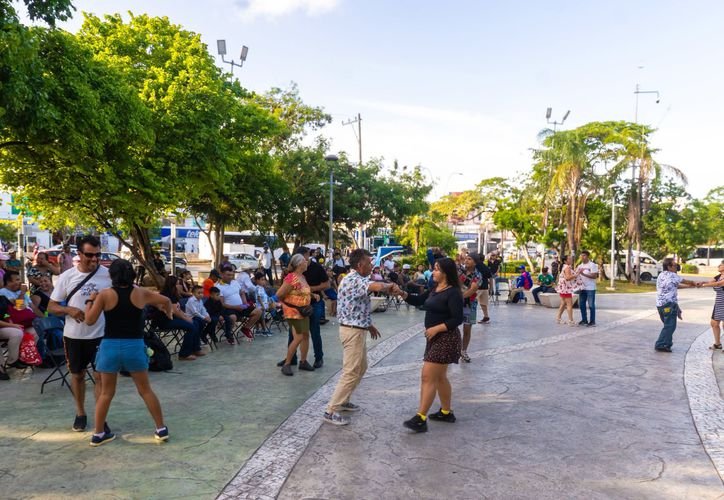
Cancún, Quintana Roo — The municipal government has formally launched the process to register “Tardes de Baile” — the city’s beloved Sunday dance gathering — in the Guinness World Records, while also pursuing a UNESCO Intangible Cultural Heritage of Humanity designation.
The weekly event, which draws an average of 2,000 people to Plaza de la Reforma, has become the main venue for wholesome entertainment and socializing for the city’s working community, bringing together cooks, construction workers and dance enthusiasts who dress up as pachucos and performers of traditional rhythms.
The director of the city’s Institute of Culture and the Arts said the first administrative and technical steps have been taken for the international recognitions, but acknowledged that the process is rigorous and requires time and social validation.
“Right now we’re building it up; we’re going to hold a celebration and also register it for the Guinness record. That’s a process we’ve already started and it’s underway,” the director said. “The other is the intangible cultural heritage declaration; the request has already been made, but it takes time, because for it to be declared, citizens must request it — it is their asset.”
The official outlined the institutional route the proposal must follow before reaching international agencies. “That declaration isn’t achieved overnight; it has to pass several filters. First, the institute’s Committee for Material and Immaterial Cultural Heritage, made up of seven or eight expert advisers, must validate it; then the proposal goes to UNESCO and national bodies. We estimate it will take about a year, because we have to demonstrate the event’s age and deep roots,” he said.
The director said the activity’s social impact lies in offering an accessible alternative for service sector and hotel zone workers, providing a safe environment with no alcohol sales.
“That’s where you see the benefit, because those people work in the hotel zone and don’t have time or money to go to bars. This is their moment to seek entertainment and have wholesome fun, because no alcohol is sold; people come to dance, they dress up and do their hair,” he said. “The premise is that ‘if you request a song, you dance it.’ Salsa, danzón and even rock and roll predominate.”
More Culture
- Puerto Morelos Plans Boat Procession, Altars and Contests for Mar de Almas
- Documentary Exposes 30 Years of Pollution in Cancún’s Chacmuchuch Lagoon
- Xcaret Says It Will Abide by Any Supreme Court Ruling on Use of Maya Culture
- Mérida to Host 2026 Mucbipollo Festival at San Sebastián Park
- Cancún Moves to Reactivate Puerto Juárez Market for Hanal Pixán
More Cancun
- Rabies Found in Fox That Scratched Baby in Cancún
- Cancún Brings Electricity to Three Popular Neighborhoods With 358 New Meters
- Quintana Roo Identifies 780 Irregular Settlements, Prepares Regularization Strategy
- Canada Drives Mexican Caribbean Demand for Final Quarter of 2026
- Funeral Services in Cancún Can Top 100,000 Pesos, Workers Say