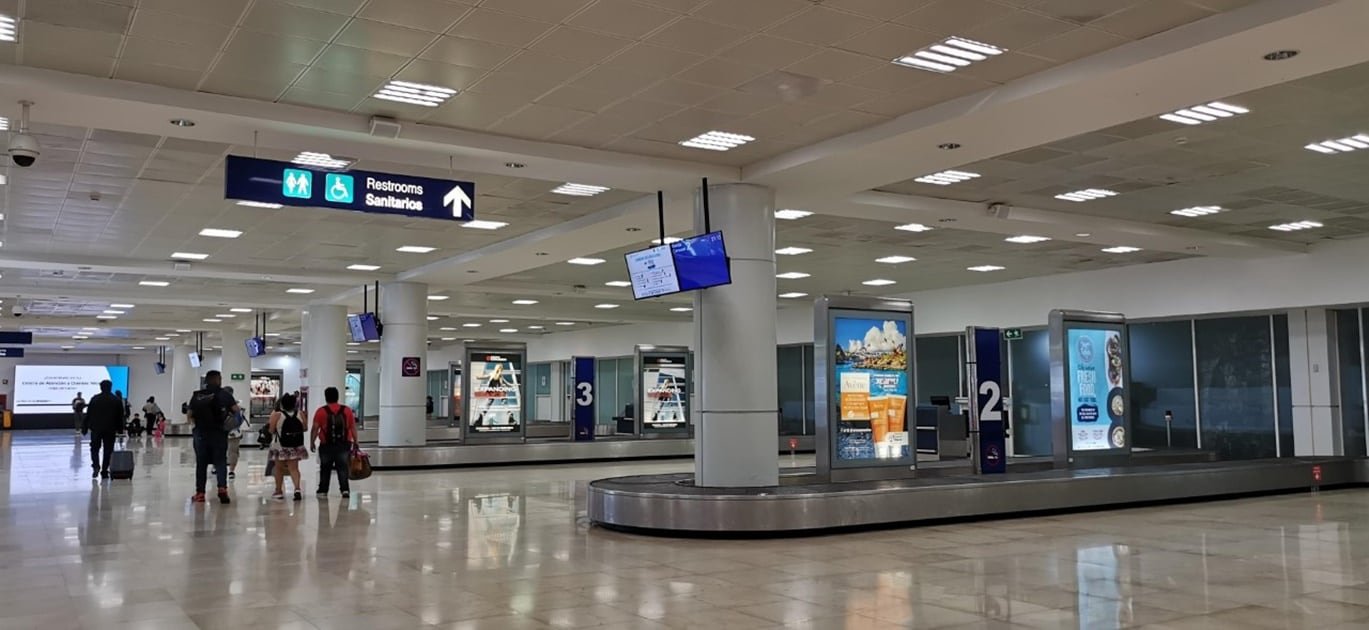
Cancun, Quintana Roo — Mexico’s second-busiest airport, Cancun International, saw passenger traffic fall again in April, deepening a downward trend that began after its record year in 2023.
The airport handled 2,464,479 passengers in April, a 4.3% drop from March, despite the Easter holiday period, according to data from Grupo Aeroportuario del Sureste (ASUR).
In the first four months of the year, total passenger numbers reached 10,497,000, down 2.4% from the same period in 2025. Domestic traffic fell 6.8%, while international traffic slipped 0.7%.
In 2023, Cancun Airport hit an all-time high of 32.8 million passengers, but annual volumes have since declined. In 2025, the airport ended the year with 29.3 million travelers.
Aviation consultant Fabricio Cojuc attributed the drop to a combination of factors. U.S. tourists are traveling less due to inflation in their home country, reducing demand for flights to the Mexican Caribbean. Airlines have cut seat capacity by 7% to 10% so far this year, affecting all U.S. carriers except Southwest, Cojuc said.
Security concerns also played a role. In March, several Mexican airports, including Cancun, saw passenger declines after the U.S. government issued travel alerts following the killing of Nemesio “El Mencho” Oseguera, leader of the Jalisco New Generation Cartel.
Cancun also faces growing competition from other destinations, particularly the Dominican Republic. “We’re seeing destinations, especially the Dominican Republic, competing very strongly with Cancun for tourists from the U.S. and Canada, and they have very interesting growth rates,” Cojuc said. “I think there has been a traffic diversion effect from the Mexican Caribbean to the Dominican Republic.”
Francisco Madrid, director of the Anahuac Cancun Center for Advanced Research in Sustainable Tourism, noted that the opening of Tulum Airport in 2024 initially diverted some traffic, but Tulum has since lost relevance while Cancun’s decline persists.
“It’s a multifactorial problem,” Madrid said. “Overall, it’s a shortage of seats from airlines, both domestic and foreign, which has been worsening, and most concerning is that it’s happening ahead of the summer season.”
He added that the end of operations for Magnicharters, which flew frequently between Monterrey and Cancun, and the closure of Spirit Airlines in the U.S. have also hurt the destination.
Rising jet fuel prices are another headwind. “Jet fuel has squeezed fares, and tourist traffic is more price-sensitive,” Cojuc said. “That sensitivity reduces people’s propensity to travel. Fewer spring breakers came this winter, and sargassum seaweed on beaches was another deterrent.”
Madrid agreed that as oil prices remain above $60 per barrel, uncertainty in the U.S. will continue to affect tourism travel. Hotels are responding by offering interest-free installment payments and added value to attract visitors.
“Cancun had a unique, fortunate moment after the pandemic as one of the first destinations to reopen worldwide, but as competition normalizes, those benefits have faded. Room supply is growing, and the seat shortage is felt more acutely,” Madrid said.
Cancun and Mexico City airports together account for more than half of the country’s total passenger traffic.
More Business
- 40-Hour Workweek in 2027 Will Speed Up Robots and AI in Hotels, IMEF Says
- Mexico’s Supreme Court Blocks Telmex Bid for Automatic Pay TV Access
- Mexico and EU Bring Modernized Global Agreement to Congress as Senate Ratification Looms
- Lawmakers Propose One Tree Every 15 Meters in New Quintana Roo Developments
- Moody’s Warns Mexico Faces Negative Fiscal Trend on Rising Debt and Weak Growth
More Cancun
- IMSS Hospital Deputy Director in Cancún Reports Death Threats After Viral Video
- Judge Binds Over Driver in Fatal Cancún Motorcycle Crash
- Crews Begin Removing 14 Sunken Boats From Cancun’s Nichupte Lagoon
- Authorities Seize Drugs, Detain Three in Two Cancún Raids
- Two 13-Year-Old Girls Found Dead in Separate Cancún Homes