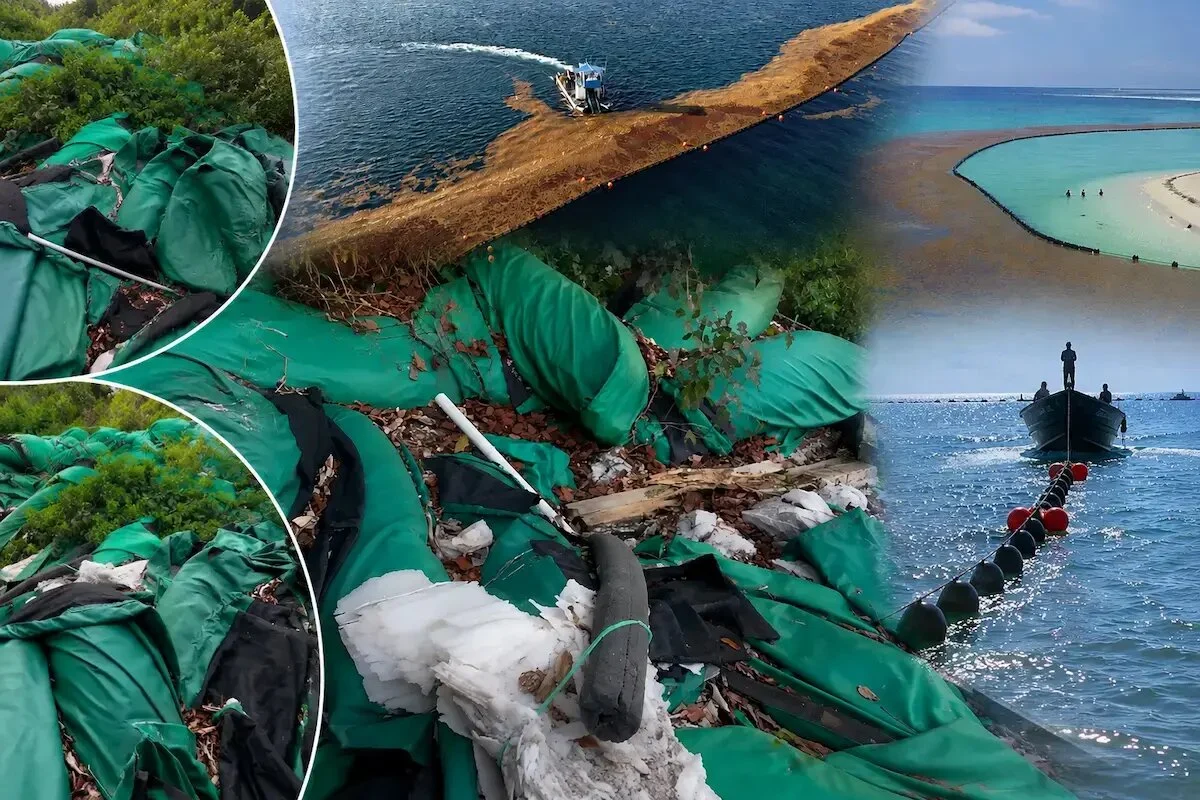
Cancún, Quintana Roo — A viral video showing dozens of sargassum containment barriers abandoned in a vacant lot has reignited public debate over transparency and the use of millions of pesos allocated to combat the seaweed crisis along the Mexican Caribbean coast.
The footage, dated June 27, 2026, shows a person walking through a field where green synthetic barriers lie piled among weeds, dry leaves, and trash. The person filming can be heard saying, “Millions of pesos thrown away on sargassum nets, hidden in a vacant lot, while we suffer from the sargassum.”
The images have sparked outrage because the barriers appear to be abandoned equipment purchased with public funds to contain sargassum, one of the region’s most pressing environmental and tourism challenges. However, experts note that the sight of barriers on land does not necessarily prove misuse; they may have been removed after reaching the end of their useful life, damaged by the sea, vandalized, or awaiting repair.
Sargassum barriers have been used in Quintana Roo since the summer of 2018, when massive seaweed influxes forced federal, state, and municipal governments, along with the private sector, to implement a permanent containment strategy. The barriers are deployed intermittently and strategically at critical points such as Mahahual, Xcalak, Puerto Morelos, Tulum, Playa del Carmen, and Benito Juárez.
In 2026, the Mexican Navy has maintained between 8,000 and 9,000 meters of barriers in key municipalities, with a state goal of reaching 15,000 meters to reinforce protection in the most affected tourist areas. Barriers are typically installed in segments of 500 to 1,000 meters, depending on the intensity of sargassum arrivals, currents, waves, and collection capacity. Their function is to intercept or deflect the seaweed out to sea so that collection vessels can remove it before it reaches the shore.
Effectiveness depends on constant operation. If sargassum accumulates for too long, the weight of the biomass can break or sink the barriers, or allow the seaweed to overflow them. Specialists warn that installing barriers without permanent collection can render them useless within days during peak seasons.
The barriers are typically made of PVC-reinforced polyester membranes, floats, ballasts, buoys, connectors, and signaling systems. Under ideal conditions, some suppliers estimate a useful life of around seven years, but in the Mexican Caribbean, intense solar radiation, salinity, waves, currents, storms, vandalism, and the weight of accumulated sargassum can significantly reduce that lifespan.
The video highlights a lack of clear public information about how many barriers are still operational, how many have been removed, their cost, how long they were used, and their final destination. According to a transparency response from the Mexican Navy dated May 13, 2026, with file number 340026600050126, the following amounts were allocated for sargassum management: 87.258 million pesos in 2020; no allocation in 2021; 42.774 million pesos in 2022; 20 million pesos each in 2023, 2024, and 2025; and 19.5 million pesos budgeted but not yet spent in 2026.
The same document details that in 2020, the Navy contracted Grupo Malsor, S.A. de C.V. to acquire 5,656.32 meters of sargassum containment barriers for 42.845 million pesos through an invitation to at least three bidders. In 2022, the Navy contracted DESMI Ro-Clean A/S for a sargassum containment and removal system costing 23.830 million pesos via direct award, justified by the company being the exclusive manufacturer and distributor of such barriers and having the technical and legal solvency to deliver the required goods.
The 2022 contract included a containment and removal system comprising sargassum barriers, floats, central band, mesh light, ballast, connectors, collection systems, signaling buoys, storage containers, spare parts, tool kits for repair, and training. The Navy reported that no contracts for sargassum management were signed in 2021, 2023, 2024, 2025, or 2026, although budgets were allocated for several of those years, raising questions about whether the money went to operations, maintenance, logistics, fuel, personnel, collection, final disposal, or other items not reflected as direct barrier purchases.
Technical estimates place the cost of one kilometer of sargassum barrier at around 4 million pesos, excluding installation, maintenance, vessels, fuel, specialized personnel, repair, and final disposal. Under that parameter, the current 8 to 9 kilometers deployed represent several tens of millions of pesos in infrastructure, while a goal of 15 kilometers would imply a much higher potential value.
The private sector also bears significant costs. In Puerto Aventuras, installing three barriers cost approximately 6.6 million pesos. Neighborhood associations have spent up to 2 million pesos in a single season just to remove accumulated sargassum. In Mahahual, tourism service providers report costs of up to 20,000 pesos per month per business. For medium-sized hotels, keeping a beach clean can cost between 70,000 and 90,000 pesos monthly, while large resorts may spend between 285,000 and over 760,000 pesos per month on cleaning, machinery, personnel, transport, and disposal.
The viral video thus exposes the least visible part of the strategy: the fate of barriers once they leave the sea. Public indignation arises because while beaches continue to receive tons of sargassum, citizens see meters of material piled on land and wonder why it is not being used where it is most needed. The technical explanation — that barriers are removed because they are damaged, have reached the end of their life, need repair, or are no longer safe to operate — does not suffice without public documents detailing installation dates, areas covered, actual operating time, cost per segment, updated inventory, condition of removed material, and final destination.
Quintana Roo has faced a sargassum crisis for over a decade, requiring hundreds of millions of pesos in public and private resources. In 2015, around 150 million pesos were allocated to combat sargassum, with subsequent questions about the handling of approximately 79 million pesos. In 2018, federal and state governments allocated more than 80 million pesos for the initial emergency. In 2019, 14.5 million pesos were reported for new containment barriers. Between 2020 and 2026, the Navy reported specific allocations totaling over 229 million pesos for sargassum management. Yet the problem persists each season.
The images of the vacant lot do not by themselves prove corruption, but they do compel authorities to answer key questions: How many meters of barrier were removed? From what year? How much did they cost? Where were they installed? How long did they operate? Why are they stored in those conditions? Will they be repaired, recycled, or discarded? Who is responsible for their custody? Is there an updated public inventory? Until those questions are answered, every pile of barrier on land will remain a symbol of a costly, worn-out, and opaque strategy.
More Environment
- Drought Reaches All 11 Municipalities in Quintana Roo
- Horseshoe Crabs in Isla Mujeres Face Threat From Bait Fishing in Laguna Chacmuchuch
- Tulum Residents Demand Comprehensive Water Quality Study for La Veleta
- Tulum Circula Advises More Than 120 Businesses on Separating and Tracking Waste
- Yum Balam Management Review Must Include Chiquilá Ejido, Commissioner Says
More Quintana Roo
- Quintana Roo Festival to Showcase Maya Culture at Mexico City’s Los Pinos
- Quintana Roo Police Face Surprise Drug Tests as 150 Officers Screened
- Counterfeit ‘G5’ Banknotes Prompt Alert Among Quintana Roo Merchants
- Quintana Roo Recycling Program Trades PET, Aluminum and Cardboard for Food Baskets
- Heavy Rain and Extreme Heat Forecast Across Quintana Roo