
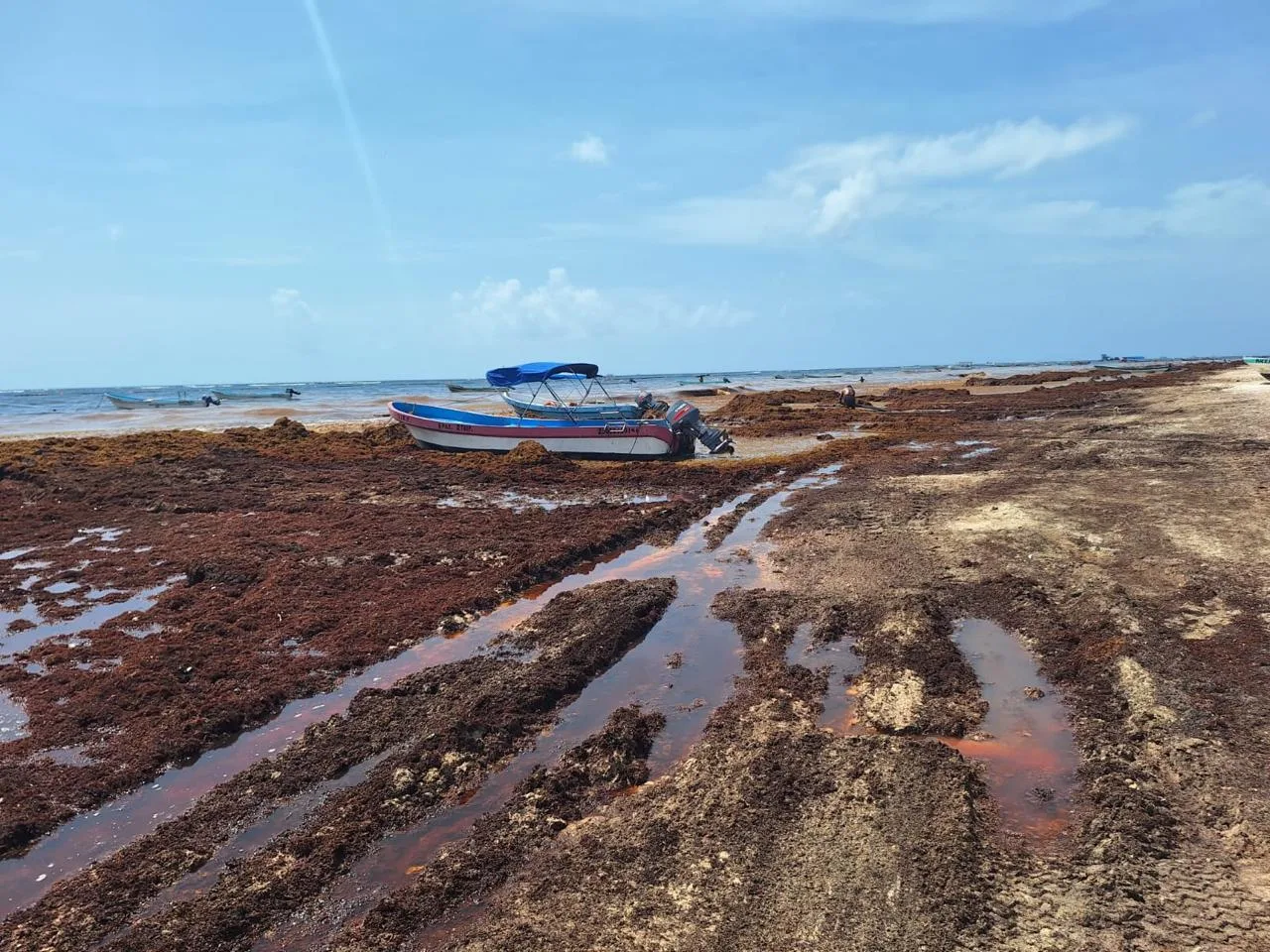
Tulum, Quintana Roo — Poor sewage infrastructure and failing wastewater treatment plants are worsening groundwater contamination in Quintana Roo and may be fueling sargassum blooms along the Mexican Caribbean coast, according to Alejandro López Tamayo, director of the water stewardship group Centinelas del Agua.
López Tamayo said the group has monitored water quality at more than 200 sites across the state, including wells in rural communities, cenotes, coastal lagoons, natural springs and marine areas. Its records show that Playa del Carmen and Tulum have the highest concentrations of groundwater pollution, along with elevated levels of contaminants in coastal springs.
He explained that Quintana Roo’s karst aquifer, which is highly permeable, allows wastewater that is not fed into a sewage network to filter directly into the subsoil and eventually reach the coastal zone.
“Any wastewater discharge that is not routed through a sewage network but instead connects directly to the aquifer flows out and contributes straight to the coastal zone,” he said.
López Tamayo also linked untreated wastewater to the region’s recurring sargassum problem, saying the nutrients it carries create favorable conditions for the seaweed when it arrives on Caribbean Mexican shores. He called on hoteliers, business owners and authorities to treat sanitation as part of any strategy to address sargassum.
“One of the factors contributing to the spread of sargassum is the lack of sanitation and wastewater treatment in the destination,” he said.
According to López Tamayo, the need for greater investment in sewer networks and wastewater treatment plants in Quintana Roo has been documented since 2015, but progress has been insufficient. He said there are major gaps between official figures for sewer coverage and the actual number of homes connected to the system.
Centinelas del Agua surveyed neighborhoods in Playa del Carmen, Tulum and Bacalar to determine how many properties were truly connected to the sewage network. The results, he said, showed that in some neighborhoods more than 60 percent of homes were not connected.
He said agencies such as the National Water Commission (Conagua) and the state water utility CAPA may report high coverage because they count a network that runs along a street, without verifying whether homes are actually connected.
“The data may show 99 percent sewer coverage in Playa del Carmen and 96 or 80 percent in Tulum, but the real percentage is much lower,” he said.
Some homes, he added, remain connected to cenotes or caves on their own properties, while others rely on septic tanks that may be in poor condition. Federal, state and municipal authorities are also failing to inspect and enforce connections where sewer infrastructure exists, he said.
In 2023, the group gave the municipal governments of Solidaridad, whose seat is Playa del Carmen, and Tulum an analysis of the problem. In the Colosio neighborhood of Playa del Carmen, Centinelas del Agua surveyed 164 lots that were not connected to the sewage network and later ran a campaign promoting household connections. The association also used its own funds to connect five low-income families to the system.
López Tamayo said the problem persists, and that new housing developments, streets and subdivisions continue to be approved in areas without adequate sewer infrastructure, particularly in Tulum.
“One of the biggest problems and challenges in Quintana Roo is that approvals are granted without the sanitary sewer infrastructure actually being in place,” he said.
Tulum’s outward growth, he noted, has not advanced at the same pace as its sanitation infrastructure, which could lead to more wastewater discharges into the aquifer. He cited a case in the municipality of Benito Juárez in which the environmental group Right to a Healthy Environment (DMAS) obtained a favorable ruling in a lawsuit involving the connection of a real estate development to the sewer network. Similar situations could emerge in other municipalities where projects are approved without adequate sanitation systems, he said.
More Environment
- Nine Sick Dolphins Stranded in Abandoned Cancún Water Park
- Playa del Carmen Presses Federal Officials to Halt Wildlife Exploitation Permits
- Scientists Detect Early Signs of Groundwater Contamination in Quintana Roo
- 22 Hotels in Mexico’s Caribbean Join Dune Restoration Push
- Cancún Protesters Demand Answers on Fate of Big Cats Kept by ‘Pepe Tigre’
More Playa del Carmen
- Playa del Carmen Cuts Intentional Homicides by 51.6% in First Eight Months of 2026
- Drainage Connection Gap Worsens Pollution of Cenotes and Beaches in Quintana Roo
- Assault Survivor Robert González Praises Eugenio Derbez’s ‘El juicio’ in Emotional Message
- Playa del Carmen Residents Demand Action After Molotov Attack on Taxi Union
- Negroni Week 2026 Brings Riviera Maya Bartenders to Playa del Carmen