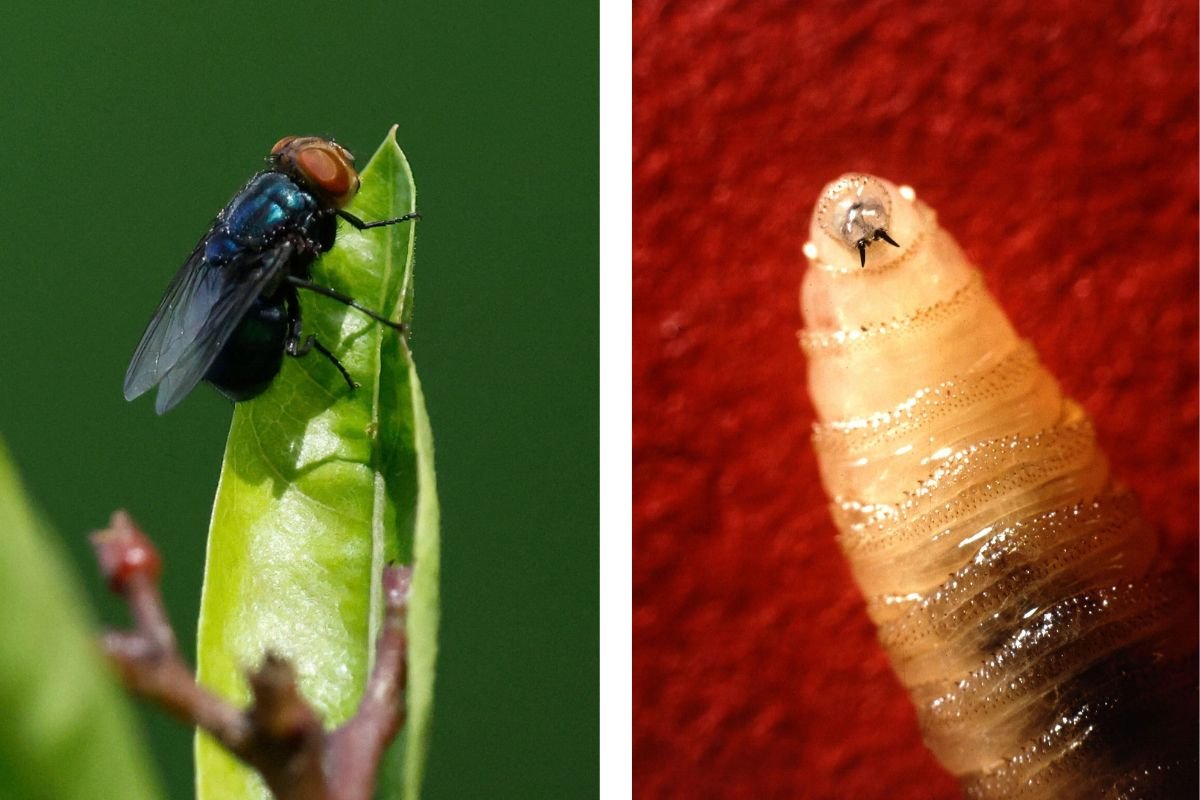
Texas — The U.S. Department of Agriculture (USDA) has now released more than 1 billion sterile flies in its campaign against the New World screwworm, a pest that reappeared on American soil in June after decades of near-absence. The aim is to swamp wild populations with insects that cannot reproduce until the species’ own breeding cycle collapses.
The approach is not experimental. It helped wipe out the screwworm in the United States in 1966 and worked again during the 2017 outbreak in the Florida Keys. The problem in 2026 is not whether it works. It is whether enough flies can be produced.
A Parasite With a Misleadingly Innocent Name
The name of the insect sounds deceptively harmless. Cochliomyia hominivorax lays its eggs in the wounds of mammals and other warm-blooded animals. When the larvae hatch, they burrow into the tissue and feed on living flesh, enlarging the wound and potentially causing serious infection or death.
How Sterile Flies Break the Cycle
The solution developed decades ago exploits an extraordinary reproductive weakness. The flies are bred on an industrial scale and then sterilized with radiation. Males are released in enormous numbers to mate with wild females. Because those females normally mate only once, a sterile partner means the eggs never produce a new generation. Repeated at sufficient scale, each cycle leaves fewer fertile flies than the one before.
It is biological control that amounts to a war of numbers — and those numbers can shift at an alarming speed. The insect’s reproductive potential allowed the United States to go from 473 recorded cases in 1971 to about 100,000 the following year, one reason officials do not find it reassuring that the current outbreak remains relatively small.
The U.S. tally had already reached 49 confirmed cases by Sept. 9, after a new detection in a horse in Presidio County. Most have been recorded in Texas.
One Billion Flies Is Not Enough
This is where the real difficulty emerges.
The plant in Panama that sustained the continental barrier for years can produce roughly 100 million flies a week. The United States is expanding its facilities and Mexico has recovered additional capacity, but experts consulted during the response estimate that about 500 million flies a week would be needed to push the pest back south to the historic Darién Gap barrier. That is almost exactly the scale used during the major eradication campaigns of the 1960s and 1970s.
Much of that infrastructure disappeared once the program succeeded. It now has to be rebuilt while the insect is already on the move. A new U.S. plant in Texas is due to begin operating in spring 2027, reach about 100 million flies a week by the end of that year and later scale up to 300 million a week by the end of 2028.
The economic incentive is significant as well. The Federal Reserve Bank of Dallas estimates that repeating an outbreak comparable to the one in 1972 today could cause roughly $2.5 billion in losses in the southwestern United States alone. A prolonged episode comparable to 1962-1980 would exceed $6 billion.
A Next-Generation Fly That Produces Only Males
Current factories also carry a fairly absurd inefficiency: they produce roughly as many males as females. For the sterilization technique, released females are of almost no use. It is the males that matter, because each one can compete to mate with a fertile wild female.
That is where NovoFly comes in, a new strain developed by USDA scientists and collaborators to produce only males. It is already advancing through field trials in Panama. If it clears the regulatory process and can be manufactured at scale, it would allow the same industrial capacity to raise roughly twice as many useful males without immediately building twice as many factories.
The paradox is hard to escape. The United States is facing a fly whose larvae eat living animals, and its most proven weapon is neither fumigation nor a new pesticide. It is manufacturing hundreds of millions of copies of that same fly every week, dropping them from aircraft and betting they will be so numerous that the next generation simply never comes to exist.
More Environment
- Cancún’s Benito Juárez Recycling Drive Recovers 6.8 Tons of Waste
- Delphinus Blue Planet Pulls Out of Deal to Buy The Dolphin Company, Leaving 101 Marine Animals in Limbo
- New Pemex Oil Spill in Gulf Won’t Reach Campeche Beaches, Company Says
- Cozumel Beach Club Kuzá Targets 4,000 Daily Visitors in Protected Area With CONANP Backing
- Sargassum and Low Season Drive Tulum Beach Weddings to Decade Low