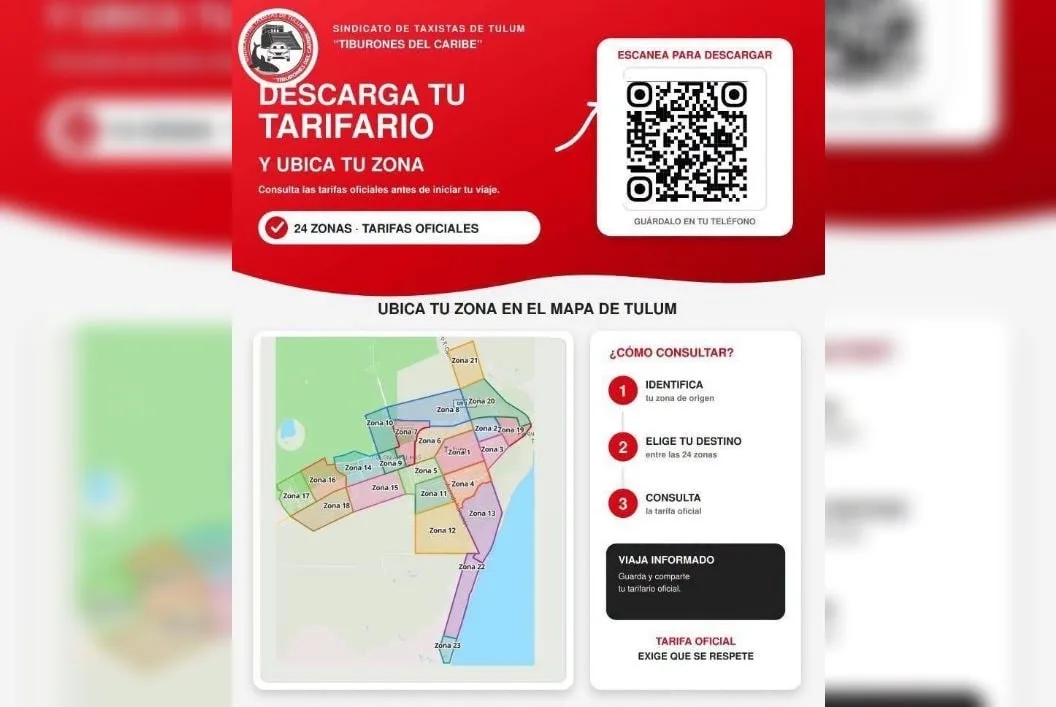
Tulum, Quintana Roo — The “Tiburones del Caribe” taxi union is distributing a new fare schedule divided into 24 zones and presenting it to passengers as the official tariff, despite the document containing no resolution number, signature, seal, effective date, or reference to a publication by the Quintana Roo Mobility Institute (Imoveqroo).
The proposed rates represent steep increases over the state’s 2019 fare table. For example, trips in La Veleta, which previously cost 31 pesos, have been split into three zones priced at 50, 80, and up to 100 pesos. In Veleta Zone 3, the increase reaches 222.6%. Other notable jumps include the Centro–Yaax Tulum route, rising from 32 to 70 pesos, and Centro–Archaeological Zone, from 49 to 90 pesos.
Union Secretary General Manuel Enrique Solís Alcocer said the goal is to give passengers clarity. He also announced that shared taxis on the Tulum–Playa del Carmen route will have a uniform livery and fare schedules accessible through QR codes, which will also be posted at stops so riders can check prices before boarding.
However, transparency alone does not replace authorization from the competent authority. Quintana Roo’s Mobility Law requires that passenger fares be established and published by Imoveqroo, and that concessionaires display only previously approved rates.
The introduction of 24 zones, compared with 18 in 2019, allows for differentiated charges in residential areas and tourist zones, but the union has not provided the technical study, administrative resolution, or official map supporting the changes.
If Imoveqroo approved the new tariff, it should publish it and clarify how long it has been in effect. If it did not, the institute should order the schedule withdrawn and state what passengers are currently required to pay.
A QR code may make fares easier to consult, but it does not turn a union fee into an official rate. Unless the agency clarifies the document’s validity, riders remain exposed to arbitrary charges and uncertainty over who is legally entitled to set the price of the service.
More Business
- Mexican Caribbean Destinations and Resorts Win Across 2026 World Travel Awards
- No GPS, No Renewal: Quintana Roo Taxi Rule Explained
- Why a Councilman Wants Tulum Out of the Airport’s Name
- US Lifts Limits on Flights From AIFA and AICM to US Cities
- Leaks Flood Cancún Airport Terminal 2 as Heavy Rain Soaks Check-In Area
More Tulum
- Zamna Tulum 2027: Dates, Lineup and Ticket Details
- Cancun Tourism Slumps 7% as Industry Leaders Urge Marketing Overhaul
- Tulum’s Mureco Museum Adds 53 Mesoamerican Pieces for Second Anniversary
- Quintana Roo Braces for Four Days of Heavy Rain and Flooding
- Tulum’s Mureco Museum Adds 53 Archaeological Pieces From Across Mesoamerica