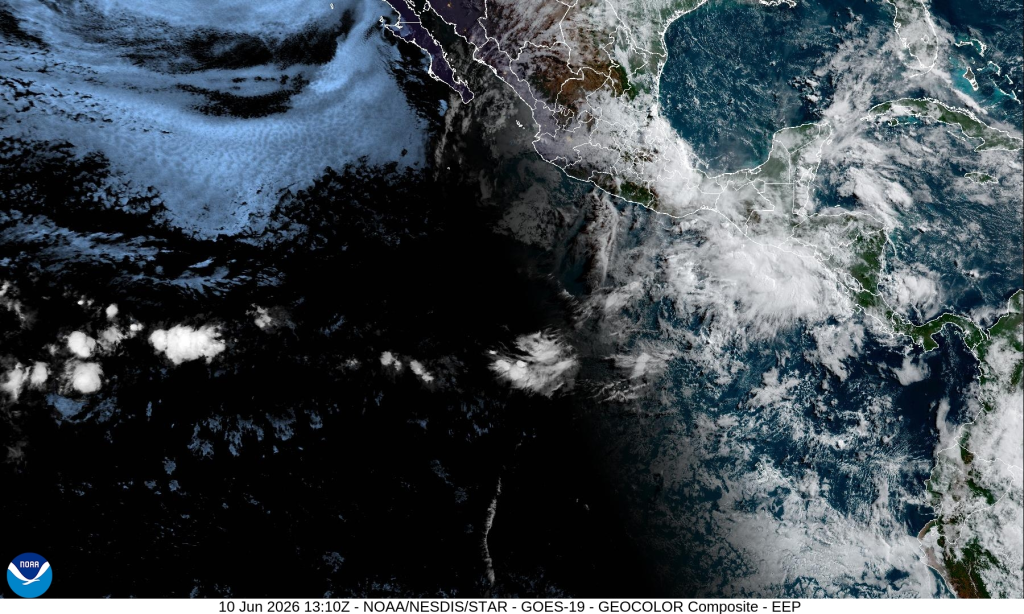
Mérida, Yucatán — Mexican weather authorities are monitoring Tropical Storm Cristina off the coast of El Salvador and a developing low-pressure system in the Bay of Campeche that could bring heavy rainfall to the Yucatán Peninsula over the weekend.
The National Meteorological Service (SMN) reported Wednesday that a cyclonic circulation aloft over the southern Gulf of Mexico, a low-pressure channel over southeastern Mexico, and atmospheric instability will produce very heavy to intense rains in several regions, including the Yucatán Peninsula.
Separately, low-pressure channels interacting with atmospheric instability and moisture from the Pacific Ocean and Gulf of Mexico will cause intense rains in Puebla and heavy to very heavy rains in northern, western, and central Mexico, including the Valley of Mexico. High waves are expected along the Pacific coast and the coast of Quintana Roo.
Hot to very hot temperatures persist in northern and northwestern Mexico, with a heat wave affecting Sonora, Chihuahua, Durango, and Sinaloa.
Tropical Storm Cristina
The U.S. National Hurricane Center (NHC) reported that Tropical Storm Cristina is moving over Pacific waters. As of 6 a.m. CST (5 a.m. Central Mexico time), the storm’s center was located near latitude 12.4 north, longitude 88.8 west, about 150 km south-southeast of San Salvador, El Salvador, and 275 km west of Managua, Nicaragua.
Cristina is moving westward at about 6 km/h. A turn toward the west-northwest and northwest is expected tonight, with a continued northwestward motion on Thursday. On this track, the storm should remain offshore of El Salvador, Honduras, and Nicaragua today, then approach the coast of El Salvador tonight into early Thursday.
Maximum sustained winds are near 65 km/h with higher gusts. Slight strengthening is possible tonight, followed by weakening on Thursday as Cristina moves inland. Tropical-storm-force winds extend up to 110 km from the center. The estimated minimum central pressure is 1006 mb (29.71 inches).
Low Pressure System in the Gulf of Mexico
Yucatán’s Civil Protection agency (Procivy) is monitoring the likely formation of a low-pressure system over the Bay of Campeche this weekend. While conditions are not currently favorable for further development, the system’s circulation will enhance moisture flow toward the Yucatán Peninsula.
Procivy noted that the interaction of various weather systems, combined with possible moisture from the remnants of Tropical Storm Cristina, could strengthen a low-pressure area over the southern Gulf of Mexico, increasing the potential for rain over the peninsula in the coming days.
For Wednesday, a tropical wave and a broad low-pressure area will bring light to intense rain across the Yucatán Peninsula. In Yucatán state, light to moderate rain is expected in the morning, intensifying to heavy and intense by midday in Valladolid, Chichimilá, Chankom, and gradually moving to central and southern municipalities including Sotuta, Yaxcabá, Tekax, Peto, Tzucacab, Akil, Teabo, Mérida, and surrounding areas.
Temperatures will be hot, with highs of 30-32°C in the east, 32-34°C in central, southern, and western areas, and 29-31°C along the coast. Morning lows will range from 23-26°C. Winds will be from the southeast at 10-20 km/h, with gusts over 50 km/h along the coast and in rain areas. Waves of 1.5 to 2 meters are expected.
Authorities urge the public to stay informed through official channels.
More Environment
- Mexican Army Nears Completion of 16-Kilometer Jungle Road Over Tulum’s Sac Actún Cave System
- Akumal Halts Turtle Swim Tours Through September
- Mexico Assigns $110 Million Navy Budget to Fight Sargassum in Quintana Roo
- Mérida Opens First Green Corridor to Fight Climate Change
- El Niño Keeps Atlantic Hurricane-Free, Setting Record for Latest First Storm in Decades
More Quintana Roo
- Quintana Roo Civil Protection Warns Against Fireworks Ahead of Independence Day
- Quintana Roo to Pilot Child Protection Protocol for Tourism Sector in October
- Sheinbaum Announces 187 Primary Care Clinics and Major Projects in Quintana Roo
- Quintana Roo Records 29,413 Sea Turtle Nests at Season’s Midpoint
- Quintana Roo Reports 1,200 Screwworm Cases as Officials Await Sterile Fly Release