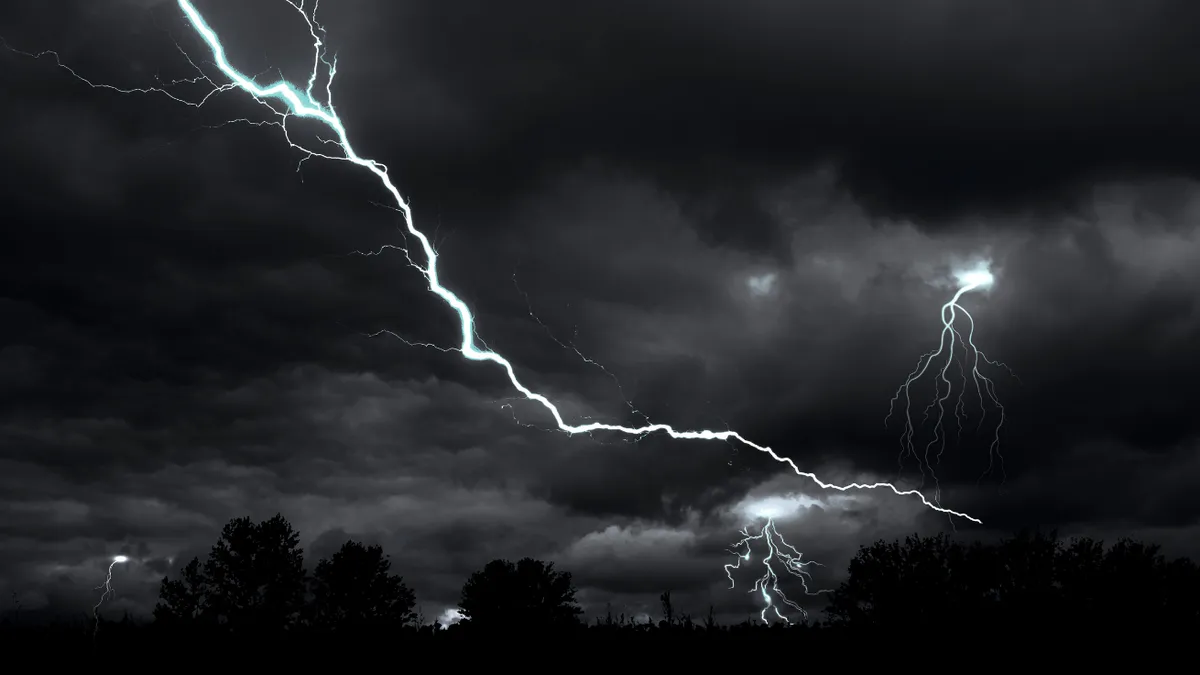
Mexico City — The National Meteorological Service (SMN) has issued warnings for torrential rains across 18 Mexican states on Saturday, June 13, as the interaction of Tropical Waves 6 and 7, low-pressure systems, and troughs triggers what meteorologists are calling a “Black Storm.”
The term “Black Storm” refers to a global phenomenon of persistent, heavy rainfall that exceeds the soil’s absorption capacity, leading to severe flooding, electrical storms, and hail. While not an official SMN classification, the name is used internationally for such extreme precipitation events.
Tropical Wave 6 is moving over southeastern, southern, eastern, central, and western Mexico, coinciding with a low-pressure area with high potential for cyclonic development approaching the coasts of Tamaulipas and Veracruz. An upper-level trough and low-pressure channels in the mid-atmosphere are intensifying the system, producing widespread storms with lightning and hail.
Rainfall Distribution
The SMN has categorized rainfall intensity by region:
- Intense (75 to 150 mm): Southern Tamaulipas, eastern San Luis Potosí, northern, eastern, and southeastern Puebla, northern and central Veracruz, southern Nayarit, and western and central Jalisco.
- Very heavy (50 to 75 mm): Southwestern Chihuahua, northwestern Durango, northeastern and southeastern Sinaloa, northern Michoacán, northwestern Guerrero, southern Hidalgo, northern Oaxaca, eastern and southeastern Chiapas, southeastern Tabasco, northern and coastal Campeche, western Yucatán, and central and southern Quintana Roo.
- Heavy (25 to 50 mm): Eastern and southeastern Sonora, southern Nuevo León, southern Zacatecas, Aguascalientes, Colima, central and northern Guanajuato, western and southern Querétaro, northern, central, and eastern State of Mexico, Mexico City, Tlaxcala, and Morelos.
- Scattered showers (5 to 25 mm): Coahuila.
- Isolated rain (0.1 to 5 mm): Baja California and Baja California Sur.
Wind and Waves
The cyclonic circulation over the Yucatan Peninsula, combined with the approach of Tropical Wave 7, is generating strong winds and dangerous sea conditions. Gusts of 40 to 60 km/h are expected in Chihuahua, Coahuila, Nuevo León, Tamaulipas, Campeche, Yucatán, and Quintana Roo, with waves of 1.5 to 2.5 meters along the coasts of Tamaulipas, Veracruz, Yucatán, and Quintana Roo. The western coast of Baja California will see gusts of 30 to 50 km/h and similar wave heights. States along the Pacific from Jalisco to Chiapas will experience gusts of 30 to 50 km/h and waves of 1.0 to 2.0 meters due to a swell effect.
Extreme Temperatures
Despite the widespread rain, extreme heat persists in northern Mexico. Maximum temperatures are forecast to exceed 45°C in northeastern Baja California, central and eastern Sonora, eastern Chihuahua, and northern Sinaloa. Temperatures of 40 to 45°C are expected in southwestern Coahuila and northeastern and northwestern Durango. Many other states, including Baja California Sur, Nuevo León, Tamaulipas, and the Yucatan Peninsula, will see highs of 35 to 40°C.
Authorities urge residents in affected areas to take precautions against flooding, landslides, and electrical storms, and to follow official updates from the SMN and local civil protection agencies.
More Environment
- Mexican Army Nears Completion of 16-Kilometer Jungle Road Over Tulum’s Sac Actún Cave System
- Akumal Halts Turtle Swim Tours Through September
- Mexico Assigns $110 Million Navy Budget to Fight Sargassum in Quintana Roo
- Mérida Opens First Green Corridor to Fight Climate Change
- El Niño Keeps Atlantic Hurricane-Free, Setting Record for Latest First Storm in Decades
More Quintana Roo
- Quintana Roo Civil Protection Warns Against Fireworks Ahead of Independence Day
- Quintana Roo to Pilot Child Protection Protocol for Tourism Sector in October
- Sheinbaum Announces 187 Primary Care Clinics and Major Projects in Quintana Roo
- Quintana Roo Records 29,413 Sea Turtle Nests at Season’s Midpoint
- Quintana Roo Reports 1,200 Screwworm Cases as Officials Await Sterile Fly Release