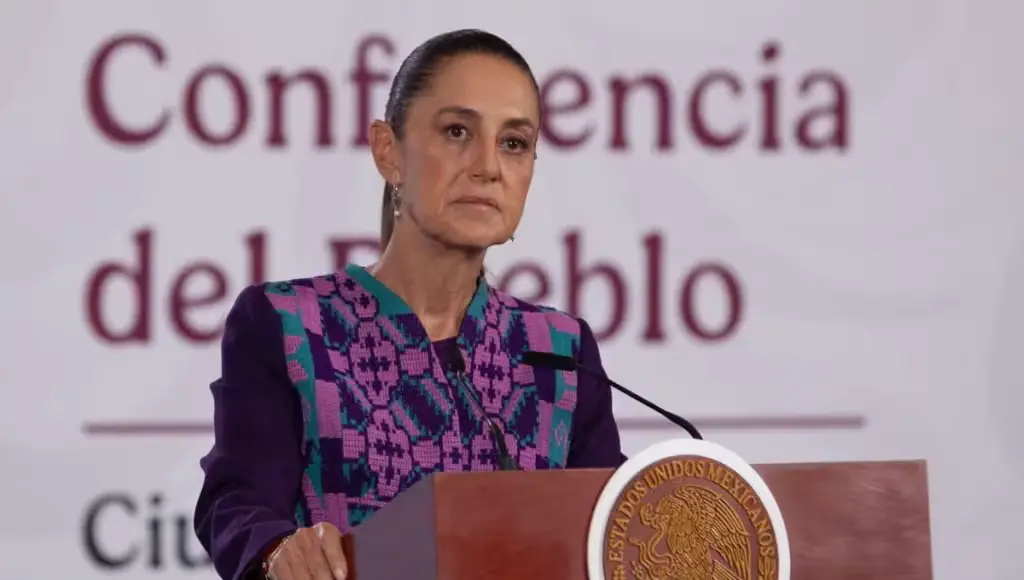
Mexico City — President Claudia Sheinbaum has opened a potentially far-reaching debate over who should be permitted to occupy Mexico’s most powerful elected offices.
During her morning press conference Tuesday, Sheinbaum said her administration is considering a constitutional amendment that would prevent anyone holding another nationality from serving as president or state governor.
“A Mexican president represents Mexico, not another country,” she said. “If you have dual nationality, then whom do you represent, Mexico or another country?”
No legislation has been submitted, and Sheinbaum did not provide a timeline. For now, it is a proposal under consideration rather than a change in the law.
Mexico already has restrictions, but there is a loophole
Mexico’s Constitution already requires the president and state governors to be Mexican by birth. Article 32 also reserves offices requiring citizenship by birth for people who have not acquired another nationality.
The Nationality Law, however, creates a procedure through which dual nationals can qualify. They may apply to the Foreign Affairs Ministry for a Certificate of Mexican Nationality after signing a declaration renouncing allegiance, protection and obedience to the other country.
The complication is that signing that declaration in Mexico does not necessarily cancel the person’s citizenship under the laws of the second country.
Mexico’s electoral court has ruled that the Mexican certificate is sufficient. Election authorities cannot require a candidate to produce proof from a foreign government that the other citizenship was formally terminated. In practical terms, someone may be treated as solely Mexican for holding office while the other country continues to recognize that person as its citizen.
Sheinbaum’s proposal appears intended to close that gap by requiring the president and governors to hold only Mexican citizenship in fact, not simply declare exclusive allegiance for Mexican legal purposes.
That distinction would need to be spelled out carefully in any amendment.
The case that prompted the proposal
Sheinbaum raised the subject while discussing Francisco Javier García Cabeza de Vaca, the former PAN governor of Tamaulipas.
Cabeza de Vaca was born in McAllen, Texas, and has been identified as both Mexican and American. Mexican authorities are seeking his extradition from the United States in connection with an outstanding arrest warrant. He denies wrongdoing.
Sheinbaum said the United States has not acted on Mexico’s request, but she also acknowledged that American citizenship does not automatically prevent extradition. The bilateral treaty gives each country discretion over whether to surrender its own nationals. It does not create an absolute prohibition.
The case nevertheless exposed an uncomfortable contradiction. A person can declare that he has renounced foreign allegiance to qualify for high office in Mexico, then potentially remain recognized and protected as a citizen of that other country.
A sovereignty question, but also a citizenship question
At a time when relations with Washington are increasingly tense, Sheinbaum’s argument is likely to resonate with many Mexicans. The president and governors control security policy, public funds and sensitive government information. Requiring undivided legal allegiance for those offices is not an unreasonable position.
But dual nationality alone is not proof of divided loyalty.
Millions of Mexicans hold another citizenship because they were born abroad, had a foreign parent or spent years working outside the country. Mexico has formally recognized dual nationality since 1998, partly to maintain its relationship with the large Mexican community in the United States. The Foreign Affairs Ministry notes that some people are considered citizens by another country automatically, even if they never requested or actively used that nationality.
A poorly drafted amendment could therefore exclude people whose second citizenship is simply an accident of birth, rather than evidence of any meaningful political allegiance.
The stronger version of this proposal would not treat dual nationals as less Mexican. It would establish that anyone seeking one of the country’s highest executive offices must first complete a genuine and verifiable renunciation under the laws of the other country.
That would be a demanding condition, but it would also be clear.
A constitutional amendment would face a high threshold
Because the qualifications for president and governor are written into the Constitution, Congress could not make this change through an ordinary law.
A constitutional amendment requires approval by two-thirds of the federal lawmakers present for the vote, followed by approval from a majority of Mexico’s state legislatures.
The eventual wording would matter enormously. Legislators would need to determine whether the restriction applies when candidates register, when they take office or throughout their term. They would also have to decide what evidence proves that another nationality has genuinely been surrendered.
For now, Sheinbaum has put a legitimate question on the national agenda: Should a person exercising executive power in Mexico remain legally entitled to the protection and privileges of another government?
Mexico’s laws already attempt to say no. Her proposal would test whether the country is prepared to make that answer unequivocal.
More Politics
- Sheinbaum Unveils Decree to Protect Minors on Social Media, Without Penalties
- Missing Quintana Roo Education Official Found Alive in Cancún
- Sheinbaum to Meet US Ambassador Johnson on Security and Bilateral Agenda
- US Drug Czar: Governors With Cartel Ties Will Be Prosecuted
- Quintana Roo Riders Resume ‘Vest Law’ Talks, No Protests